Dumbbell Shrug.
The dumbbell shrug builds the upper traps by elevating the shoulders straight up against a dumbbell held in each hand. With the weights at your sides instead of in front, the load lines up cleanly under the muscle.

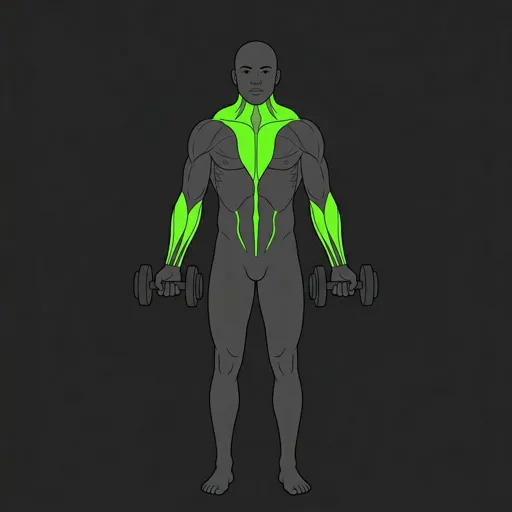
Step by step.
Stand tall with a dumbbell in each hand, arms hanging at your sides, palms facing your body.
Without bending the elbows, lift your shoulders straight up toward your ears as high as they go.
Hold the top for a full second and squeeze the traps. The squeeze is the rep.
Lower the shoulders back down slowly, letting the traps stretch at the bottom.
Keep the arms straight throughout. If the biceps start helping, the weight is too heavy.
Avoid rolling the shoulders in circles. Straight up, straight down.
Dumbbells hang right where the traps want the load. A barbell shrug puts the bar in front of your thighs, so the weight pulls slightly forward of the muscle, but a dumbbell in each hand sits directly underneath and lets you travel straight up the line the fibers run. Reach for them when your traps never seem to get a real contraction.
Stop rolling your shoulders. The circular shrug got handed down for years and it adds nothing but a grinding feel in the joint, because traps elevate the shoulder, they do not rotate it. Go straight up, pause, come straight down. Rolling just smears the tension around the joint when you want it stacked on the muscle.
The pause is not optional. Traps respond to a hard squeeze held at the top far more than to a heavy weight whipped up and dropped. Most people load a number they can only heave with momentum and a bit of bicep, then wonder why nothing grows. Cut the weight, hold the top for a full second, and you will feel the difference inside one session.
Run it for higher reps, 12 to 20, at the end of a pull or shoulder day, and grab straps once the load outgrows your grip, which it will. When you want to go heavier with the weight centered on you rather than swinging in front, the trap bar shrug is the next step up.
Common questions.
They line up cleaner. A barbell sits in front of your thighs so the load pulls slightly forward, while dumbbells hang straight down under the traps along the line they work. The barbell still loads more total weight. Use dumbbells for the cleaner contraction, the bar for max load.
No. Traps elevate the shoulder, they do not rotate it, so rolling adds joint grind without adding stimulus. Move straight up and straight down, pause, squeeze. The rolling shrug is a myth that refuses to die.
Usually too heavy and too fast. Heaving the weight with momentum and a little bicep skips the contraction that builds the trap. Drop the load, hold the top for a full second, and lower slowly. A controlled shrug with a real squeeze beats an ego loaded one.
They recover fast and grow from volume and a hard squeeze more than from low rep grinding, so 12 to 20 a set works well. Place them at the end of a pull or shoulder session and use straps once the load outgrows your grip.


Run the numbers.
One-rep max.
Estimate your max from any rep count. Five formulas, full percentage table.
Plate calculator.
What to load for any target weight, in lb or kg.
RPE calculator.
Convert rate of perceived exertion to training percentages.
Wilks score.
Bodyweight-adjusted total for comparing strength across weight classes.
DOTS score.
The IPF's newer bodyweight-adjusted scoring formula.
IPF GL points.
The IPF's official Goodlift score, in use at meets since 2020.
Volume calculator.
Weekly sets per muscle group, tonnage, and load management.
Strength ratio.
Screen your squat, bench, and deadlift to find the lift that is lagging.
Stop calculating.
Start tracking.
Log every set in RepRaptor. Free forever for lifters.