Barbell Shrug.
The barbell shrug trains the upper trapezius through direct vertical elevation of the shoulder girdle. Standing with a pronated overhand grip, the bar rests against the thighs while the shoulders drive straight up toward the ears and return under control.

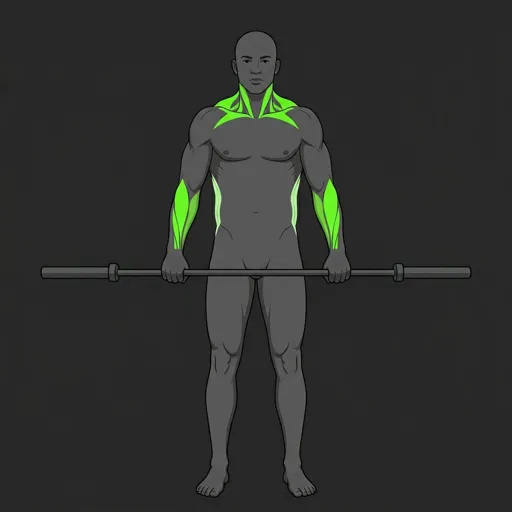
Step by step.
Set up standing tall with a barbell held in front of your thighs, hands a bit wider than your hips in a pronated overhand grip. Strap in so grip does not end the set early.
Stand upright with your arms straight, chest up, and core braced. Let your shoulders relax down so the bar hangs and you feel a stretch through your upper traps at the bottom.
Drive your shoulders straight up toward your ears as high as they will go. Keep your arms straight and move only the shoulder girdle, with no rolling forward or back.
Squeeze and hold at the top for a second so you cannot cheat the range. Aim for the full elevation your traps allow rather than a short twitch under heavy weight.
Lower the bar back down slowly over a 2-3 second count and let the shoulders settle into the stretch again. Reset and repeat without bouncing the bar off the bottom.
Rolling the shoulders is one of the most persistent technique errors in the gym, and it does nothing good. Shrugging forward or backward at the top recruits the anterior or posterior fibers of the trap minimally, while also loading the AC joint at an awkward angle. The movement is straight up. That's it. Shoulder blades elevate vertically. They don't circle, rotate, or sweep backward like you're trying to crack your upper back.
The grip will fail before the traps do. This isn't a grip training exercise, and fighting through grip failure at 225 lbs just means your traps are under-stimulated while your forearms give out. Straps are appropriate here. They're not a crutch on an isolation movement that doesn't test grip by design. Once straps are on, you can actually feel the traps working through the full range.
Most people shrug too fast and too heavy and end up with a 2-inch range of motion that achieves nothing. The upper trap can elevate the scapula through roughly 4-6 inches depending on your anatomy. You want to use that full range, hold for a second at the top, and lower with a 2-3 second count to feel the stretch at the bottom. If 185 lbs gets you a full controlled range and 225 lbs turns it into a quarter-inch twitch, the lighter weight is producing more actual trap stimulus.
One loading note: your deadlift and barbell row already hit the mid and lower traps through heavy pulling. The shrug is covering the upper trap specifically. You don't need to go as heavy as your pull strength would allow. The upper trap fiber orientation responds better to moderate load through full range than to maximal load through abbreviated range. If the barbell version bothers your wrists or lower back, the dumbbell shrug lines the load up at your sides and the trap bar shrug centers it for heavier pulls.
Common questions.
No. Shoulder rolling during a shrug is a habit that somehow spread through gym culture despite having no mechanical basis. The upper trapezius elevates the scapula. It doesn't rotate it. Rolling forward or backward briefly engages different muscle groups and places the AC joint under unnecessary rotational stress. Shrug straight up, hold, lower straight down. That's the complete movement.
As high as you can get the shoulders. No half-reps. The upper trap is a long muscle running from the base of the skull to the outer end of the clavicle, and it shortens considerably at full elevation. Most lifters stop 60-70% of the way up because the weight is too heavy to complete the movement honestly. If your shoulders aren't reaching toward your ears at the top, either the weight is too heavy or you're not actively trying to hit full range. A 1-second hold at the top makes it harder to cheat and gives you a reference for whether you're actually getting there.
Yes, and there's a small case for them. Dumbbells sit at the sides of the body rather than in front of it, which pulls the shoulder girdle into a slightly different position and may feel more natural for some lifters with narrow shoulders. The range of motion is also slightly freer since you're not constrained to the bar path in front of the thighs. The limitation is practical: most gyms top out at 120-150 lb dumbbells, and the upper trap responds well to heavier loads once you've built a base. Barbell shrugs let you load heavier without straining grip.
The upper trap responds well to both moderate-rep hypertrophy work (8-15 reps with a hold at the top) and heavier loading (5-8 reps). Where most lifters go wrong is using very high rep sets with uncontrolled rhythm, bouncing through 20 reps with no pause and calling it trap training. Three to four sets of 10-12 controlled reps with a dedicated hold at the top will outperform six sloppy sets of 20. Add shrugs after your compound pulling movements, not before. The traps are already warmed up and you won't be fatiguing them for deadlifts.


Run the numbers.
One-rep max.
Estimate your max from any rep count. Five formulas, full percentage table.
Plate calculator.
What to load for any target weight, in lb or kg.
RPE calculator.
Convert rate of perceived exertion to training percentages.
Wilks score.
Bodyweight-adjusted total for comparing strength across weight classes.
DOTS score.
The IPF's newer bodyweight-adjusted scoring formula.
IPF GL points.
The IPF's official Goodlift score, in use at meets since 2020.
Volume calculator.
Weekly sets per muscle group, tonnage, and load management.
Strength ratio.
Screen your squat, bench, and deadlift to find the lift that is lagging.
Stop calculating.
Start tracking.
Log every set in RepRaptor. Free forever for lifters.