Barbell Row.
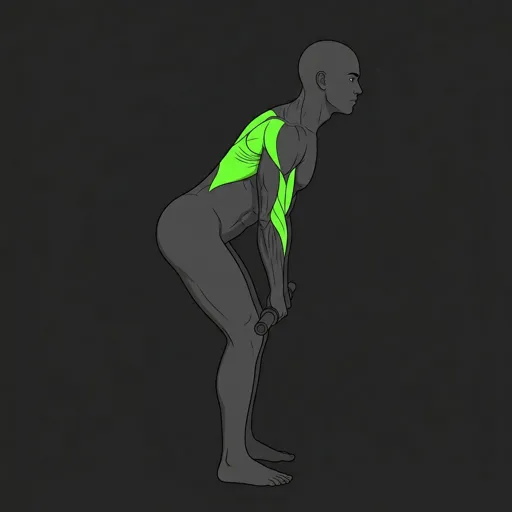
The barbell row is the main horizontal pull in strength training. Torso nearly parallel to the floor, bar hanging below the chest, elbows drive back and up to pull the bar to the lower chest while the shoulder blades retract fully at the top.

Step by step.
Stand with feet about hip width and the bar over your mid foot. Take an overhand grip a little wider than shoulder width and lift the bar to a standing position.
Push your hips back and hinge forward until your torso is almost parallel to the floor, letting the bar hang straight down below your chest with a small bend in the knees.
Brace your abs hard, set a natural arch in your lower back, and pull your shoulders down so the lats are loaded before you pull.
Drive your elbows back and up, keeping them close to your sides, and row the bar to your lower chest just below the sternum.
Squeeze the shoulder blades together at the top and pause briefly, feeling the middle back contract rather than letting the bar bounce off your body.
Lower the bar under control back to the hanging position while holding the torso angle still. Keep the chest from dropping and the back from rounding through the whole rep.
Torso angle determines what the row actually trains. At 45 degrees of forward lean you're doing a partial row that looks like a row but trains more rear delt than back. At 90 degrees (torso parallel to the floor) you're loading the middle and upper back, rhomboids, and lats hard. The exercise description calls for "almost parallel." That's the target. If holding that angle fatigues you before the set is over, your lower back isn't strong enough yet to support the position, and that's the thing to fix.
Elbows close to the body, driving back past the torso. Not flared out like a T. Flared elbows shift the pull toward the rear delts and away from the middle back. The test: at the top contracted position, your elbows should be behind your body and your shoulder blades should feel like they're being pinched together. If you can't feel the middle back contracting, the elbows are probably too wide or the torso is too upright.
The most common row mistake isn't grip or stance. It's the swing. Lifters load more weight than their back can control and compensate by dipping and jerking the torso upward with each rep to generate momentum. It looks like a heavy row but it's mostly a hip extension movement. Real rows happen with a stationary torso. The bar comes to you, not the other way around.
Pronated grip (palms facing down) emphasizes the rhomboids and middle trapezius. A supinated grip (palms up) creates more elbow flexion and shifts some load to the biceps. Both are valid; pronated is more common and matches the standard description of this movement. If you want to add variety, rotating grip on different sessions is a reasonable strategy.
The barbell loads both sides at once, so a strong side can quietly carry a weak one. A one arm dumbbell row closes that gap. Braced on a bench, each side works on its own through a longer range, and your lower back stops being the part that gives out first. Past technique, back thickness comes from accumulated work, so count your sets per muscle group each week and nudge the total up over the block.
Common questions.
The lower chest, just below the sternum. Pulling the bar to the upper chest turns the row into more of a rear-delt exercise. Pulling to the belly involves the lats more but reduces the involvement of the mid-back muscles. Most programs targeting the rhomboids and middle trapezius specify lower chest as the contact point, where the shoulder blades can fully retract. Pause briefly in that position on each rep rather than bouncing the bar off the torso.
Lower back pain in the bent-over row almost always comes from one of two places: the weight is too heavy and you're compensating with lumbar flexion under load, or the torso angle is dropping toward the floor but the lower back isn't braced to support it. Fix: brace the abs as hard as you would for a deadlift before each set, keep a natural lumbar arch throughout, and use a weight you can actually control for the full range of motion without swinging. If pain persists, try seated cable rows or chest-supported rows as a substitute while your lower back catches up to your pulling strength.
Both work. The overhand (pronated) grip is the standard and places more demand on the rhomboids and middle trapezius because it encourages horizontal elbow drive. The underhand (supinated) grip allows the elbows to tuck closer and involves the biceps more. It's sometimes called a Yates row after the bodybuilder who popularized it. If you use an underhand grip, grip strength and biceps tendon stress become factors at heavier loads. Most lifters should spend the majority of their row volume with the overhand grip and experiment with underhand as a secondary variation.
A rough benchmark for natural lifters: once technique is solid, a barbell row in the range of 60-70% of your bench press is a reasonable intermediate target. If you bench 200 lb, rowing 120-140 lb for sets of 5 with controlled form is in the right range. Rows done with a strict parallel torso and no swing will always feel lighter than rows done with momentum. That's not weakness, that's accuracy. Many lifters overestimate their row because they've been cheating the torso angle for years. Film a set from the side to check.


Run the numbers.
One-rep max.
Estimate your max from any rep count. Five formulas, full percentage table.
Plate calculator.
What to load for any target weight, in lb or kg.
RPE calculator.
Convert rate of perceived exertion to training percentages.
Wilks score.
Bodyweight-adjusted total for comparing strength across weight classes.
DOTS score.
The IPF's newer bodyweight-adjusted scoring formula.
IPF GL points.
The IPF's official Goodlift score, in use at meets since 2020.
Volume calculator.
Weekly sets per muscle group, tonnage, and load management.
Strength ratio.
Screen your squat, bench, and deadlift to find the lift that is lagging.
Stop calculating.
Start tracking.
Log every set in RepRaptor. Free forever for lifters.