Reverse Grip Barbell Row.
The reverse grip barbell row flips the hands to a palms up grip, which tucks the elbows and pulls the work toward the lower lats. The supinated grip also brings the biceps in strongly, so most people row more here than with an overhand grip.

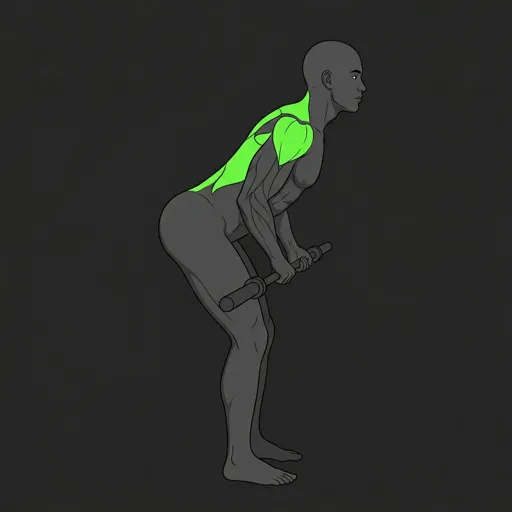
Step by step.
Hold a barbell with a supinated grip, palms facing forward, hands about shoulder width.
Hinge at the hips with soft knees until your torso is near parallel to the floor, back flat, head neutral.
Let the bar hang at arms length. This is the start.
Row the bar to your lower abdomen, keeping the elbows tucked close to your sides.
Squeeze the lats and mid back at the top, hold a beat, then lower under control.
Keep the torso angle fixed. Do not stand up to heave the bar.
Flipping to an underhand grip moves where the row lands. The supinated grip naturally tucks your elbows against your sides, and that tucked path drives the pull into the lower lats more than the flared elbow position of a standard overhand barbell row. If your lats lag behind your upper back, the reverse grip is a targeted fix.
You will probably row more weight here, and the biceps are why. A palms up grip lets them assist the pull far more than an overhand grip does, so the whole system is stronger. That helps you overload the back, but stay honest, because the biceps can quietly become the prime mover. Think about driving the elbows back and down toward your hip pockets so the lats lead and the arms just go along.
The hinge rules still apply, and the heavier load makes them matter more. The bigger weight tempts people to jerk the torso upright to get the bar moving, which dumps the load straight onto the lower back. Brace, hold the near parallel angle, and if you cannot keep it, the bar is too heavy whatever your biceps can curl.
Use it as a main back movement or a rotation off the overhand barbell row, in the 6 to 10 range. Strong loading and a lower lat bias make it a productive heavy pull, as long as the back is the engine and the arms only finish the job.
Common questions.
The palms up grip tucks the elbows close to the body, which shifts the pull toward the lower lats compared with the flared elbows of an overhand barbell row. It also lets the biceps assist more, so most lifters row heavier. Use it for a lower lat bias or a strong loading day.
A supinated grip puts the biceps in a much stronger position to help, so the whole movement handles more load than an overhand grip. That makes it good for overloading the back, but it also lets the arms take over. Cue the elbows back to your hips so the lats stay in charge.
It biases the lower lats, because the underhand grip tucks the elbows and a tucked path recruits the lats more than a flared one. An overhand barbell row with wider elbows leans toward the mid back and rear delts. Run both to cover the back from two angles.
It is a sign the back is not leading. The biceps will always assist an underhand row, but they should not run it. Lighten the load and focus on driving the elbows back and down so the lats start every rep. If your arms fail well before your back, fix the cue and the weight.


Run the numbers.
One-rep max.
Estimate your max from any rep count. Five formulas, full percentage table.
Plate calculator.
What to load for any target weight, in lb or kg.
RPE calculator.
Convert rate of perceived exertion to training percentages.
Wilks score.
Bodyweight-adjusted total for comparing strength across weight classes.
DOTS score.
The IPF's newer bodyweight-adjusted scoring formula.
IPF GL points.
The IPF's official Goodlift score, in use at meets since 2020.
Volume calculator.
Weekly sets per muscle group, tonnage, and load management.
Strength ratio.
Screen your squat, bench, and deadlift to find the lift that is lagging.
Stop calculating.
Start tracking.
Log every set in RepRaptor. Free forever for lifters.