Bent Over Dumbbell Row.
The bent over dumbbell row trains the whole back with two dumbbells, hinged forward at the hips. Both arms work at once with a free range of motion, building thickness through the mid back, lats, and rear shoulders.

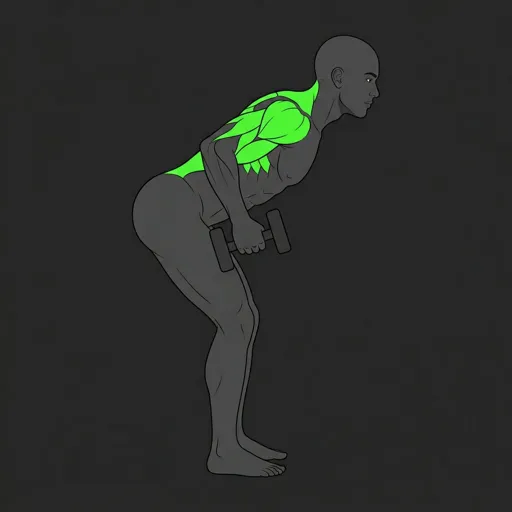
Step by step.
Hold a dumbbell in each hand, knees soft, and hinge forward at the hips until your torso is near parallel to the floor.
Let the dumbbells hang straight down, arms perpendicular to the floor, head neutral and back flat. This is the start.
Row both dumbbells up to your sides, keeping the elbows fairly close to the body.
Squeeze the back at the top and hold for a beat. Do not just yank and drop.
Lower the dumbbells under control back to the full hanging stretch.
Keep the torso still the whole set. If it rises and falls to move the weight, lighten up.
The hinge is the lift, and it is where most people fail before they ever pull. If your torso drifts up toward standing as you row, you have stopped rowing and started doing a stiff legged swing with your lower back. Set a near parallel torso, brace, and hold that angle from the first rep to the last. Two dumbbells give you a freer path than a barbell row, but only if the platform underneath stays still.
This is the easier sibling of the barbell row to learn, and a good place to even out a strength gap. Each hand carries its own dumbbell, so a weak side has to pull its own weight instead of riding along on the strong one. If your one arm dumbbell row already showed you a left to right difference, rowing both bells keeps that honesty while letting you move more total load.
Elbow path picks the target. Drive the elbows close to your sides and the lats do more of the pulling. Let them flare wide and the work drifts onto the mid back and rear delts. Both are fine, so choose the bias for the day and hold it instead of wandering between the two mid set.
Run it as a primary back builder in the 8 to 12 range. Pause at the top, lower it slow, and treat that dead stretch at the bottom as part of the rep, never a spot to rest and rebound.
Common questions.
They handle the same job differently. Two dumbbells give a freer range and force each side to pull its own load, while a barbell row lets you move more total and is simpler to brace. The dumbbell version is easier to learn and better for evening out left to right gaps. Most back plans use both.
Your torso is rising as you pull. When the hinge opens during the rep, it becomes a swing driven by the lower back rather than a row driven by the upper back. Set a near parallel torso, brace your core, and hold that angle for the whole set. If you cannot, the weight is too heavy.
It depends on the target. Tucking the elbows toward your sides loads the lats, while flaring them wide hits the mid back and rear delts. Both have a use, so pick the bias for that session and keep it consistent rather than drifting within a set.
Yes. Since each hand holds its own dumbbell, a lagging side cannot coast on the stronger one the way it does on a fixed bar. Rowing both bells keeps each arm accountable, and dropping to a one arm dumbbell row isolates a weak side further when you really need to close a gap.


Run the numbers.
One-rep max.
Estimate your max from any rep count. Five formulas, full percentage table.
Plate calculator.
What to load for any target weight, in lb or kg.
RPE calculator.
Convert rate of perceived exertion to training percentages.
Wilks score.
Bodyweight-adjusted total for comparing strength across weight classes.
DOTS score.
The IPF's newer bodyweight-adjusted scoring formula.
IPF GL points.
The IPF's official Goodlift score, in use at meets since 2020.
Volume calculator.
Weekly sets per muscle group, tonnage, and load management.
Strength ratio.
Screen your squat, bench, and deadlift to find the lift that is lagging.
Stop calculating.
Start tracking.
Log every set in RepRaptor. Free forever for lifters.