Seated Cable Row.
The seated cable row trains the mid-back (rhomboids, middle trapezius, and lats) through horizontal pulling. A V-bar with neutral grip is pulled to the abdomen from a seated position with the torso upright, elbows driven back close to the body, and shoulder blades fully retracted at the finish.

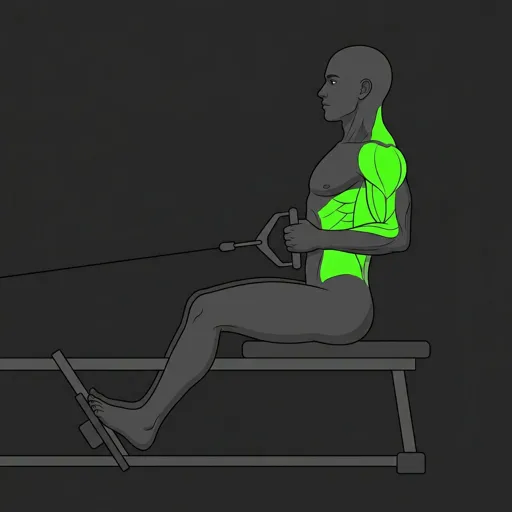
Step by step.
Sit at the row station, plant your feet on the platform, and grab the V-bar with a neutral grip. Keep a slight bend in the knees rather than locking them out.
Sit up tall with your chest lifted and the torso close to vertical. Let the cable pull your arms forward so your shoulder blades spread apart. This is your start.
Begin the pull by drawing your shoulder blades back toward your spine, before the elbows bend. This makes the back muscles initiate the movement instead of the biceps.
Once the blades are retracting, drive your elbows back past your torso, keeping them close to your sides. Bring the V-bar to your lower abdomen.
At the finish, squeeze the shoulder blades firmly together with the elbows behind you, and hold for a second. Keep the torso upright instead of leaning back to cheat the bar in.
Reverse the path under control, letting the elbows straighten and the shoulder blades spread forward again. Feel the stretch across the mid back before the next rep.
Torso swing is the form breakdown that swallows this exercise whole. Leaning back far on the way back and rocking forward on the way out turns a rowing exercise into a partial hip hinge with some cable tension as an afterthought. The torso should stay nearly perpendicular to the floor throughout. A degree or two of natural sway is fine, but 20-30 degrees of layback is not. When the torso swings back, the lower back does the work of extending the hip, and the arms just carry the bar through space. The rhomboids and middle trap barely fire.
The scapular movement is the actual point of the exercise. From the start position (arms extended, scapulas spread apart and pulled forward by the cable tension), the row should move through two phases: first the scapulas retract toward the spine, then the elbows drive back past the torso. The scapulas moving first ensures the back muscles are doing the initiating work rather than the biceps. Lifters who skip the scapular retraction phase and just bend their elbows are doing a standing bicep curl with their wrists pointed sideways.
At the peak contraction, the shoulder blades should be squeezed firmly together, elbows fully behind the torso, and the V-bar touching the lower abdomen. Hold that for a second. Then let the scapulas protract on the way back out. Don't just let the arms extend while the shoulder blades stay retracted. The eccentric stretch on the rhomboids and lats is part of the stimulus.
Knee bend matters at the start. Knees should have a slight bend throughout: not locked out (which strains the hamstring insertion), not deeply bent (which changes the torso angle). The position is almost like sitting upright on a rowing machine: upright spine, slight knee flex, feet firmly planted.
This is the supported cousin of the barbell row. The barbell version makes your lower back hold a hinge every rep. Here you sit tall and pour everything into the middle of your back, which makes it the pick for days your hinge is already fried from deadlifts.
Common questions.
Slightly, naturally. The torso will shift a degree or two as the weight is pulled and the hips stabilize. But any deliberate layback to generate momentum is a form error. The torso should be close to vertical for the entire set. If you need to lean back to complete a rep, the weight is heavier than your back can pull without help from the hips. Reduce the stack and focus on keeping the torso stationary.
The V-bar is the standard setup and the one described here. It gives a neutral grip with palms facing each other, which is comfortable for most wrists and lets the elbows travel close to the torso at the finish. A wide bar with an overhand pronated grip shifts emphasis toward the upper back and rear delts with more of a horizontal abduction component, closer to a face pull in muscle emphasis. Both are productive. The V-bar is the better default for general back development; the wide bar is worth adding when the rear delts or upper traps need specific work.
They're different tools. The barbell row loads the back heavily and lets you move significant weight, but the torso angle and the need for hamstring and lower back stability changes the muscle recruitment pattern. The cable row maintains constant tension through the full range (no moment arm drop at the bottom like a barbell), trains the mid-back in a more isolated position, and is easier on the lower back. Most solid programs include both: barbell rows for heavy loading, cable rows for targeted volume and a cleaner eccentric.
Focus on initiating the pull by retracting the shoulder blades before bending the elbows. Think of the arms as hooks: the back muscles drive the movement and the arms just carry the load. If you're feeling it mostly in the biceps, you're initiating with elbow flexion instead of scapular retraction. Another cue that helps: try to point the elbows back and down, not just back, and imagine squeezing a pencil between the shoulder blades at the finish. The biceps will be tired afterward, but the back should feel like it worked more.


Run the numbers.
One-rep max.
Estimate your max from any rep count. Five formulas, full percentage table.
Plate calculator.
What to load for any target weight, in lb or kg.
RPE calculator.
Convert rate of perceived exertion to training percentages.
Wilks score.
Bodyweight-adjusted total for comparing strength across weight classes.
DOTS score.
The IPF's newer bodyweight-adjusted scoring formula.
IPF GL points.
The IPF's official Goodlift score, in use at meets since 2020.
Volume calculator.
Weekly sets per muscle group, tonnage, and load management.
Strength ratio.
Screen your squat, bench, and deadlift to find the lift that is lagging.
Stop calculating.
Start tracking.
Log every set in RepRaptor. Free forever for lifters.