Arnold Press.
The Arnold press adds a supination-to-pronation rotation to the overhead press. Starting with palms facing the body (as in the top of a curl), the wrists rotate outward as the dumbbells are pressed overhead, so the palms face forward at the top. This hits the anterior deltoid through a longer range than a standard press.

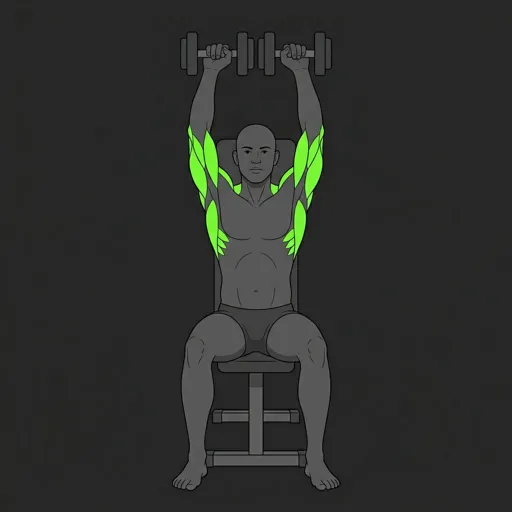
Step by step.
Sit on a bench with back support and hold a dumbbell in each hand at shoulder height. Start with your palms facing your body and your elbows in front of you, close together, like the top of a curl. Use lighter weight than your standard press, around 10-20% less.
Keep your elbows in front of your body at the bottom. Letting them drift behind your midline puts the shoulder in a stressed position under load.
Brace your core and keep your back against the pad before you start the rep.
Press the dumbbells up and rotate your wrists outward at the same time, so your palms turn to face forward as the weights rise. Let the elbows travel out and up naturally as you rotate.
Finish overhead with the elbows locked and the palms facing forward.
Reverse the motion on the way down, rotating the palms back toward your face as you lower to shoulder height. Keep the rotation smooth on every rep, and if it starts disappearing the weight is too heavy.
What the rotation actually does: starting with palms facing your face means the arm is in internal rotation at the bottom. As the wrists rotate outward during the press, the humerus externally rotates, and the anterior deltoid has to work to both rotate and press simultaneously through that arc. The result is a longer effective range of motion for the anterior deltoid compared to a standard press where the arm is already in external rotation at the start position.
The tradeoff is that you cannot use the same load as a standard dumbbell shoulder press. The rotation changes the mechanics enough that most people handle 10-20% less weight on the Arnold press. This is fine. The point is the anterior delt work, not absolute load.
Elbow path matters. At the bottom (palms facing you, start position), your elbows should be in front of your body and fairly close together (like the top of a dumbbell curl held at shoulder height, not flared out to the sides). As you press and rotate, the elbows naturally travel out and up. Don't force them to stay forward the whole way. Let the rotation guide the path.
One practical note: the Arnold press can aggravate the shoulder if the rotation is rushed or the elbows drift behind the body at the bottom. The starting position of palms facing in, elbows forward is protective. Letting the elbows go behind the midline puts the shoulder capsule in an anterior-stress position under load. Keep elbows in front of the body at the bottom. That's the cue most descriptions skip.
Common questions.
The rotation. A standard dumbbell shoulder press starts with palms forward and stays that way from bottom to top. The Arnold press starts with palms facing the body and rotates to palms forward at the top. That rotation takes the anterior deltoid through external rotation while it's also pressing, extending the range of motion for that muscle compared to a conventional press. The anterior delt is the part of the shoulder that faces forward, and it gets more total work through the arc of the Arnold press than it does in a fixed-pronation standard press.
For anterior deltoid hypertrophy, it has an argument. The rotation adds range that a standard press doesn't have. For raw strength and maximal load, the standard press wins because you can use heavier weight without the rotation compromising leverage. Most programs use both: the standard dumbbell or barbell press for the primary strength stimulus, and the Arnold press as an accessory movement for additional anterior delt volume. They're not interchangeable. They're complementary.
Moderate loads, not maximal. The rotation component puts the shoulder through a range that requires the rotator cuff to stabilize the humeral head throughout the movement. Going very heavy shortens the rotation (people skip it to handle the weight) or puts the shoulder under load at positions where it has less joint stability. The Arnold press works best in a moderate rep range (8-15 reps) with a weight you can rotate through fully on every rep. If the rotation is disappearing by rep 5, the weight is too heavy for this exercise.
Yes, though seated with back support is more common and easier to control. Standing forces the whole body to stabilize against the rotating load, which adds a stability demand but also makes it easier to compensate by swinging the torso or using leg drive. For the exercise to train what it's designed to train (the anterior deltoid through a rotating press), seated with back support removes the cheat options and keeps the stimulus honest. Standing is fine if you're experienced and want the added stability challenge.


Run the numbers.
One-rep max.
Estimate your max from any rep count. Five formulas, full percentage table.
Plate calculator.
What to load for any target weight, in lb or kg.
RPE calculator.
Convert rate of perceived exertion to training percentages.
Wilks score.
Bodyweight-adjusted total for comparing strength across weight classes.
DOTS score.
The IPF's newer bodyweight-adjusted scoring formula.
IPF GL points.
The IPF's official Goodlift score, in use at meets since 2020.
Volume calculator.
Weekly sets per muscle group, tonnage, and load management.
Strength ratio.
Screen your squat, bench, and deadlift to find the lift that is lagging.
Stop calculating.
Start tracking.
Log every set in RepRaptor. Free forever for lifters.