Kettlebell Arnold Press.
The kettlebell arnold press adds a rotation to the overhead press, turning the palm from facing you to facing forward as you drive up. The twist sweeps the shoulder through more of its range, and the kettlebell load sitting on the back of the wrist changes the demand on the way.

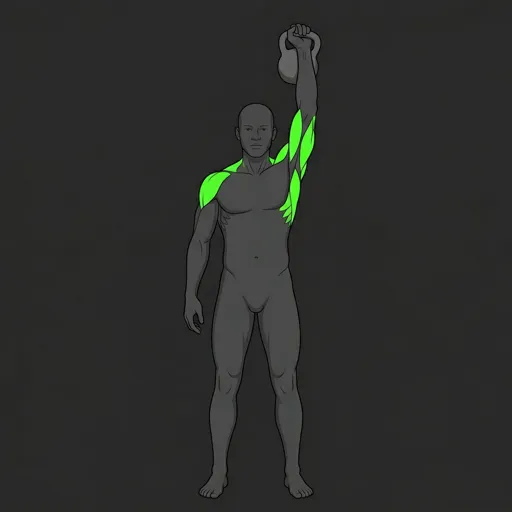
Step by step.
Clean a kettlebell to your shoulder with the palm facing you, the bell resting on the back of your forearm.
Looking straight ahead, begin pressing the kettlebell up and overhead.
As you press, rotate your wrist so the palm turns to face forward at the top.
Lock out overhead with the arm fully extended and the bell stable above the shoulder.
Reverse the path on the way down, rotating the palm back toward you as you return to the shoulder.
Keep the rotation smooth and matched to the press, not a separate jerky twist.
The whole movement is built around the twist. A standard arnold press with dumbbells starts your palms facing in and rotates them out as you press, sweeping the shoulder through internal to external rotation and catching more of the front and side delt than a straight press. The kettlebell version keeps that sweep and adds its own wrinkle, since the bell hangs off the back of your wrist and tries to roll, so your grip and forearm fight to keep it stable the whole way.
Treat that instability as the point of the drill. The offset load means the kettlebell is never perfectly balanced over your hand the way a dumbbell is, so the small stabilizers around the shoulder work overtime. You will press less than you would with a dumbbell arnold press, and that is fine, since this trains control and shoulder health more than max load.
Match the twist to the press. The classic mistake is rotating the wrist as a separate motion, spinning early before you press or pressing first and twisting at the top. Blend them so the rotation happens through the middle of the press. If you find yourself jerking the bell to flip it, the weight is too heavy.
Run it lighter and for more reps than your straight overhead press, around 10 to 15. It belongs as a shoulder builder and prehab style movement, and it slots in nicely once your heavy pressing is done.
Common questions.
The rotation. Starting with the palm facing you and turning it forward as you press sweeps the shoulder through more range and recruits the front and side delts more than a straight press. The kettlebell adds an unstable load on the back of the wrist, so the stabilizers work harder. It is a range and control movement.
A kettlebell hangs off the back of your wrist with its weight below and behind your hand, so it never stacks the way a dumbbell does. That offset makes the bell want to roll, and your grip, forearm, and shoulder stabilizers fight it the whole press. You will use less than a dumbbell arnold press as a result.
Through the middle of the press, blended into one smooth motion. Spinning early before you press, or pressing straight then twisting at the top, both break the movement and can stress the shoulder. The rotation and the press happen together. If you have to jerk to flip the bell, lighten the load.
An accessory. The rotation and the unstable bell make it a poor pick for heavy loading but a strong one for shoulder development and joint health. Run it lighter for 10 to 15 reps after your main overhead press. Treat the smooth controlled rotation as the goal, not the number on the bell.


Run the numbers.
One-rep max.
Estimate your max from any rep count. Five formulas, full percentage table.
Plate calculator.
What to load for any target weight, in lb or kg.
RPE calculator.
Convert rate of perceived exertion to training percentages.
Wilks score.
Bodyweight-adjusted total for comparing strength across weight classes.
DOTS score.
The IPF's newer bodyweight-adjusted scoring formula.
IPF GL points.
The IPF's official Goodlift score, in use at meets since 2020.
Volume calculator.
Weekly sets per muscle group, tonnage, and load management.
Strength ratio.
Screen your squat, bench, and deadlift to find the lift that is lagging.
Stop calculating.
Start tracking.
Log every set in RepRaptor. Free forever for lifters.