Lateral Raise.
The lateral raise trains the lateral deltoid by lifting both arms out to the sides until parallel with the floor. A slight elbow bend and forward wrist tilt are maintained throughout, with the torso stationary. Most of the load lands on the lateral delt between 60 and 90 degrees of arm elevation.

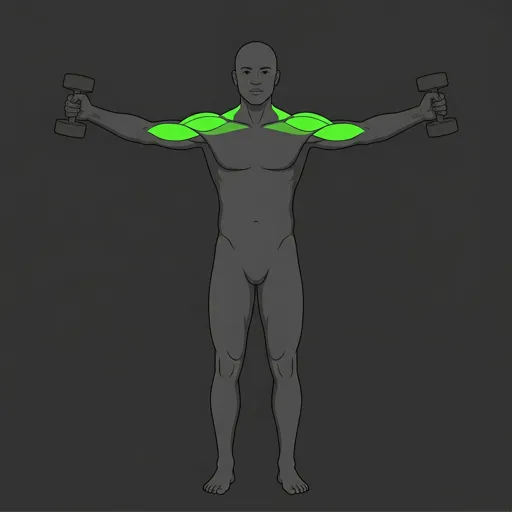
Step by step.
Stand with a dumbbell in each hand, palms facing your thighs and a soft bend in the elbows. Set your feet about hip width and pack your shoulders down away from your ears.
Brace your trunk and keep the torso upright. The body stays still for the whole set, with no dip or swing to start the weights moving.
Raise both arms out to the sides, leading with the elbows rather than the hands. Keep that slight elbow bend fixed as you go.
As you lift, tilt the hands so the pinky side sits a touch higher than the thumb side, like pouring from a jug. This keeps the lateral delt loaded and the shoulder clear.
Stop when your arms reach shoulder height, parallel with the floor. Hold for a beat at the top.
Lower the dumbbells slowly back to your sides, fighting gravity the whole way. Pick a weight light enough to control without leaning or heaving.
The "pour water from a jug" cue exists for a reason. At the top of the movement, the thumb side should be slightly lower than the pinky side, the hand tilted so the little finger leads. This internal shoulder rotation positions the lateral deltoid optimally and keeps the supraspinatus from getting pinched under the acromion. When people lift with thumbs higher than pinkies (externally rotated, palm facing up), the supraspinatus impinges against the acromion at the top of the arc. Over enough volume, that's the mechanism for shoulder impingement. This isn't a minor cue. It's the difference between an exercise that builds the lateral delt over years and one that eventually hurts the shoulder.
The lateral deltoid has almost no moment arm at 0-30 degrees of elevation. You're lifting nearly pure dead weight in that early range, and the supraspinatus is doing most of the work initiating the movement. The lateral delt really kicks in from about 60-90 degrees. This is why people who ego-load on lateral raises (20 lb dumbbells with a body swing to get them moving) are working supraspinatus and traps more than lateral delt. They swing through the range where the target muscle actually works.
Use a weight you can lift without any torso lean or dip. If you need to dip the torso sideways or swing the hips to get the dumbbells moving, the weight is wrong. A pair of 15s with clean form will produce more lateral delt stimulus than 25s with a body-rock, because the 15s stay in the muscle's working range without recruiting the torso.
Partial-range lateral raises done at the top half (from roughly 45 degrees to parallel) are a legitimate technique for extending a set or focusing on the range where the lateral delt is most active. Not a cheat. A specific tool.
The lateral raise is the isolation piece, not the whole shoulder. Build the bulk of your delt strength on a heavy overhead press, then use the raise to pile extra volume onto the side head the press can't single out.
Common questions.
The weight is too heavy and the lifting speed is too fast. When the load is too much to control with the lateral delt alone, the upper trapezius elevates the shoulder girdle to help initiate the movement, and the momentum carries the dumbbells up. Slow down, drop 30% of the weight, and try pausing for a full second at the top with the arms parallel. If the traps are still dominant, you may need to cue the shoulders down actively before and during the set. Pack them away from the ears before the first rep and keep them there.
To parallel with the floor, arms at shoulder height. Going above parallel shifts stress toward the upper trap and moves away from the lateral delt's primary function. The common advice to go to 'ear level' is too high and loads the wrong structures. Stop at shoulder height, hold for a beat, lower with control. The lateral delt is most active right at the point where the arm is horizontal, so that's the position worth spending time in.
Yes, and there's a real argument for cable lateral raises over dumbbell lateral raises. Dumbbells have near-zero resistance at the bottom of the movement (where the arm hangs at the side) and maximum resistance at the top when the arm is parallel. A cable set at a low pulley and pulled laterally maintains tension throughout a larger portion of the range, including at the bottom. This is more consistent loading across the arc. Many coaches consider single-arm cable lateral raises more effective for hypertrophy than dumbbell versions.
Both work, but they differ slightly. Standing allows a small amount of torso lean and hip movement, which can help initiate the movement. Not always a problem if it's controlled and brief. Seated lateral raises remove that completely, forcing stricter isolation. If your standing lateral raises tend to drift into shrug-and-swing territory, try seated. If your seated lateral raises feel fine, there's no need to change.


Run the numbers.
One-rep max.
Estimate your max from any rep count. Five formulas, full percentage table.
Plate calculator.
What to load for any target weight, in lb or kg.
RPE calculator.
Convert rate of perceived exertion to training percentages.
Wilks score.
Bodyweight-adjusted total for comparing strength across weight classes.
DOTS score.
The IPF's newer bodyweight-adjusted scoring formula.
IPF GL points.
The IPF's official Goodlift score, in use at meets since 2020.
Volume calculator.
Weekly sets per muscle group, tonnage, and load management.
Strength ratio.
Screen your squat, bench, and deadlift to find the lift that is lagging.
Stop calculating.
Start tracking.
Log every set in RepRaptor. Free forever for lifters.