Donkey Calf Raise.
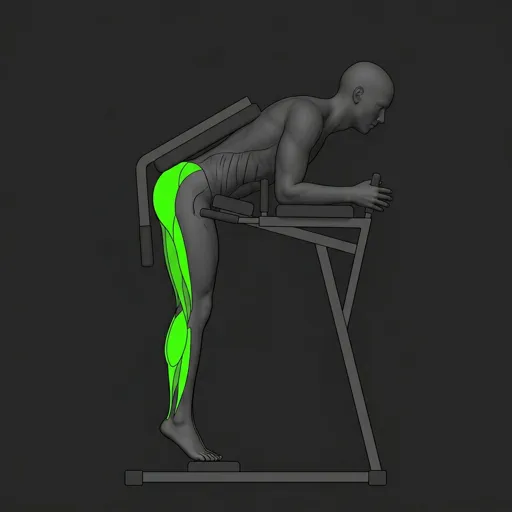
The donkey calf raise has you hinged forward at the hips with the load resting across your lower back, raising your heels from the balls of your feet on a block. Straight knees keep the gastrocnemius as the target, and the setup lets you load a deep stretch at the bottom, which old school bodybuilders swore by for calf size.

Step by step.
Position your hips and lower back under the padded lever of a donkey calf machine, balls of your feet on the block.
Hold the front handles and hinge forward so your torso is bent at the hips, legs fairly straight. This is the start.
Sink your heels well below the block until the stretch bites.
Raise your heels as high as possible by flexing the calves, keeping the knees still.
Hold the contraction at the top for a beat, then lower under control.
Keep the hinge fixed and the knees straight throughout the set.
The donkey raise is an old school favorite, and the reason holds up once you state it correctly. The hinge does not stretch the gastrocnemius across the hip, since that muscle crosses the knee and ankle, not the hip. What the position actually does is keep your knees straight so the gastrocnemius stays the target, while the load draped across your hips lets you sink into a strong, loaded stretch at the bottom of every rep. Arnold era bodybuilders piled onto this movement, often with a training partner sitting on their back, because that bottom stretch grew calves that ignored everything else.
The stretch is what you came for, so do not waste it. Like all calf work, this gets butchered with short bouncy reps, but the donkey setup hands you an especially deep bottom position. Sink the heels as far below the block as they will go, feel the calves pull, then drive all the way up. Skip the stretch and you have turned a great calf exercise into an ordinary one.
Keep the legs straight and the hinge locked. A bent knee shifts the load off the gastrocnemius, so hold the legs fairly straight and freeze the hinge angle once you set it. The only thing moving is your ankles. The hips and knees stay put.
Run 12 to 20 reps with a long pause buried in the stretch. No donkey machine? Hinge over a bench with a band across your hips or a willing partner on your back, and you have the same exercise, covering the gastrocnemius while a seated calf raise takes care of the soleus.
Common questions.
The straight knee keeps the gastrocnemius loaded, and the bent over setup lets you sink into a deep stretch at the bottom of each rep, which is where calves grow. That stretch comes from dropping the heels under load, not from the hip hinge, since the gastrocnemius does not cross the hip. Old school bodybuilders leaned on it for stubborn calves for exactly that reason.
Where the load sits and how deep you can stretch. A standing calf raise keeps you upright, while the donkey version bends you forward so the weight rides your hips and you can drop into a bigger bottom stretch. Both train the gastrocnemius with straight legs, but the donkey setup makes that deep, loaded stretch easy to hit.
Yes. Hinge forward over a bench or rack with the balls of your feet on a block, and add load with a band looped over your hips or a partner seated on your lower back. Recreate the bent over position with the load across your hips, then raise and lower through a full range.
A seated calf raise, so you cover both the gastrocnemius and the soleus across your calf training. Run the donkey raise itself for around 12 to 20 reps with a long pause buried in the deep bottom stretch, the stretch being why you chose this variation.


Run the numbers.
One-rep max.
Estimate your max from any rep count. Five formulas, full percentage table.
Plate calculator.
What to load for any target weight, in lb or kg.
RPE calculator.
Convert rate of perceived exertion to training percentages.
Wilks score.
Bodyweight-adjusted total for comparing strength across weight classes.
DOTS score.
The IPF's newer bodyweight-adjusted scoring formula.
IPF GL points.
The IPF's official Goodlift score, in use at meets since 2020.
Volume calculator.
Weekly sets per muscle group, tonnage, and load management.
Strength ratio.
Screen your squat, bench, and deadlift to find the lift that is lagging.
Stop calculating.
Start tracking.
Log every set in RepRaptor. Free forever for lifters.