Seated Calf Raise.
The seated calf raise works the lower calf with the knees bent under a pad, which targets the soleus rather than the larger gastrocnemius. The bent knee position is what separates it from standing calf work.

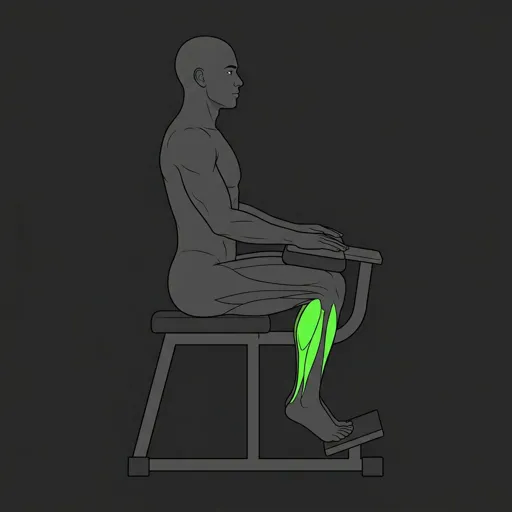
Step by step.
Sit on the machine with the balls of your feet on the platform and your heels hanging off.
Set the thigh pad snug just above your knees and release the safety. This is the start.
Let your heels sink slowly until the calves are under a deep stretch.
Raise your heels as high as possible by contracting the calves, exhaling at the top.
Hold the top contraction for a beat before lowering.
Use a full range every rep, all the way down to the stretch and all the way up.
Bending the knee here changes which muscle does the work. Your calf is two muscles: the gastrocnemius, the big visible one that crosses the knee, and the soleus beneath it, which does not. A bent knee takes the gastrocnemius out of play and hands the job to the soleus, while a standing calf raise with straight legs keeps the gastrocnemius in charge. Pair this with standing work and you cover the whole calf, and on its own the seated raise is the one common way to load the soleus directly.
The soleus is underrated. It is dense with endurance fibers and works in everything you do on your feet, yet most people only ever train calves standing and leave it out. If your lower legs have stalled, the soleus is usually the missing piece, and a few weeks of dedicated seated work fixes it.
Full range, every rep, with a pause. Calves attract the laziest reps in the gym, tiny bounces with no stretch and no squeeze. Sink the heels until you feel a real stretch at the bottom, drive all the way up to a hard contraction, and hold it. That bottom stretch is where calf growth lives, so never cut it short.
The soleus is endurance heavy, so give it reps, 12 to 20, with a pause at the stretch and at the squeeze. Most lifters never load it on purpose, and this is the lift that finally lets you.
Common questions.
The knee position. A seated calf raise bends the knee, which slackens the gastrocnemius and targets the soleus underneath. A standing calf raise keeps the legs straight and hits the gastrocnemius, the larger visible calf muscle. Doing both builds a more complete lower leg than either alone.
It is a large, endurance heavy muscle involved in nearly everything you do on your feet, yet most people only train calves standing and skip it. If your calves have stalled, the soleus is often the neglected piece, and the seated calf raise is the main way to load it directly.
Usually lazy reps and a neglected soleus. Calves get trained with tiny bouncing partials, no stretch and no squeeze. Use a full range with a pause at the bottom stretch and the top contraction, train both standing and seated, and use enough volume. That bottom stretch drives growth.
Often. Calves recover quickly and tolerate frequent, higher volume work better than most muscle groups, with 12 to 20 reps suiting the endurance oriented soleus. Pause at both the deep stretch and the peak contraction to make the reps count.


Run the numbers.
One-rep max.
Estimate your max from any rep count. Five formulas, full percentage table.
Plate calculator.
What to load for any target weight, in lb or kg.
RPE calculator.
Convert rate of perceived exertion to training percentages.
Wilks score.
Bodyweight-adjusted total for comparing strength across weight classes.
DOTS score.
The IPF's newer bodyweight-adjusted scoring formula.
IPF GL points.
The IPF's official Goodlift score, in use at meets since 2020.
Volume calculator.
Weekly sets per muscle group, tonnage, and load management.
Strength ratio.
Screen your squat, bench, and deadlift to find the lift that is lagging.
Stop calculating.
Start tracking.
Log every set in RepRaptor. Free forever for lifters.