Standing Dumbbell Calf Raise.
The standing dumbbell calf raise trains the calves with straight legs while holding dumbbells, biasing the larger gastrocnemius. Standing on a block or plate for extra range, it is the simplest way to do standing calf work without a machine.

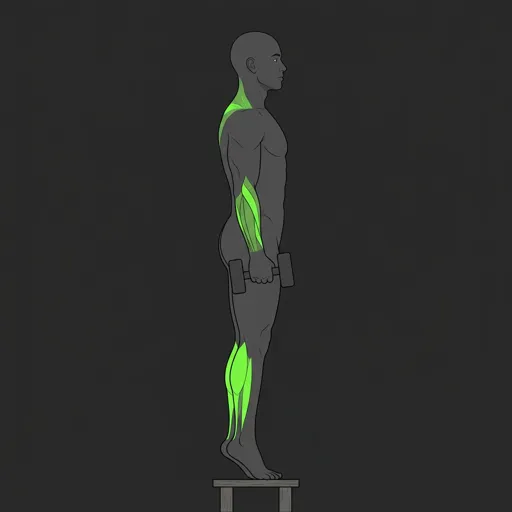
Step by step.
Hold a dumbbell in each hand at your sides and place the balls of your feet on a sturdy block, heels hanging off.
Stand tall with legs straight and a slight bend in the knees that does not change. This is the start.
Drop your heels below the block as far as they will go, feeling the stretch build.
Raise your heels as high as possible by contracting the calves, exhaling at the top.
Hold the peak contraction for a beat, balanced on the balls of your feet.
Keep the knees fixed. Bending and straightening them turns it into a different exercise.
Straight legs are what point this at the gastrocnemius, the big diamond shaped muscle that crosses the knee. That muscle only pulls hard when the knee is extended, so a fixed, slight bend that never changes is the rule here. Let the knees flex and rebound and the work bleeds over to the soleus, which is what a seated calf raise is for. The standing and seated raises split the calf between them, and this is the standing half with nothing but a pair of dumbbells.
Range of motion is the single biggest upgrade you can make to calf training. Put the balls of your feet on a block or plate and your heels can drop well below your toes into a deep stretch at the bottom. Calves grow off that loaded stretch, and grinding the reps out flat on the floor throws most of it away. Drop deep, drive high.
What usually ends the set is your hands. Heavy bells make you wobble, more so on one leg, so steady yourself on a rack or wall with a free hand, and reach for straps once your grip quits before the calves do. Neither balance nor grip should be what calls time.
Keep the reps in the 10 to 20 range with a pause at the stretch and the squeeze. Calves are stubborn and bounce back quickly, so hit them often and through a full range, and the stubborn ones eventually give.
Common questions.
Straight legs target the gastrocnemius, the large calf muscle that crosses the knee and only pulls hard when the knee is extended. Bending the knees shifts the work toward the soleus and turns it into a poor seated calf raise. Hold a fixed slight bend that does not change.
It makes a big difference. Raising the balls of your feet on a block or plate lets your heels drop well below your toes for a deep stretch, and calves grow largely off that loaded stretch. Doing the raise flat on the floor cuts the range short and wastes much of the benefit.
The knee position changes the target. Standing with straight legs hits the gastrocnemius, while a seated calf raise bends the knee to bias the soleus underneath. They train different muscles, so the standing and seated versions are partners and doing both builds a more complete calf.
Usually balance or grip. Heavy dumbbells make you wobble, especially on one leg, so hold a rack or wall with one hand, and use straps once the bells are heavy enough that your hands give out first. Neither should be the reason the set ends before the calves are worked.


Run the numbers.
One-rep max.
Estimate your max from any rep count. Five formulas, full percentage table.
Plate calculator.
What to load for any target weight, in lb or kg.
RPE calculator.
Convert rate of perceived exertion to training percentages.
Wilks score.
Bodyweight-adjusted total for comparing strength across weight classes.
DOTS score.
The IPF's newer bodyweight-adjusted scoring formula.
IPF GL points.
The IPF's official Goodlift score, in use at meets since 2020.
Volume calculator.
Weekly sets per muscle group, tonnage, and load management.
Strength ratio.
Screen your squat, bench, and deadlift to find the lift that is lagging.
Stop calculating.
Start tracking.
Log every set in RepRaptor. Free forever for lifters.