Goblet Squat.
The goblet squat holds a kettlebell or dumbbell at chest height while squatting to full depth. The front load acts as a counterbalance that makes upright torso position automatic, which is why it teaches squat mechanics faster than almost anything else.

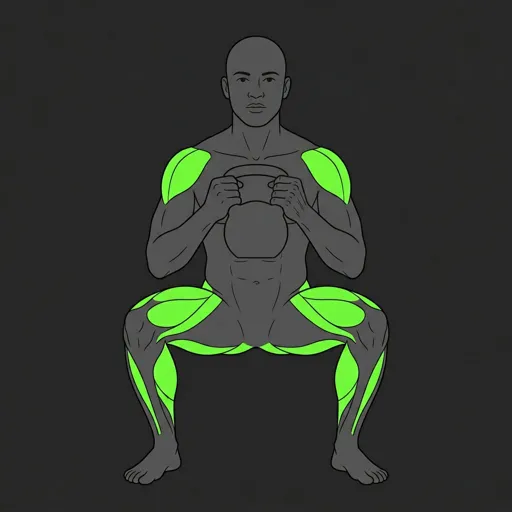
Step by step.
Hold a kettlebell by the horns or cup the head of a dumbbell against your chest. Keep the weight snug to your sternum with your elbows pointing down.
Set your feet a little wider than your shoulders with your toes turned out slightly, and stand tall.
Take a breath, brace your core, and sit straight down by bending the knees and pushing the hips back together.
Descend until your hamstrings reach your calves or as deep as you can go with your heels flat and your chest up.
At the bottom let your elbows settle inside your knees and push the knees out so they track over your second toes.
Drive through your whole foot to stand back up, keeping the weight close to your chest the entire rep.
The front load is the entire point. Hold the kettlebell by the horns close to your sternum, not out at arm's length, not drooping toward your belly. When the weight drifts forward, you lose the counterbalance effect and start rounding forward. The whole reason the goblet squat works as a teaching tool is that keeping the weight close forces a chest-up position without any external cueing.
At the bottom, elbows go inside the knees and push them out. This is the cue that distinguishes goblet squats from everything else: the active use of elbows to create external rotation at the hip. Knees track the second toe; they don't cave inward. If your knees dive in the moment you hit depth, the problem is usually weak hip abductors or tight hip flexors. The goblet squat's elbow cue directly trains around the first while the full-depth position works on the second.
Depth is the goal. Hamstrings to calves or as close as possible. Most people can hit full depth in a goblet squat before they can in a barbell back squat because the front load shifts the center of mass and the counterbalance allows a more upright torso at depth. If you can't hit full depth without the heels lifting, your ankle dorsiflexion is limited. A small heel elevation (5-10 lb plates under each heel) is a diagnostic and a temporary fix. Work on ankle mobility alongside.
Don't dismiss this exercise because the load ceiling is modest. A 24 kg kettlebell for 5x10 paused reps with a 2-second hold at the bottom is harder than it sounds and legitimate training for most people up through intermediate level.
Common questions.
Both are front-loaded squats that encourage an upright torso, but they differ in where the load sits and how demanding they are. The goblet squat holds a single kettlebell or dumbbell at chest height with the arms supporting the weight from below. The barbell front squat racks a bar across the front deltoids and clavicle, which requires a specific wrist and elbow position that takes time to develop. Goblet squats are easier to set up, have a lower learning curve, and are appropriate for beginners. Front squats allow much heavier loading and are more transferable to Olympic weightlifting.
For building squat mechanics and leg muscle at lower loads, yes. The goblet squat trains the quads, glutes, and core in the same fundamental pattern. The practical ceiling is around 24-32 kg for most people before the hold position becomes the limiting factor rather than the legs. Your arms fatigue holding the weight before your quads give out. At that point, transitioning to a barbell squat variation makes sense. Some older lifters, people with shoulder restrictions, or those who simply prefer it do goblet squats as a primary squat movement for years with good results.
Hold the kettlebell by the horns (the sides of the handle, not the top of it). This creates a stable grip with the bell hanging between your forearms and against your chest. The weight sits snug against the sternum, elbows pointing down and slightly forward. Gripping the top of the handle (the 'goblet' grip on a dumbbell) works the same way but gives a slightly different hand position. What matters is that the weight is close to the body and the elbows can drop to cue the knees outward at the bottom.
Limited ankle dorsiflexion. At full squat depth, the tibia has to move forward over the foot, which requires the ankle to flex. If the calf or Achilles is tight, the heel lifts to compensate. A heel elevation under both feet (plates, a wedge, or heel-elevated squat shoes) is a useful workaround while you work on ankle mobility. Ankle mobility drills (specifically the kneeling wall ankle stretch, about 2-3 minutes per side daily) make a noticeable difference over a few weeks.


Run the numbers.
One-rep max.
Estimate your max from any rep count. Five formulas, full percentage table.
Plate calculator.
What to load for any target weight, in lb or kg.
RPE calculator.
Convert rate of perceived exertion to training percentages.
Wilks score.
Bodyweight-adjusted total for comparing strength across weight classes.
DOTS score.
The IPF's newer bodyweight-adjusted scoring formula.
IPF GL points.
The IPF's official Goodlift score, in use at meets since 2020.
Volume calculator.
Weekly sets per muscle group, tonnage, and load management.
Strength ratio.
Screen your squat, bench, and deadlift to find the lift that is lagging.
Stop calculating.
Start tracking.
Log every set in RepRaptor. Free forever for lifters.