Leg Press.
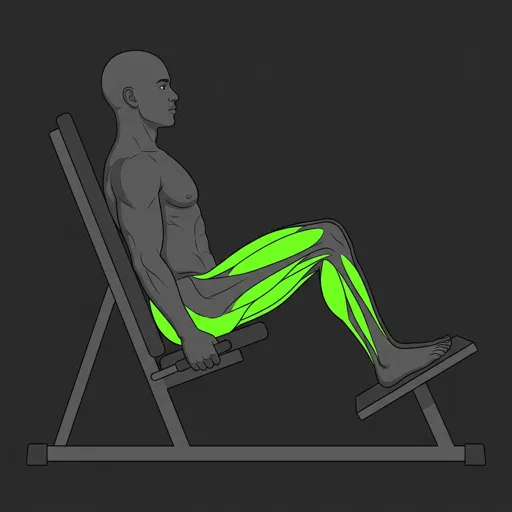
The leg press is a machine-based lower body push that trains the quadriceps, glutes, and hamstrings with the spine supported. It removes the balance and upper body demands of a squat, which lets you load the legs very heavily and accumulate volume without taxing the lower back as a limiting factor.

Step by step.
Sit in the machine with your back and hips flat against the seat pad. Place your feet on the platform around shoulder width, with a mid placement for a balanced quad and glute press.
Press the platform up to take it off the stops and release the safety handles to the sides. Keep a soft bend in your knees at the top rather than locking out hard.
Lower the platform slowly by bending your knees and letting them track in line with your toes. Stop the moment your lower back starts to peel off the pad, since that point is your true bottom.
For most people the platform comes down to around a 90 degree knee angle. Hold the bottom briefly with the back still flat and the weight under control.
Drive through your whole foot to press the platform back up. Push the legs to near full extension without snapping the knees into a hard lockout.
Repeat for your reps, then set the safety handles back into place before stepping out. Never let the platform drop fast or bottom out beyond where your back stays supported.
Foot position on the leg press changes what you're training more than most people appreciate. Feet shoulder-width in the center of the plate gives you a quad-dominant press close to neutral. Feet higher on the platform puts the hip in greater flexion at the bottom, which increases glute and hamstring involvement and reduces the knee's range of motion. Feet lower on the plate increases quad range of motion and shear force at the knee, which is useful for quad development but harder on the knee joint for people who have issues. Feet wider targets more inner quad and adductor. Pick your foot position deliberately, not randomly.
The lower back rounding is the technique fault that can actually hurt you here. At the bottom of the rep, when the platform comes toward your chest, your pelvis is in posterior tilt. Some is fine, a lot is a problem. When the lower back rounds sharply off the seat pad under load, you're compressing the lumbar discs in a bad position. The fix is simple: don't go that deep. Stop the descent when your lower back stays in contact with the pad. That's your actual safe range of motion for this exercise, not how far the platform will physically travel.
The lock-out-or-not debate: most people are told never to lock out the knees. That's slightly overcautious. Briefly straightening the legs at the top is fine. What you want to avoid is hyperextending under load or locking out with a snap. Gentle full extension is acceptable and actually allows the quad to contract fully at the end position.
A practical note on loading: because the machine supports the spine and you're in a favorable mechanical position, leg press numbers can get very high. Some experienced lifters press 600 to 1000 lbs. Those numbers are not directly comparable to squat numbers and shouldn't be used to gauge leg strength in general.
Use this for what it does best. The leg press lets you keep hammering the quads on a day your barbell squat has already cooked your lower back, since the seat carries the spine and there's nothing to balance.
Common questions.
Gentle full extension is fine. Snapping the knees into hyperextension with momentum is not. The concern about lock-out is that some lifters snap the knees past neutral at the top, which is jarring on the joint and removes tension from the muscle. If you extend fully in a controlled way and then immediately begin the next rep's descent, that's normal. If you're straightening the legs to take a rest between reps by unloading the quad entirely, that reduces the time under tension but isn't injurious. The technique that actually causes problems is the hyperextension snap.
Far enough to get a meaningful range of motion from the quad and glute, but not so far that your lower back rounds off the pad. For most people, that's somewhere around a 90-degree knee angle or slightly past it. Going much deeper in order to hit chest-to-knee range of motion typically requires lumbar rounding and shifts load onto the spine in a position it can't safely handle. Range of motion below your point of lumbar stability is just adding risk without adding muscle.
It depends on what you mean by replacement. For quad and glute hypertrophy, the leg press can produce similar results to squats, especially when loaded heavily through a controlled range. For total-body strength and the neural and stability demands of standing barbell work, it doesn't transfer the same way. Squats train the core, upper back, balance, and hip hinge pattern simultaneously. The leg press trains none of those. For athletes who need functional strength, squat patterns are important. For someone focused purely on leg size who has back issues that limit squatting, the leg press is a legitimate primary leg movement.
Lower on the platform and narrower. This increases the range of knee flexion and extension and removes some of the hip involvement that occurs when the feet are high. The trade-off is higher shear force at the knee joint, which is why people with knee issues often prefer a higher foot placement. If your knees feel fine, a mid-to-lower foot position with shoulder-width stance gives the quads more work. If you're targeting the quads specifically and the leg press is your primary quad exercise, this foot placement makes sense.


Run the numbers.
One-rep max.
Estimate your max from any rep count. Five formulas, full percentage table.
Plate calculator.
What to load for any target weight, in lb or kg.
RPE calculator.
Convert rate of perceived exertion to training percentages.
Wilks score.
Bodyweight-adjusted total for comparing strength across weight classes.
DOTS score.
The IPF's newer bodyweight-adjusted scoring formula.
IPF GL points.
The IPF's official Goodlift score, in use at meets since 2020.
Volume calculator.
Weekly sets per muscle group, tonnage, and load management.
Strength ratio.
Screen your squat, bench, and deadlift to find the lift that is lagging.
Stop calculating.
Start tracking.
Log every set in RepRaptor. Free forever for lifters.