Leg Extension.
The leg extension isolates the quadriceps through knee extension on a machine, with the hips fixed and the rest of the body removed from the movement. It is the closest thing to a direct quad isolation exercise available in most gyms, and it trains the quads in a shortened position that squats and leg press don't fully reach.

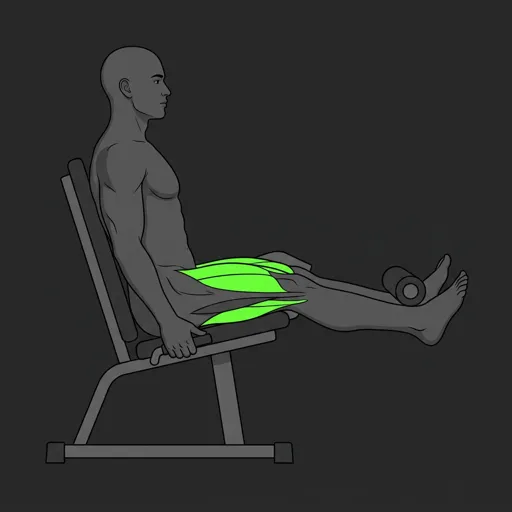
Step by step.
Adjust the seat back so the crease behind your knee lines up with the front edge of the seat pad. Set the ankle pad to rest just above your ankles, against the lower shins.
Sit tall with your back against the pad and hook your feet under the roller. Grab the side handles to keep your hips and torso anchored to the seat.
Extend your knees and lift the pad until your legs are straight. Drive the movement from the quads rather than swinging the weight up with momentum.
At full extension, flex the quads hard and hold the squeeze for a beat. This top position is where the exercise trains the part of the range a squat never reaches.
Lower the pad slowly back down, resisting the weight the whole way until your knees return to about 90 degrees or a touch past.
Keep the tempo steady on every rep. If the movement turns into a fast jerky kick, the weight is too heavy and the quads are doing less of the work.
Seat position is the one setup detail that actually matters on this machine, and it's routinely ignored. The back of the knee (the popliteal crease) should sit at the edge of the seat pad, not behind it, not in the middle of it. If you're sitting too far back, the knee joint hangs off the edge at a bad angle and the movement becomes uncomfortable and mechanically poor. If you sit too far forward, the pad engages at the shin rather than just above the ankle and the lever arm changes. Adjust the seat back until the crease of the knee lines up with the seat's edge.
Leg extension gets an unfair reputation for damaging the knee. The research on this is more nuanced than the warning usually heard in gyms. For healthy knees, leg extensions under controlled load through a controlled range of motion are not dangerous. For post-ACL surgery rehabilitation, the terminal range of extension (the last 30 degrees) was historically restricted during early healing phases. That caution got extrapolated into "leg extensions are bad for knees," which is an overreach. If you have healthy knees and train this with reasonable weight, you're fine.
The contraction at the top is where this exercise earns its keep. Extend fully, flex the quad hard, hold a beat, then lower slowly. That squeeze at full extension trains the rectus femoris in its shortened position. A squat never achieves this because the knee doesn't fully extend under load at the top of a squat. The quad's top-range strength is a real performance gap for many lifters, and this machine addresses it directly.
Don't go heavy enough that the movement is jerky. The quad works harder under slow controlled extension than under a fast kick that relies on momentum. There's no benefit to speed here.
Common questions.
For healthy knees, no. The concern originates from physical therapy protocols for post-ACL reconstruction patients, where open-chain knee extension (leg extension) in the 0 to 30 degree range was restricted during early healing to protect the graft. That specific clinical caution got generalized into a broad claim that leg extensions damage knees, which isn't supported by evidence for people without ACL issues. If you have a healthy knee and train this with reasonable loads and controlled technique, there's no evidence it causes harm. If you have existing knee pathology, talk to your physio before including it.
Full range. The terminal extension (the last portion before full lockout) is where the quad is in its most shortened position, which is exactly what makes this exercise distinctive compared to squats and leg press. Stopping short of full extension and not fully flexing at the bottom wastes the exercise's unique advantage. Pause at the top with the leg extended, squeeze for one second, and then lower with control all the way back to 90 degrees or slightly past it.
No. The leg extension isolates the quad as a pure knee extensor with the hip fixed. A squat trains the quad in coordination with the hip extensors, core, and stabilizing muscles across multiple joints. The leg extension contributes to quad size and top-range strength, but it produces none of the systemic training effect, hip extensor strength, or athletic carryover that squats build. Use leg extensions to add quad volume on top of compound lower body work, not instead of it.
Leg extensions work across a range of rep counts, but they tend to respond well to moderate-to-high reps. Sets of 10 to 20 are common and effective. The reasoning is practical: the movement is isolated and the quad's time under tension per rep is short. Higher reps extend the total time the muscle spends under load per set. Heavy low-rep leg extensions are also useful for building top-range strength, but the knee joint tolerates high-rep moderate-load work better than max-effort single-digit sets on an isolation machine.


Run the numbers.
One-rep max.
Estimate your max from any rep count. Five formulas, full percentage table.
Plate calculator.
What to load for any target weight, in lb or kg.
RPE calculator.
Convert rate of perceived exertion to training percentages.
Wilks score.
Bodyweight-adjusted total for comparing strength across weight classes.
DOTS score.
The IPF's newer bodyweight-adjusted scoring formula.
IPF GL points.
The IPF's official Goodlift score, in use at meets since 2020.
Volume calculator.
Weekly sets per muscle group, tonnage, and load management.
Strength ratio.
Screen your squat, bench, and deadlift to find the lift that is lagging.
Stop calculating.
Start tracking.
Log every set in RepRaptor. Free forever for lifters.