Landmine Press.
The landmine press drives one end of a barbell up and forward on a diagonal, with the other end pinned in a landmine or corner. The angled path is friendlier to cranky shoulders than a vertical press while still building the front delt and upper chest.

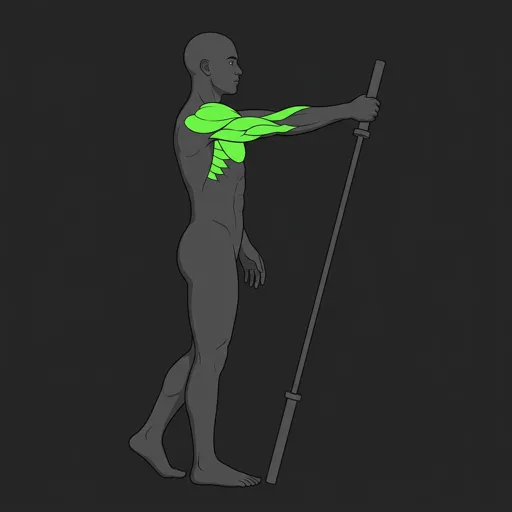
Step by step.
Wedge one end of a barbell into a landmine attachment or a corner and load the other end. Stand facing it.
Pick up the loaded end in one hand and hold it at shoulder height, the same side foot slightly forward.
Brace your core and press the bar up and forward by extending the elbow and driving through the shoulder.
Follow the natural diagonal arc of the bar, not a straight vertical line.
Lock out with the arm extended up and out in front of you, then lower under control to the shoulder.
Complete all reps on one side before switching arms.
A landmine press travels on a diagonal, somewhere between a vertical overhead press and a horizontal bench, and that in between path lets a lot of lifters press hard without the shoulder pain a straight overhead press provokes. The arc keeps the joint in a more forgiving position through the rep, so if pressing overhead lights up your shoulder, this is one of the best ways to keep training the press while you sort the issue out.
Because it is loaded on one side, the core gets pulled into the work. With the weight in one hand and out in front, your trunk has to resist a sideways pull and a rotational one at the same time, which quietly makes the landmine press a strong anti rotation drill on top of a shoulder builder. Brace hard and keep your hips and shoulders square so the torso does not twist toward the bar.
Let the bar go where its arc wants to. The common mistake is fighting the fixed pivot and pressing straight up, which feels awkward and strains the wrist and shoulder. The bar is anchored at one end, so its path is a diagonal sweep up and forward. Press along that line and it feels smooth.
Run it for 8 to 12 reps per arm. It loads and learns easily, so it works for beginners, for anyone rehabbing a shoulder, or as accessory volume after your main overhead press. Progress it like any other press, adding weight as your overhead strength grows.
Common questions.
It is one of the better pressing options for sore shoulders. The diagonal path sits between vertical and horizontal pressing and keeps the shoulder in a more forgiving position than a straight overhead press, so many lifters can press pain free on a landmine. It is not a cure for an injury, but it lets you keep training the press.
No. The bar is anchored at one end, so it pivots through a natural diagonal arc up and forward. Fighting that to press straight up feels awkward and strains the wrist and shoulder. Follow the arc the landmine wants to give you, pressing up and out in front, and the movement feels smooth and strong.
Yes, more than it looks. Pressing one arm with the load out in front creates both a sideways and a rotational pull that your trunk has to resist, which makes it a solid anti rotation exercise alongside the shoulder work. Brace hard and keep your hips and shoulders square rather than letting the torso twist toward the bar.
Very. The fixed bar path is easy to learn, the diagonal angle is joint friendly, and it is simple to load and progress, so it suits beginners, lifters returning from a shoulder issue, and anyone adding accessory pressing volume. Work it for sets of 8 to 12 per arm and let the weight climb as your overhead pressing gets stronger.


Run the numbers.
One-rep max.
Estimate your max from any rep count. Five formulas, full percentage table.
Plate calculator.
What to load for any target weight, in lb or kg.
RPE calculator.
Convert rate of perceived exertion to training percentages.
Wilks score.
Bodyweight-adjusted total for comparing strength across weight classes.
DOTS score.
The IPF's newer bodyweight-adjusted scoring formula.
IPF GL points.
The IPF's official Goodlift score, in use at meets since 2020.
Volume calculator.
Weekly sets per muscle group, tonnage, and load management.
Strength ratio.
Screen your squat, bench, and deadlift to find the lift that is lagging.
Stop calculating.
Start tracking.
Log every set in RepRaptor. Free forever for lifters.