Narrow Stance Hack Squat.
The narrow stance hack squat uses the hack squat machine with the feet set close together, a setup used to emphasize the outer quad sweep. The machine supports your back and fixes the path, so you can chase quad growth without balancing a bar.

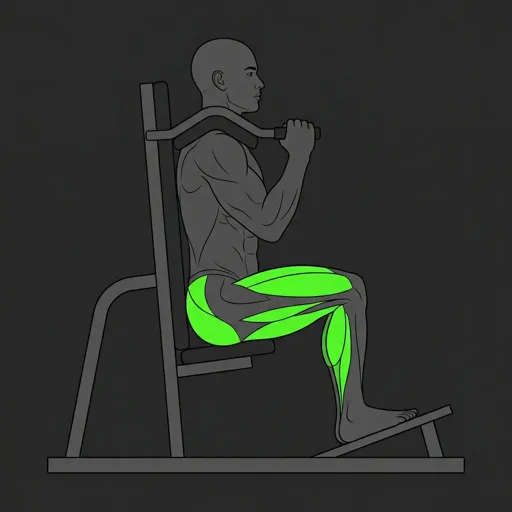
Step by step.
Set your back against the pad and your shoulders under the shoulder rests on the hack squat machine.
Place your feet on the platform close together, around three inches apart, toes slightly out.
Straighten your legs to lift the carriage and release the safety handles. This is the start.
Lower under control by bending the knees until your thighs drop below parallel.
Keep your back flat on the pad and your whole foot in contact with the platform.
Drive through your feet to press back up without locking the knees hard at the top.
Set the feet narrow on a hack squat and the load drifts to the outer quad sweep. A close stance sends the knees forward more, and the outer quad tends to take a bigger share of the work, building the sweep that gives the thigh its width from the front. The machine is the place to play with this, since it supports the spine and fixes the path, so you can chase the quad bias without the balance or lower back fatigue a free barbell hack squat would demand.
The machine is a license to go deep and grind. A free squat or barbell hack squat usually taps out when your lower back or balance fails before the quads do, but the back support here removes that ceiling. So you can drive the quads to honest failure safely, which is what actually grows them. Use the safety it buys you and do not just shorten the range.
Knees forward is the goal here, not the sin it is elsewhere. On a barbell squat you ration how far the knees travel, but the narrow stance hack squat is built to let them come forward and load the quads through a deep bend. Keep the whole foot down and the back pinned to the pad, and let the knees track out over the toes as you descend.
Slot it in after your main squatting and run higher reps, 10 to 15, to a real burn. The supported, deep position is one of the few places you can safely take the legs close to failure, so spend it there.
Common questions.
A close stance lets the knees travel forward more and shifts the work toward the outer quad sweep, building width across the front of the thigh. A wider stance brings in more glutes and inner thigh. Foot position on the hack squat is a quad targeting dial, and narrow points it at the outer quad specifically.
The machine supports your back and fixes the bar path, so your lower back and balance do not give out before your quads do. That lets you go deep and push close to failure safely, which is hard on a free squat or barbell hack squat. It is one of the best tools for chasing pure quad growth.
On the narrow stance hack squat, forward knee travel is the goal, not a fault. The whole point of the close stance is to let the knees come forward and load the quads through a deep bend, with the machine supporting your spine. Keep your whole foot down and back flat on the pad, and let the knees track out over the toes.
After your main squat, as a quad finisher run for higher reps to a deep burn. The supported position lets you push the legs close to failure, so favor a full, deep range over a heavier partial one.


Run the numbers.
One-rep max.
Estimate your max from any rep count. Five formulas, full percentage table.
Plate calculator.
What to load for any target weight, in lb or kg.
RPE calculator.
Convert rate of perceived exertion to training percentages.
Wilks score.
Bodyweight-adjusted total for comparing strength across weight classes.
DOTS score.
The IPF's newer bodyweight-adjusted scoring formula.
IPF GL points.
The IPF's official Goodlift score, in use at meets since 2020.
Volume calculator.
Weekly sets per muscle group, tonnage, and load management.
Strength ratio.
Screen your squat, bench, and deadlift to find the lift that is lagging.
Stop calculating.
Start tracking.
Log every set in RepRaptor. Free forever for lifters.