Rear Delt Fly.
The rear delt fly isolates the back of the shoulder by sweeping the arms out and back against resistance. On a machine it pins your chest in place, so the rear delts and upper back work without the lower back or momentum helping.

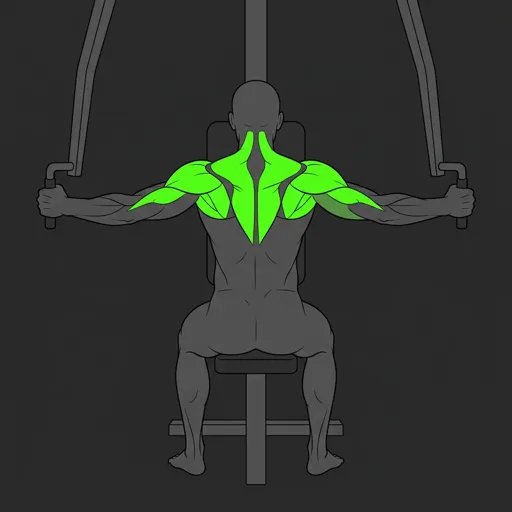
Step by step.
Sit facing the pad of a rear delt machine with your chest pressed against it and the handles in front at shoulder height.
Grab the handles with a neutral or palms down grip, arms extended forward with a slight elbow bend. This is the start.
Sweep your arms back in a wide arc, driving the elbows out behind your shoulders.
Squeeze the rear delts and shoulder blades together at the end and hold for a beat.
Return the handles slowly to the front under control.
Keep the chest on the pad and resist the urge to jerk the arms back.
The rear delts are the part of the shoulder almost everyone neglects, and it shows up as rounded posture and a bench that outpaces the back of the body. Pressing trains the front delt relentlessly while the rear gets only scraps from rowing. A dedicated rear delt fly closes that gap, and the chest supported machine is the easiest place to do it well, because the pad kills the body swing that wrecks rear delt work on free weights.
The rear delt is a weak isolator, so the instant you start pulling with your hands, the mid back and biceps take over and the rep becomes a row. Cue yourself to sweep the elbows out and back in a wide arc with the elbow angle fixed, so the small muscle at the back of the shoulder stays the prime mover. It is the same elbow first idea that makes a face pull work.
Go light and chase the squeeze. Like every shoulder isolation movement, the rear delt fly gets ruined by heavy weight, which just recruits bigger muscles to heave the load. Pick a weight you can sweep back smoothly and hold at the contracted position, and treat that pause as the most important part of the rep.
Train it often and for high reps, 15 to 25, since the rear delts bounce back quickly and most people start from a deficit. Pair it with a face pull and that steady rear delt volume becomes what finally balances all your pressing.
Common questions.
Pressing hammers the front delt while the rear gets almost nothing, which over time pulls the shoulders forward and leaves the back of the shoulder weak. Direct work balances the pressing, improves posture, and rounds out the shoulder. Most lifters are well behind here, so it pays off fast.
You are pulling with your hands, which brings in the mid back and biceps. The rear delt is a weak isolator that bigger muscles bully out of the movement. Sweep the elbows out with the angle fixed and go light enough that the back of the shoulder does the work. It is the same fix that makes a face pull work.
Light. The rear delt is small and easily overpowered, so heavy weight just turns the movement into a rowing heave. Choose a load you can sweep back smoothly and pause at the contracted position. If you cannot feel the back of the shoulder doing the work, you are going too heavy.
Frequently. The rear delts are small and recover fast, and most people start from a deficit, so high frequency and high reps suit them. Sets of 15 to 25 several times a week are reasonable. Pairing the rear delt fly with a face pull gives the back of the shoulder the volume pressing never provides.


Run the numbers.
One-rep max.
Estimate your max from any rep count. Five formulas, full percentage table.
Plate calculator.
What to load for any target weight, in lb or kg.
RPE calculator.
Convert rate of perceived exertion to training percentages.
Wilks score.
Bodyweight-adjusted total for comparing strength across weight classes.
DOTS score.
The IPF's newer bodyweight-adjusted scoring formula.
IPF GL points.
The IPF's official Goodlift score, in use at meets since 2020.
Volume calculator.
Weekly sets per muscle group, tonnage, and load management.
Strength ratio.
Screen your squat, bench, and deadlift to find the lift that is lagging.
Stop calculating.
Start tracking.
Log every set in RepRaptor. Free forever for lifters.