Seated Lateral Raise.
The seated lateral raise isolates the side deltoid by lifting dumbbells out to the sides while seated. Sitting removes the leg and hip swing people use to cheat a standing raise, so the side delt has to do the work alone.

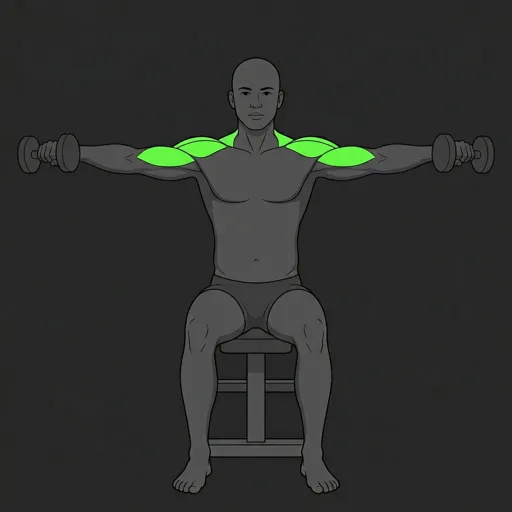
Step by step.
Sit at the end of a bench, feet flat, holding a dumbbell in each hand at your sides, palms facing in.
With a slight bend in the elbows, raise the dumbbells out to the sides. This is the rep.
Drive the elbows up first and tilt the hands slightly down at the top, as if pouring out a glass of water.
Lift until your arms are roughly parallel to the floor, no higher. Pause briefly at the top.
Lower under control all the way back down, resisting the weight on the way.
Keep the torso still. No rocking, no swinging the dumbbells up with momentum.
Sitting is how you finally feel the side delt. A standing lateral raise lets you dip and pop your hips, bouncing the dumbbells up with a little body english almost everyone uses without realizing. Plant yourself on a bench and that escape route closes, so the only thing lifting the weight is the muscle you are after. If your lateral raise has always felt like a forearm and trap exercise, doing it seated is the first fix to try.
Leave the heavy dumbbells alone. The side delt is a small muscle with terrible leverage out at arms length, so the weight that actually trains it is far lighter than ego wants. Pick something you can raise smoothly to parallel and lower under control, then let the burn in the side delt tell you the set was right. Heavy laterals just call in the traps and turn the whole thing into a shrug with extra steps.
Two cues clean up most bad raises. Lift through the elbows so the delt drives the movement, and stop the moment your arms reach shoulder height, since going higher hands the work to the traps. A slight downward tilt of the hand at the top, like pouring out a glass, keeps the tension parked on the side delt.
Run it for high reps, 12 to 20, often with a pause or a slow lowering to make light weight feel heavy. This is pure isolation, so volume and control will always outwork load here.
Common questions.
Sitting removes the leg dip and hip swing people use to cheat a standing raise, so the side delt cannot offload onto momentum. If your standing laterals feel like traps and forearms doing the work, seated forces the target muscle to fire. It is the simplest way to clean up the movement.
Much lighter than you think. The side delt is small and works on a long lever out at arms length, so it grows from light weight moved well. Choose a load you can raise smoothly to parallel and lower under control. If the traps are doing the lifting, the dumbbells are too heavy.
To about shoulder height, where your arms are parallel to the floor. Going higher shifts the work onto the traps and does nothing for the side delt. Lift through the elbows rather than the hands, tilt the hands slightly down at the top, and stop at parallel for the cleanest tension.
Usually too much weight or raising too high, both of which call in the traps. Drop the load, keep the torso still, lift through the elbows, and stop at parallel. A slight forward and downward tilt of the hands at the top also keeps the tension on the side delt rather than letting the traps shrug it up.


Run the numbers.
One-rep max.
Estimate your max from any rep count. Five formulas, full percentage table.
Plate calculator.
What to load for any target weight, in lb or kg.
RPE calculator.
Convert rate of perceived exertion to training percentages.
Wilks score.
Bodyweight-adjusted total for comparing strength across weight classes.
DOTS score.
The IPF's newer bodyweight-adjusted scoring formula.
IPF GL points.
The IPF's official Goodlift score, in use at meets since 2020.
Volume calculator.
Weekly sets per muscle group, tonnage, and load management.
Strength ratio.
Screen your squat, bench, and deadlift to find the lift that is lagging.
Stop calculating.
Start tracking.
Log every set in RepRaptor. Free forever for lifters.