Single Arm Dumbbell Shoulder Press.
The single arm dumbbell shoulder press drives one dumbbell overhead at a time, which forces the core to resist the load trying to bend you sideways. It builds the shoulder and the trunk together, and exposes any strength gap between sides.

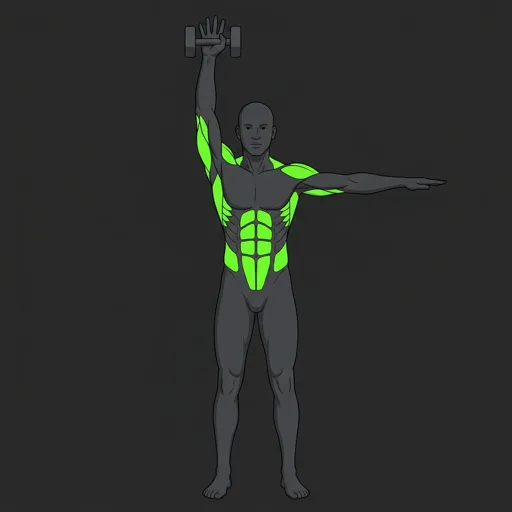
Step by step.
Sit or stand tall and clean a dumbbell to shoulder height, palm facing forward, other hand free or braced.
Brace your core hard, especially the side opposite the working arm. This is the start.
Press the dumbbell straight up until the arm locks out overhead.
Pause at the top with the weight stacked over the shoulder, keeping the torso upright.
Lower under control back to shoulder height without letting your torso lean.
Finish all reps on one side, then switch. Keep the hips and shoulders square throughout.
Loading one side turns a shoulder press into a core lift in disguise. With weight on a single arm, gravity tries to tip you toward that side, and your obliques and deep trunk muscles fire hard just to keep you upright. A two arm overhead press or a balanced dumbbell shoulder press never asks for that, because even load gives you nothing to resist. Brace the off side like your life depends on it.
It doubles as an honesty test. Pressing each arm alone means a lagging side cannot quietly tap the stronger one for help, the way it does when both arms go up together. If one arm grinds while the other flies, you have found an imbalance worth fixing. Train the weaker side first, match the stronger side to its reps, and let it catch up.
Stay stacked and stop chasing weight. The most common fault is leaning away from the working arm to steal leverage, which trades the core benefit for a cheat and loads the spine badly. Keep your hips and shoulders square and your torso vertical. If you are bending sideways to finish a rep, the dumbbell is too heavy for an honest press.
Press it seated for more pure shoulder work, or standing for more core demand, and keep it around 8 to 12 reps per arm. Either way it feeds your arnold press and your two arm pressing by drilling a stable, balanced overhead position.
Common questions.
A single sided load makes your core resist being pulled sideways, so you train the shoulder and the anti lean strength of the trunk at once. A balanced two arm press never creates that demand. It also stops a stronger arm from carrying a weaker one, which exposes and helps fix left to right gaps.
Standing adds the most core and balance demand, since your whole body resists the offset load. Seated removes some of that, lets you focus on the shoulder, and usually lets you press a bit more. Pick standing for trunk and athletic carryover, seated for stricter shoulder work.
The load is pulling you that way and you are giving in to grab leverage. Leaning trades the core benefit for a cheat and puts the spine in a poor spot. Brace the side opposite the working arm hard, keep your hips and shoulders square, and lower the weight if you cannot stay vertical.
Press each side on its own so neither can hide, and always start with the weaker arm. Do the reps it can manage with good form, then match the stronger side to that number rather than pushing it further. Over a few weeks the gap closes. The single arm press is the ideal tool for it.


Run the numbers.
One-rep max.
Estimate your max from any rep count. Five formulas, full percentage table.
Plate calculator.
What to load for any target weight, in lb or kg.
RPE calculator.
Convert rate of perceived exertion to training percentages.
Wilks score.
Bodyweight-adjusted total for comparing strength across weight classes.
DOTS score.
The IPF's newer bodyweight-adjusted scoring formula.
IPF GL points.
The IPF's official Goodlift score, in use at meets since 2020.
Volume calculator.
Weekly sets per muscle group, tonnage, and load management.
Strength ratio.
Screen your squat, bench, and deadlift to find the lift that is lagging.
Stop calculating.
Start tracking.
Log every set in RepRaptor. Free forever for lifters.