Sissy Squat.
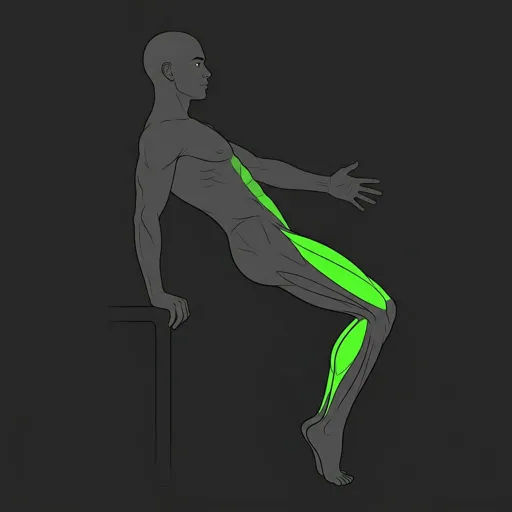
The sissy squat leans the torso back and drives the knees forward to isolate the quads through a deep stretch. Despite the name, it is brutally hard on the front of the thigh and a favorite for quad detail.

Step by step.
Stand upright with feet about hip width. Hold a rack or wall with one hand for balance.
Rise onto the balls of your feet and lean your torso backward.
Bend your knees and push them forward, keeping your hips extended so your body stays in a straight line from knees to head.
Lower until you feel a deep stretch in the quads, going as far as your control allows.
Drive through the quads to straighten the knees and return to upright.
Keep the movement slow. Speed turns it into an uncontrolled fall.
The name is a lie. The sissy squat is one of the harder things you can do to your quads. Leaning back and shoving the knees forward while the hips stay open loads the quads in a deep stretch and takes the glutes and hamstrings almost fully out of it. That isolation is unusual for something that looks compound, and it puts the sissy squat in the same quad detailing role as a leg extension, just with your own bodyweight and a much bigger stretch.
Knees way forward is the entire mechanism, so do not fight it. On most squats you ration knee travel, but here the forward drive is what stretches and loads the quads, so let it happen. The flip side is that this stretched, knees forward position asks a lot of the knee joint, so build up slowly. Cranky knees mean a tiny range and a hand on the rack, and you never force depth you cannot control.
Control is the whole game. The lift only works if you lower slowly and own every inch; rush it and you simply fall backward into your knees. Use a support to meter the descent, keep the core braced and the hips extended, and treat the slow eccentric as the main event. The stretch under control is what builds the quad.
Use it as a quad finisher after your heavier squatting, the hack squat or a barbell squat, for higher reps in the 10 to 15 range. Add a plate held to your chest once bodyweight is easy, but earn the range before you ever earn the load.
Common questions.
Not at all, despite the name. Leaning back and driving the knees forward loads the quads through a deep stretch while removing the glutes and hamstrings, which makes it brutally hard on the front of the thigh. It is a serious quad isolation movement, closer in role to a leg extension than to a regular squat.
The deep knees forward position is demanding on the knee joint, so it requires respect rather than avoidance. Build up slowly, start with a small range and a hand on a rack for support, and never force depth you cannot control. Lifters with healthy knees who progress gradually tend to tolerate it well, but it is not a beginner first step.
Forward knee travel is the entire mechanism of the sissy squat. Pushing the knees forward while leaning back and keeping the hips extended is what stretches and loads the quads. Unlike a barbell squat where you manage knee travel, here you want it, so let the knees drive forward while you control the descent.
Once you can control bodyweight through a full range, hold a plate against your chest to add load, or slow the lowering further to increase time under tension. Earn the range and the control before the weight.


Run the numbers.
One-rep max.
Estimate your max from any rep count. Five formulas, full percentage table.
Plate calculator.
What to load for any target weight, in lb or kg.
RPE calculator.
Convert rate of perceived exertion to training percentages.
Wilks score.
Bodyweight-adjusted total for comparing strength across weight classes.
DOTS score.
The IPF's newer bodyweight-adjusted scoring formula.
IPF GL points.
The IPF's official Goodlift score, in use at meets since 2020.
Volume calculator.
Weekly sets per muscle group, tonnage, and load management.
Strength ratio.
Screen your squat, bench, and deadlift to find the lift that is lagging.
Stop calculating.
Start tracking.
Log every set in RepRaptor. Free forever for lifters.