Barbell Walking Lunge.
The barbell walking lunge moves forward step after step with a bar across the upper back, building the quads, glutes, and hamstrings while demanding balance and conditioning. It loads single leg strength heavily and leaves you breathing hard.

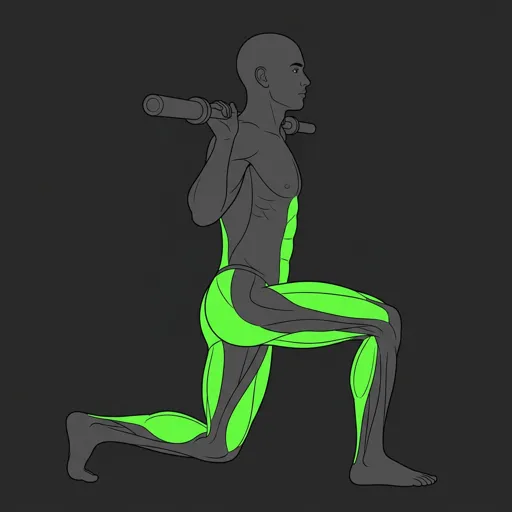
Step by step.
Set a barbell across your upper back like a squat and stand tall with feet about shoulder width.
Step forward with one leg and drop your hips until your rear knee nearly touches the floor.
Keep your torso upright and your front knee over your front foot.
Drive through the front heel and step your rear foot forward into the next lunge.
Continue walking forward, alternating legs, for the prescribed distance or reps.
Keep each step controlled. Do not let momentum string the reps together sloppily.
Walking lunges are equal parts leg builder and engine work, and the barbell turns both up. Stringing steps together under a loaded bar torches the quads and glutes while your heart rate climbs, so a long set leaves you genuinely winded in a way stationary dumbbell lunges never do. That double demand is the appeal, but it also means form decays as you tire, so the last few steps deserve the same care as the first.
The bar is the balance test. A barbell up on your back sits high and wants to tip you, especially mid stride when you are stuck on one leg, where dumbbells held low would keep you stable. That makes the barbell walking lunge a real stability challenge and a reason to start lighter than your ego suggests. Brace the core hard and lock your eyes on a fixed point ahead to hold the line.
Step length sets the emphasis and minds the knee. A longer step pushes work toward the glutes and hamstrings and keeps the front knee back; a shorter step hits the quads more but drives the knee forward. Pick a stride that keeps the front shin reasonably vertical at the bottom and stops the rear knee from crashing down.
Run it for distance or for 8 to 12 reps a leg as a main lower body movement. Because it taxes balance and conditioning alongside strength, it works as a brutal finisher to leg day or as a builder all on its own.
Common questions.
Walking lunges move continuously forward, stringing steps together, which adds a conditioning and balance demand on top of the strength work. Stationary lunges and dumbbell lunges let you reset between reps. The walking version torches the legs and spikes your heart rate, making it both a leg builder and a finisher that leaves you winded.
A barbell sits high on your back and wants to tip you, especially mid stride when you are balanced on one leg. Holding dumbbells low at your sides is far more stable. That extra balance demand makes the barbell walking lunge a genuine stability test, so start lighter than you think, brace hard, and fix your eyes on a point ahead.
It depends on the target. A longer step shifts work to the glutes and hamstrings and keeps the front knee back, while a shorter step hits the quads more but drives the knee forward. Choose a stride that keeps your front shin roughly vertical at the bottom and stops the rear knee from crashing into the floor.
It can be either. Loaded for 8 to 12 reps a leg or for distance, it stands as a main lower body movement; tacked onto the end of leg day, it is a brutal finisher. Keep the load moderate and the steps tight, and if your form goes before the target, set the bar down rather than grinding ugly reps.


Run the numbers.
One-rep max.
Estimate your max from any rep count. Five formulas, full percentage table.
Plate calculator.
What to load for any target weight, in lb or kg.
RPE calculator.
Convert rate of perceived exertion to training percentages.
Wilks score.
Bodyweight-adjusted total for comparing strength across weight classes.
DOTS score.
The IPF's newer bodyweight-adjusted scoring formula.
IPF GL points.
The IPF's official Goodlift score, in use at meets since 2020.
Volume calculator.
Weekly sets per muscle group, tonnage, and load management.
Strength ratio.
Screen your squat, bench, and deadlift to find the lift that is lagging.
Stop calculating.
Start tracking.
Log every set in RepRaptor. Free forever for lifters.