Dumbbell Lunges.
Dumbbell lunges train the quadriceps, glutes, and hamstrings through alternating single-leg loading in a split stance. Each rep produces a full step forward, a descent to near-floor contact with the trailing knee, and a push back to standing, covering both strength and balance in a single pattern.

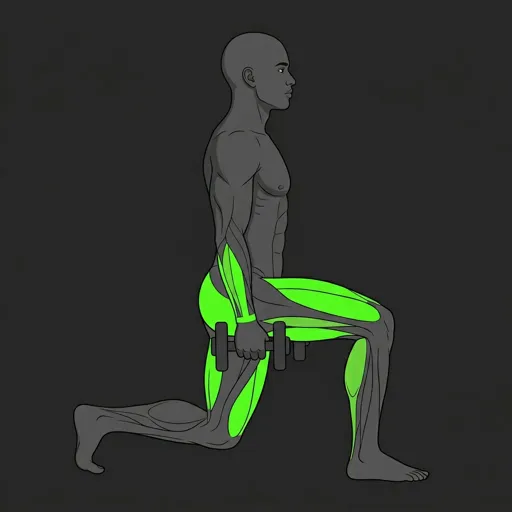
Step by step.
Stand tall with a dumbbell in each hand, arms hanging at your sides with a neutral grip and palms facing your thighs. Keep your chest up and core braced.
Step one foot forward roughly two feet so you land in a split stance. The right step distance is whatever leaves your front shin vertical at the bottom.
Lower straight down by bending both knees until your rear knee comes within an inch of the floor. Keep the front shin close to vertical so the knee stays over the ankle.
Press the front knee out in line with your toes so it does not cave inward as you descend.
Drive through the front heel to push back up to standing, bringing your feet together. Control the movement rather than rushing it.
Alternate legs each rep, or hold a fixed split stance if balance is the limiter. If you wobble, slow the descent to about 3 seconds with a 1 second hold at the bottom.
The front shin perpendicular to the floor is the checkpoint that determines whether this is a quad exercise or a knee-battering exercise. Shin vertical at the bottom means the knee is directly over the ankle, and the force goes straight down through the joint, which is how joints are designed to be loaded. When the knee drifts forward past the toes, the load shifts to the patellar tendon and the knee joint face. A little drift is normal and fine; the front shin at 45 degrees is not.
Step distance determines which muscle gets most of the work. Too short a step puts the torso forward and transfers load to the quads, creating more of a squat pattern. A longer step keeps the torso more upright and loads the glute and posterior chain more on the push back up. Roughly two feet of step distance works for most people, but the test is whether the shin ends up vertical at the bottom. If it does, your step distance is correct regardless of the number.
Dumbbells at the sides (not in front, not on shoulders) is the standard position for this exercise. Arms hanging, neutral grip, palms facing thighs. The weight acts as a load on the system without altering the torso angle the way a barbell would. One benefit of the dumbbell version over a barbell lunge: if you lose balance during a heavy set, you can drop the dumbbells. That's not a trivial safety advantage with heavy unilateral loading.
Balance is a genuine limiter before strength is, for most people starting out. If the lunge feels unstable, slow the descent (3 seconds down, 1 second hold at the bottom, then push back up). Tempo removes the wobble that fast reps create and forces the stabilizers to do their job. Once you can do 12 slow reps per leg without balance breaks, the instability issue usually goes away on its own. To progress, the dumbbell reverse lunge is easier on the knees, the barbell walking lunge adds a conditioning element, and dumbbell step ups build single leg drive.
Common questions.
They're different exercises that happen to look similar. The forward lunge steps forward and pushes back with the front heel. The quads are doing more work. The reverse lunge steps backward and pushes through the front foot. The glute of the front leg takes more of the load, and the pattern is more stable because you're controlling the step onto a fixed foot rather than stepping off a fixed foot. For knee health, the reverse lunge is generally friendlier because the knee of the working leg stays behind the toes more naturally. Either works; most programs benefit from having both at some point.
Almost always either knee tracking (the knee caving inward toward the midline on the descent) or the front shin going too far forward past vertical. For knee cave, focus on pressing the front knee outward in the direction of the pinky toe (not dramatically, just enough to stay in line with the foot). For anterior knee pain from shin angle, check your step distance and make sure the shin stays close to vertical at the bottom of the rep. Shoes with a thick cushioned heel can also contribute by creating a forward lean. Flat-soled training shoes (or bare feet) tend to clean up lunge form for many people.
Gradually. The balance demand is real, and adding load too fast before balance is established produces ugly compensation. Start with a pair of light dumbbells (10-15 lbs per hand is enough to feel the exercise) and run a full set at full control before adding more. Going to a static lunge (no step, just a fixed split stance lowering and rising) is useful when the walking version is too unstable with load. Once static lunges with moderate weight feel stable, the walking version usually becomes manageable.
Not literally touch, but close matters. The rear knee should come within an inch of the floor at the bottom. Stopping short of full depth means you're only training a portion of the range, and the muscles at the bottom of the movement, particularly the hip flexor of the rear leg and the glute of the front leg at its most lengthened position, are getting minimal work. If you can't get close to the floor without losing torso position, the issue is usually hip flexor tightness on the trailing leg. Some dedicated hip flexor stretching before lunges will often fix it within a few weeks.


Run the numbers.
One-rep max.
Estimate your max from any rep count. Five formulas, full percentage table.
Plate calculator.
What to load for any target weight, in lb or kg.
RPE calculator.
Convert rate of perceived exertion to training percentages.
Wilks score.
Bodyweight-adjusted total for comparing strength across weight classes.
DOTS score.
The IPF's newer bodyweight-adjusted scoring formula.
IPF GL points.
The IPF's official Goodlift score, in use at meets since 2020.
Volume calculator.
Weekly sets per muscle group, tonnage, and load management.
Strength ratio.
Screen your squat, bench, and deadlift to find the lift that is lagging.
Stop calculating.
Start tracking.
Log every set in RepRaptor. Free forever for lifters.