Dumbbell Reverse Lunge.
The dumbbell reverse lunge loads a backward stepping lunge with a dumbbell in each hand, building the quads and glutes per leg. Holding the weight at your sides keeps the load low and stable, which makes it easy to balance and scale.

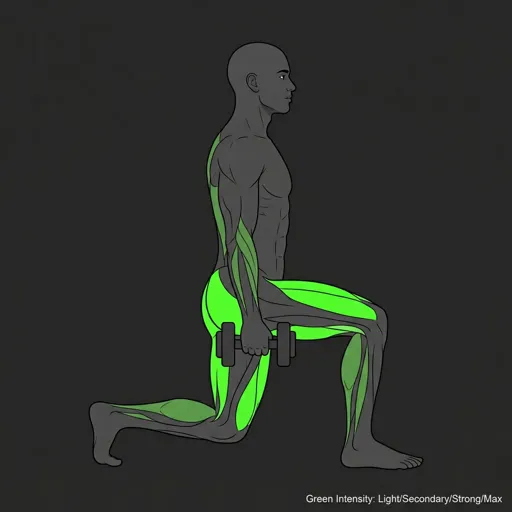
Step by step.
Stand upright with a dumbbell in each hand at your sides, neutral grip.
Step one foot straight back and lower until both knees reach roughly 90 degrees.
Keep your torso upright and your front shin close to vertical, knee over your midfoot.
Stop with the rear knee just above the floor, no crashing down.
Drive through the front heel to return to standing, bringing the rear leg forward.
Alternate sides or complete all reps on one leg before switching.
Dumbbells at your sides load a lunge in the most forgiving way there is. The weight hangs low, near your center of mass, so it steadies your balance where a bar racked high on your back would tip you. That makes the dumbbell reverse lunge the easiest loaded lunge to get right and to push hard, since you are not wrestling a barbell upright at the same time. It is the loaded step up from the bodyweight reverse lunge and a friendlier entry than barbell variations.
Keep the knee friendly mechanics that make reverse lunges worth doing in the first place. The backward step is what holds the front shin vertical and the knee out of trouble, so do not let the extra weight pull you into a forward crash. Step back under control, settle into the front heel, and stand by driving that heel down. The dumbbells should load the movement and nothing more.
Grip will eventually call your sets, and that is the cost of loading this way. As the dumbbells climb, the hands quit before the legs do. Straps fix it and let the legs be the limiter, which is what you want. It is also a hint you may be ready to put a bar on your back for heavier work, like dumbbell lunges done with a barbell instead.
Run 8 to 12 reps a leg. The low, stable load makes it a fine pick for building leg strength on the days your lower back needs a break from squatting.
Common questions.
The weight hangs low near your center of mass, which actually aids balance instead of fighting it the way a barbell on your back does. That makes a dumbbell reverse lunge the easiest loaded lunge to balance and to push hard. It is the simplest way to add resistance to single leg work without a balance penalty.
It should not. Keep the same backward step that keeps your front shin vertical and your knee safe, and just let the dumbbells load the movement. Step back under control, settle into the front heel, and stand by driving that heel down. If the weight pulls you into a forward crash, lighten it until the mechanics hold.
Often your grip. As the dumbbells get heavy, your hands tend to fail before your legs do. Straps let the legs be the limiter, which is the goal. When grip becomes a constant ceiling, it is also a hint you might load heavier by putting a barbell on your back instead.
Choose dumbbells when you want stability, easy scaling, and a lower back break, since the low held load is simple to balance and control. A barbell version lets you go heavier but is harder to balance and taxes the spine more. Many lifters use the dumbbell reverse lunge as their main lunge and save the bar for occasional heavy work.


Run the numbers.
One-rep max.
Estimate your max from any rep count. Five formulas, full percentage table.
Plate calculator.
What to load for any target weight, in lb or kg.
RPE calculator.
Convert rate of perceived exertion to training percentages.
Wilks score.
Bodyweight-adjusted total for comparing strength across weight classes.
DOTS score.
The IPF's newer bodyweight-adjusted scoring formula.
IPF GL points.
The IPF's official Goodlift score, in use at meets since 2020.
Volume calculator.
Weekly sets per muscle group, tonnage, and load management.
Strength ratio.
Screen your squat, bench, and deadlift to find the lift that is lagging.
Stop calculating.
Start tracking.
Log every set in RepRaptor. Free forever for lifters.