Reverse Lunge.
The reverse lunge steps backward instead of forward, which keeps the front shin more vertical and is far easier on the knees than a forward lunge. It builds the quads and glutes one leg at a time with only bodyweight to start.

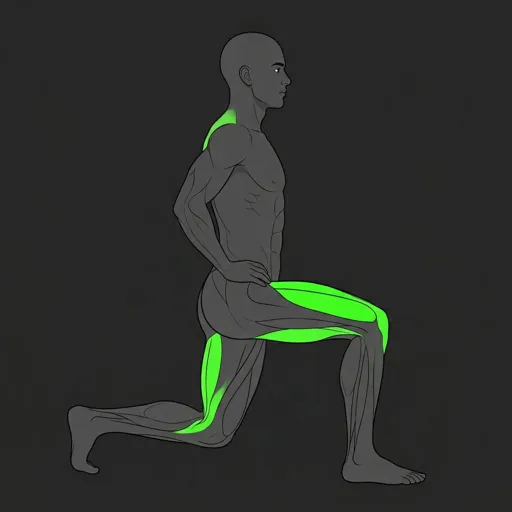
Step by step.
Stand tall with feet hip width, hands on your hips or at your sides.
Step one foot straight back and lower your hips until both knees reach about 90 degrees.
Keep your front shin close to vertical and your torso upright.
Let your rear knee hover just above the floor without slamming it down.
Drive through the front heel to push back to standing, bringing the rear foot forward.
Alternate legs or finish all reps on one side before switching.
Reverse lunges win on the knees. In a forward lunge your momentum carries the knee out over the toes as you land, and a lot of people feel that in the joint. Stepping backward keeps the front shin much more vertical and settles the weight into the front heel, so the knee stays happy. If forward lunges or dumbbell lunges bother your knees, this is the first swap to try.
It is also steadier, which makes it a great teaching lunge. Stepping back gives you a controlled descent instead of catching yourself on a forward fall, so it is easier to balance and easier to learn clean single leg mechanics. Beginners should own the reverse lunge before moving to harder unilateral work like the bulgarian split squat.
Control the back knee and drive the front heel. The two faults are crashing the rear knee into the floor and shoving off the back foot to stand. Lower the back knee under control to a hover just above the ground, then come up by pressing the front heel down so the front leg does the work. The back leg is mostly there for balance.
Groove the pattern with bodyweight first, then load it by holding dumbbells or racking a bar on your back, working 8 to 12 reps a leg. Few movements build single leg strength while treating the knees this kindly.
Common questions.
Generally, yes. Stepping backward keeps your front shin more vertical and settles your weight into the front heel, while a forward lunge drives the knee out over the toes as you land. That makes the reverse lunge a good option for anyone whose knees bark on forward lunges or dumbbell lunges. Keep the front heel planted to get the benefit.
Drive through the front heel. The front leg should do the work of standing back up, while the back leg mainly provides balance. Shoving off the rear foot turns it into a half rep and takes the load off the target leg. Think about pressing the floor away with the front heel to come up.
Very. Stepping back gives a controlled descent that is easier to balance than the forward fall of a standard lunge, so the movement is simpler to learn. Master the bodyweight reverse lunge first, then add dumbbells or a bar, and use it as the foundation before harder single leg work like the Bulgarian split squat.
Hold a dumbbell in each hand at your sides, or rack a barbell across your upper back once the bodyweight version is easy. Dumbbells are simpler to balance and easy to scale, while a bar lets you load heavier. Progress the load gradually as your single leg strength builds.


Run the numbers.
One-rep max.
Estimate your max from any rep count. Five formulas, full percentage table.
Plate calculator.
What to load for any target weight, in lb or kg.
RPE calculator.
Convert rate of perceived exertion to training percentages.
Wilks score.
Bodyweight-adjusted total for comparing strength across weight classes.
DOTS score.
The IPF's newer bodyweight-adjusted scoring formula.
IPF GL points.
The IPF's official Goodlift score, in use at meets since 2020.
Volume calculator.
Weekly sets per muscle group, tonnage, and load management.
Strength ratio.
Screen your squat, bench, and deadlift to find the lift that is lagging.
Stop calculating.
Start tracking.
Log every set in RepRaptor. Free forever for lifters.