Bicycle Crunch.
The bicycle crunch combines a crunch with a rotation and a pedaling leg motion, working the entire abdominal wall at once. It consistently ranks at the top of studies measuring ab activation, especially for the obliques.

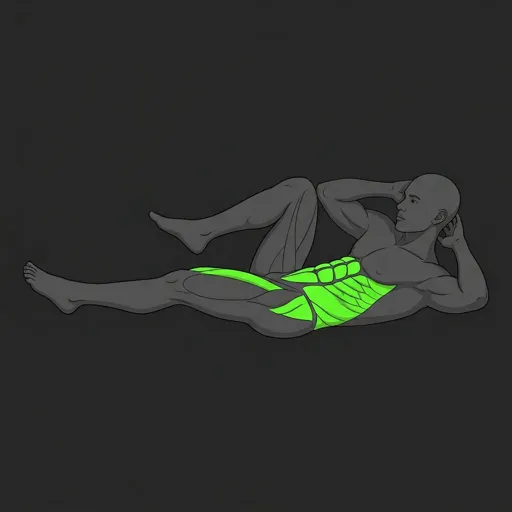
Step by step.
Lie on your back with your hands lightly behind your head and your legs raised, knees bent at 90 degrees.
Extend one leg straight out while rotating your torso to bring the opposite elbow toward the bent knee.
Switch immediately, extending the other leg and rotating the other elbow toward its opposite knee.
Keep your shoulder blades off the floor the entire time.
Move in a smooth pedaling rhythm rather than jerking side to side.
Each elbow to knee touch counts as one rep.
The bicycle crunch earns its reputation by working every part of the abs in one move. The crunch handles the upper abs, the pedaling legs pull in the lower abs and hip flexors, and the rotation fires the obliques. That mix is why it sits near the top of the well known ab activation studies, since few single exercises light up the whole abdominal wall so completely. It even captures the rotation a plain crunch skips, putting it in the same conversation as the russian twist for oblique work.
Speed is where it falls apart. Almost everyone rushes, throwing the elbows at the knees on momentum while the abs barely fire. Slow the pedal right down and actually rotate the torso, bringing the shoulder toward the opposite knee rather than just the elbow. A handful of slow, deliberate reps beats a frantic minute of flapping arms.
Your hands are there to support the head, with the lifting left to the abs. Crank on your neck to fake the crunch and you strain it while the abs coast. Lace the fingers loosely, keep the elbows wide, and let the head ride along with the torso. An aching neck afterward is the sign your hands did the work your abs should have.
Run 15 to 25 reps a side, or work to time, keeping the shoulder blades off the floor the whole set so the tension never drops. Judge the set by the burn in the abs and obliques, not by how fast you can pedal.
Common questions.
It consistently ranks at or near the top of studies measuring abdominal activation, especially for the obliques, because it combines a crunch, a leg pedal, and a rotation to hit the whole wall at once. That makes it one of the most efficient single ab moves, though variety still helps.
Almost always because you are going too fast. Flailing the elbows with momentum lets the arms and hip flexors carry it while the abs coast. Slow the pedal right down, rotate the torso to bring your shoulder toward the opposite knee, and keep your shoulder blades off the floor.
Rest your hands lightly behind your head with the fingers loose and the elbows wide, and lift from the abs. Hauling the head forward strains the neck and cheats the abs. If your neck aches afterward, your hands were doing the lifting your core should have been.
The bicycle crunch does more than rotate. It adds a crunch for the upper abs and a leg pedal for the lower abs on top of the oblique twist, covering the whole wall, while a russian twist stays seated, isolates rotation, and takes load easily. Run both and the abs get rotation plus everything else.


Run the numbers.
One-rep max.
Estimate your max from any rep count. Five formulas, full percentage table.
Plate calculator.
What to load for any target weight, in lb or kg.
RPE calculator.
Convert rate of perceived exertion to training percentages.
Wilks score.
Bodyweight-adjusted total for comparing strength across weight classes.
DOTS score.
The IPF's newer bodyweight-adjusted scoring formula.
IPF GL points.
The IPF's official Goodlift score, in use at meets since 2020.
Volume calculator.
Weekly sets per muscle group, tonnage, and load management.
Strength ratio.
Screen your squat, bench, and deadlift to find the lift that is lagging.
Stop calculating.
Start tracking.
Log every set in RepRaptor. Free forever for lifters.