Crunches.
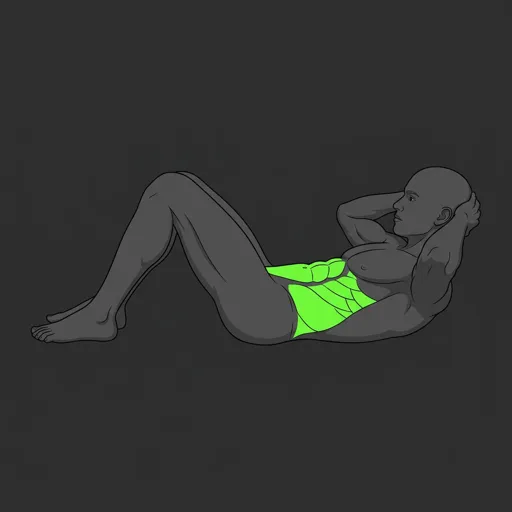
Crunches train the rectus abdominis through spinal flexion, lifting the shoulder blades approximately four inches off the floor while keeping the lower back pressed down. Range of motion is short. The lower back stays on the ground throughout.

Step by step.
Lie on your back with knees bent and feet flat on the floor about hip width apart. Rest your hands on the sides of your head, not laced behind your neck.
Press your lower back into the floor and keep it there for every rep. This is what makes the abs do the work instead of the hip flexors.
Keep your neck long and your chin off your chest, as if you were holding a tennis ball under it. The curl comes from your upper spine, not from pulling your head forward.
Curl your shoulder blades up off the floor, raising them about four inches. Your lower back stays pinned down the whole time.
Squeeze the abs and hold the top position for one full second instead of tapping and dropping.
Lower your shoulders back down under control until they touch the floor, then start the next rep without bouncing off the ground.
The crunch fails most people because they turn it into a neck exercise by pulling their head forward and calling it a rep. Hands on the sides of the head, not laced behind the neck. The head stays neutral, like you're holding a tennis ball under your chin. Neck stays long. The movement comes from the upper thoracic spine curling forward, not from chin-to-chest flexion.
Lower back pressed into the floor is non-negotiable. When the lower back loses contact, the hip flexors take over from the abs. You can feel the difference: lower back pinned down means the abdominals actually shorten to produce the movement. Let the back come up and the psoas does most of the work, which is already heavily loaded from sitting all day.
The contraction at the top is where the actual stimulus is. Shoulders four inches off the floor, hold it for one full second, not a fast tap. That isometric component at peak contraction is what differentiates a crunch from a bounce. In practice, 3 sets of 15-25 slow, controlled reps with a deliberate hold beats 3 sets of 50 sloppy reps every time.
One thing the exercise instructions don't say clearly enough: if your feet are hooked under a bench or held by a partner, that's for stability only. Anchoring the feet too aggressively and pulling against them turns the movement into a sit-up and brings the hip flexors back into the equation. Light foot contact, not a drag-yourself-up anchor.
Crunches stay easy forever if you only ever add reps. Once a weighted crunch feels light, move some of your core work to the hanging leg raise. It trains the same rectus abdominis from a dead hang and loads the lower portion the crunch barely reaches.
Common questions.
The concern about crunches and spinal health largely comes from Stuart McGill's research on spinal flexion and disc compression. McGill argues that repeated spinal flexion under load causes disc damage over time. His alternative prescriptions (dead bugs, bird dogs, planks) are legitimately good exercises. Still, most gym crunches involve very little axial load, and the population doing them is not doing thousands of flexion cycles under compression. The practical answer: crunches are fine for healthy people. If you have existing disc issues, spinal stenosis, or significant lower back pain, talk to a physio before loading spinal flexion. Otherwise, the evidence for harm in normal training volumes is thin.
A crunch lifts only the shoulder blades off the floor, keeping the lower back down and training spinal flexion through a short range. A sit-up brings the entire torso to vertical, requiring the hip flexors (iliopsoas) to do a significant portion of the work to bring the body past the point where the abs run out of leverage. Both train the abdominals, but the sit-up distributes load more broadly and puts more stress on the lower back at the bottom of the range. Crunches are more isolated; sit-ups have more carry-over to functional full-body flexion.
Fewer than you think, done better. The abdominals respond to progressive overload like any other muscle. Twenty slow, controlled reps with a one-second isometric hold at the top beats 100 fast reps where momentum does the work. When 3 sets of 20 becomes easy with strict form, add a progression: an incline bench (greater range against gravity), a weight plate held on the chest, or a cable crunch. Just doing more reps of the same easy movement produces diminishing returns quickly.
Stability ball crunches extend the range of motion by allowing the spine to arch back over the ball before curling up, which increases the stretch on the rectus abdominis at the bottom. That larger range can increase the training stimulus compared to a flat-floor crunch. The tradeoff is stability. The unstable surface forces more co-contraction to maintain position, which some people find helpful and others find distracting. If you have good balance and can maintain the movement quality, ball crunches are a legitimate progression. They're not magic, though. A weighted flat crunch done with control beats a sloppy ball crunch.


Run the numbers.
One-rep max.
Estimate your max from any rep count. Five formulas, full percentage table.
Plate calculator.
What to load for any target weight, in lb or kg.
RPE calculator.
Convert rate of perceived exertion to training percentages.
Wilks score.
Bodyweight-adjusted total for comparing strength across weight classes.
DOTS score.
The IPF's newer bodyweight-adjusted scoring formula.
IPF GL points.
The IPF's official Goodlift score, in use at meets since 2020.
Volume calculator.
Weekly sets per muscle group, tonnage, and load management.
Strength ratio.
Screen your squat, bench, and deadlift to find the lift that is lagging.
Stop calculating.
Start tracking.
Log every set in RepRaptor. Free forever for lifters.