Plank.
The plank is an isometric hold that trains the entire anterior core (rectus abdominis, internal and external obliques, and the deep stabilizers) without any spinal flexion. The goal is to resist gravity and maintain a rigid body position, not to move through a range of motion.

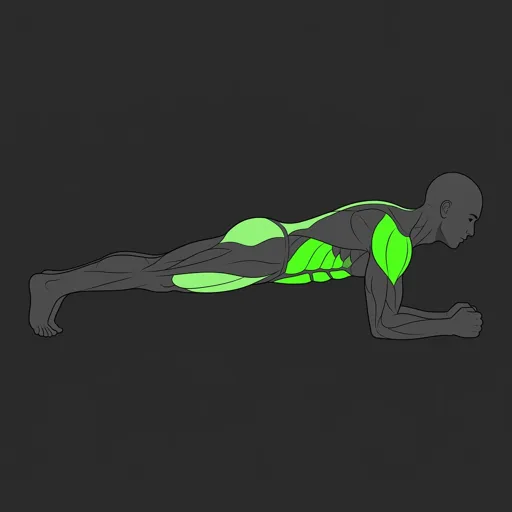
Step by step.
Get on the floor on your forearms and toes. Set your elbows directly under your shoulders with your forearms parallel and pointing forward.
Straighten your body into one rigid line from your heels to your head. The hips should neither sag toward the floor nor pike up into the air.
Tuck your tailbone slightly toward your heels to flatten the lower back, and squeeze your glutes. This keeps the lumbar spine from arching under the hold.
Brace your trunk hard, the way you would right before a cough, and hold that tension. Pull your forearms toward your feet without sliding them to lock the whole body in.
Squeeze your quads until your kneecaps lift, and keep your neck neutral by looking at a spot just past your hands. Breathe steadily through the hold instead of holding your breath.
Maintain the position for your target time, then lower under control. End the set the moment the hips start to drop or rise rather than grinding through broken form.
Most people either sag at the hips or pike them up, and they don't know it because they can't see themselves. Both are the same failure: the core isn't producing enough stiffness to hold the position, so the body finds a way to cheat. The fix isn't to try harder. Pull the floor toward you with your forearms (without actually moving them) and squeeze your quads hard enough that your kneecaps rise. The tension you feel is the whole-body irradiation that makes the plank actually work.
Elbow position matters more than most cues address. Elbows directly under the shoulders, forearms parallel or very slightly angled inward. When elbows drift forward of the shoulders, the load shifts from the abdominals toward the shoulder complex and the upper trap, which is not the goal.
Two real markers worth knowing: if you can hold a plank for over 90 seconds with good form, you don't need longer sets. You need harder progressions. Go to feet on a bench, a weighted plate on the lower back (15-25 lbs), or an RKC plank (elbows pulled toward feet, hips slightly posteriorly tilted, absolutely everything contracted). Those expose the gaps that long easy holds paper over.
Don't bother cueing "brace your core" without telling someone what that actually feels like. Have them cough. That involuntary contraction is close. Do that deliberately, hold it, and then get into position.
All this stiffness has a job outside the plank. It builds the brace you hold to keep a neutral spine under a heavy barbell squat, and drilling the plank hard is what makes that brace automatic once the bar loads your back.
Common questions.
Duration is secondary to quality. A 20-second plank with genuine whole-body tension is more useful than a 2-minute plank with a sagging lower back and relaxed glutes. Most research on core training suggests that shorter, harder holds produce better transfer to athletic and strength tasks than grinding through long easy holds. 3-5 sets of 20-45 seconds of genuinely hard effort is a reasonable target for most people. If you can hold 60+ seconds without any form breakdown, the progression is to make the exercise harder, not longer.
The forearm plank (elbows on the floor) reduces the lever arm and makes the exercise slightly more forgiving on the shoulders. The extended-arm plank (wrists under shoulders, straight arms) adds a rotational challenge because the wrists create a longer moment arm and the shoulder stabilizers have to work harder to prevent the body from rolling. For core training purposes, both are valid. The forearm plank tends to be the starting point; the extended-arm plank has more carryover to push-up strength. Neither is strictly better. They're different enough that training both is reasonable.
Lower back pain in the plank usually comes from lumbar extension. The hips have dropped and the lumbar spine is arching to compensate. Posterior-tilt the pelvis slightly by tucking the tailbone toward the ceiling. You're not looking for a big movement, just enough to flatten the lower back. If the pain persists after correcting hip position, the load may simply be too high. Drop to a knee plank or an incline plank with hands elevated on a bench, build the required stiffness at a lower load, and progress from there.
It builds anti-extension strength: the ability to resist forces that try to extend or arch the spine. That's a specific, trainable quality that carries over to deadlifts, squats, overhead pressing, and almost every sport. Whether it builds what most people think of as 'abdominal strength' (the ability to flex the spine under load) is a different question. Crunches and hanging leg raises do more of that. A complete core program has both: movements that resist extension (planks, dead bugs, ab wheel) and movements that train flexion (hanging leg raises, weighted crunches).


Run the numbers.
One-rep max.
Estimate your max from any rep count. Five formulas, full percentage table.
Plate calculator.
What to load for any target weight, in lb or kg.
RPE calculator.
Convert rate of perceived exertion to training percentages.
Wilks score.
Bodyweight-adjusted total for comparing strength across weight classes.
DOTS score.
The IPF's newer bodyweight-adjusted scoring formula.
IPF GL points.
The IPF's official Goodlift score, in use at meets since 2020.
Volume calculator.
Weekly sets per muscle group, tonnage, and load management.
Strength ratio.
Screen your squat, bench, and deadlift to find the lift that is lagging.
Stop calculating.
Start tracking.
Log every set in RepRaptor. Free forever for lifters.