Push-Ups.
The push-up is a bodyweight horizontal press that trains the chest, anterior deltoids, and triceps through the same pattern as a bench press. Hands about 36 inches apart, body held in a rigid plank, chest descends to just above the floor and presses back up.

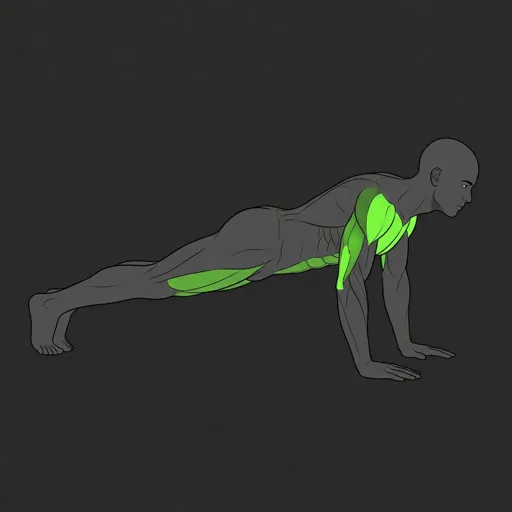
Step by step.
Set your hands on the floor about 36 inches apart, slightly wider than your shoulders, with the fingers spread and pointing forward. Step your feet back until your body forms one straight line from your head to your heels.
Squeeze your glutes and brace your abs so the hips neither sag toward the floor nor pike up toward the ceiling. This rigid plank is the position you hold for every rep.
Lower yourself by bending the elbows and letting them track back at roughly 45 degrees from your torso, not flared straight out to the sides. Keep the body line locked as you descend.
Bring your chest down until it is just above the floor. Your elbows should be at or just past 90 degrees at the bottom.
Press the floor away and drive back up until the arms are fully straight, keeping the plank rigid the whole way. Do not let the hips lag behind or shoot up first.
Pause briefly at the top with elbows locked, then begin the next rep. If your hips start to sag, you have reached your honest rep limit for the set.
The push-up is not a beginner exercise that you graduate from. Done correctly (hands at 36 inches, elbows tracking at 45 degrees from the torso, chest to the floor, full extension at the top, and a completely rigid body throughout) it's a demanding movement at any rep count. Most people's push-ups are not done correctly. The most common error is the half-rep with the hips sagging like a hammock and the elbows flaring out to 90 degrees. That's a very different exercise.
Elbow angle matters more than people think. Hands placed wide and elbows flaring out past 90 degrees from the torso puts the anterior deltoid and AC joint in a compromised position. Elbows tracking at 45 degrees (tucked partially in, not straight out to the sides) keeps the pec in the best mechanical position and takes stress off the shoulder joint. This is the same principle as the bench press cue "45-degree elbow angle."
Body position is where the real test of strength sits. The plank line from head to heels is either there or it isn't. Hips sagging means the abs have checked out. Hips piking upward means you're using the hips to cheat the lower range. Both are failures of body position that reduce the amount of work the pressing muscles actually do. If you can't maintain a plank for the whole set, you've found your actual rep limit regardless of what your arms want to do.
For progression: once you can do 3 sets of 20 clean reps, the standard push-up is no longer a challenging strength exercise for most people. Add difficulty by elevating the feet (shifts load toward upper chest and anterior delt), wearing a weighted vest, or transitioning to ring push-ups, which add instability and force the chest to do more stability work.
Common questions.
The standard is about 36 inches apart, which is wider than shoulder-width for most people. This places the elbows at roughly a 45-degree angle from the torso at the bottom of the movement, the same angle that minimizes shoulder stress in pressing movements. Narrower than shoulder-width turns it into a close-grip push-up that emphasizes the triceps. Wider than 36 inches reduces the range of motion and increases shoulder stress. The 36-inch standard works for most adults; adjust slightly based on shoulder width and comfort.
As a movement pattern, yes. They train the same muscles through nearly the same range of motion. As a progressive strength tool, they have limits. The problem is load: once you're strong enough to push your bodyweight easily for high reps, you can't easily add resistance the way you can add plates to a barbell. You can slow the tempo, add a weighted vest, elevate the feet, or move to ring push-ups to increase difficulty, but a barbell lets you add precise small increments over years. Push-ups are excellent for building base chest strength and are a legitimate substitute when equipment isn't available.
Usually an elbow angle problem. When the elbows flare straight out to the sides (90 degrees from the torso), the anterior deltoid handles more of the load than the chest. Bring the elbows in to 45 degrees relative to the torso (this is what 'elbows tucked' means) and the pec major comes back into play. Hand position can also contribute: if the hands are very close together, the movement becomes more triceps-dominant. Try a wider hand placement combined with the 45-degree elbow angle and see if the chest activation changes.
Past 20 reps with clean form, strength adaptations slow significantly. You're training endurance more than strength. To keep getting stronger, add resistance. A weighted vest is the most practical option. Alternatively, elevate your feet on a bench or box (this also shifts emphasis toward the upper chest and anterior delt). Ring push-ups add instability that increases pec activation even at the same bodyweight. For maximal pressing strength, add barbell work. The load increments and the mechanical similarity to the bench press make it a more direct strength builder above a certain rep threshold.


Run the numbers.
One-rep max.
Estimate your max from any rep count. Five formulas, full percentage table.
Plate calculator.
What to load for any target weight, in lb or kg.
RPE calculator.
Convert rate of perceived exertion to training percentages.
Wilks score.
Bodyweight-adjusted total for comparing strength across weight classes.
DOTS score.
The IPF's newer bodyweight-adjusted scoring formula.
IPF GL points.
The IPF's official Goodlift score, in use at meets since 2020.
Volume calculator.
Weekly sets per muscle group, tonnage, and load management.
Strength ratio.
Screen your squat, bench, and deadlift to find the lift that is lagging.
Stop calculating.
Start tracking.
Log every set in RepRaptor. Free forever for lifters.