Incline Dumbbell Press.
The incline dumbbell press targets the clavicular head of the pectoralis major, the upper chest region that sits between the collarbone and the lower pec. The incline angle also increases anterior deltoid involvement. It pairs well with flat pressing as a way to develop chest thickness and the shelf-like appearance of the upper pec.

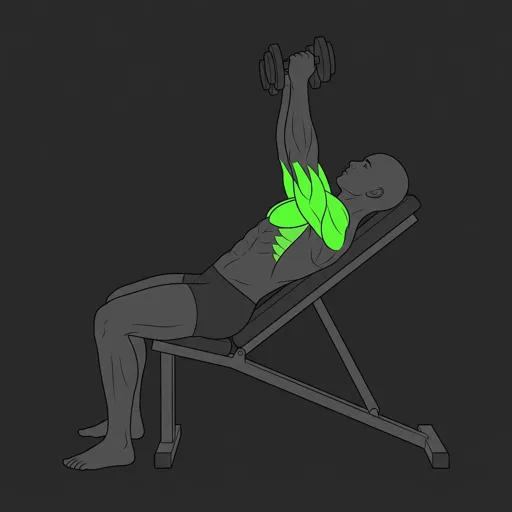
Step by step.
Set the bench to about 30 degrees of incline so the work stays on the upper chest. If the only options are 30 or 45, take the 30, since steeper angles hand the lift to the front delts.
Sit back against the pad with a dumbbell on each thigh, then kick one knee up at a time to bring the dumbbells to your shoulders as you lean into the bench.
Plant your feet, pull your shoulder blades down and back, and press both dumbbells up until the arms are straight above the upper chest with the palms facing forward.
Lower both dumbbells together under control until they reach near your armpits, not your lower chest, which is the correct bottom position for the inclined angle. Keep the elbows in line with the bench rather than drifting forward.
Press back up until the arms lock out over the upper chest, driving the dumbbells slightly together at the top so the chest does the work instead of the shoulders.
After the final rep, bring the dumbbells to your lower chest, sit up using your core, and set them down on your thighs.
Bench angle is the thing most people ignore and it changes what you're training. A 30-degree incline keeps most of the work on the upper chest. A 45-degree incline starts to shift the load toward the anterior deltoid. Above 60 degrees and you're essentially doing a shoulder press with a slight chest component. Most people set the bench at whatever notch is easiest to reach, which is usually 45 to 60 degrees, and then wonder why they feel the lift in their shoulders more than their chest.
Set it to 30 degrees if you can. If your bench only has 30 or 45, use 30. You'll feel the difference.
The other issue specific to this variation: the dumbbells have to travel further to get into position because you're sitting at an angle. The thigh-kick to get them up works here too, but the geometry is slightly different. From the inclined position, the dumbbells should land near your armpits at the bottom, not at your lower chest like they would on a flat bench. That's the correct bottom position for the incline angle.
Shoulder fatigue can creep in and mask chest fatigue on incline pressing. If your front delts are burning before your upper chest, the angle is probably too steep or your elbows are drifting too far forward. Elbows slightly back from the wrists at the bottom, in line with the bench angle. The chest should be the first thing that hits failure, not the shoulders.
Incline work covers the clavicular head up top, but it leaves the lower pec short. Run a dumbbell bench press on a flat bench the same week and the chest gets loaded from collarbone to sternum. To finish the upper chest with a stretch, the incline dumbbell flyes and the incline cable flye both isolate the clavicular head after this press.
Common questions.
Research and practical coaching both point to 30 degrees as the angle that maximizes clavicular head activation while minimizing anterior deltoid takeover. At 45 degrees, the anterior deltoid contribution increases substantially, and by 60 degrees it's mostly a shoulder press. The problem is most adjustable benches don't have a comfortable 30-degree notch. They skip from flat to a notch that puts you around 45. If that's what you have, use it, but know you're getting more anterior deltoid involvement. True 30-degree incline pressing is worth seeking out.
For upper chest development, they're comparable. The dumbbell version allows more range of motion at the bottom (dumbbells can go slightly wider and lower than a barbell), which increases the stretch on the pec. The barbell allows heavier loading. For most people training for hypertrophy, the extra range of motion with dumbbells is worth slightly less weight. If you're doing both, the dumbbell variation works well as a second movement after incline barbell, or as the primary incline press if barbell work bothers your shoulders.
Almost always the bench angle. Anything above 45 degrees tilts the movement into shoulder territory. The second most common cause is elbows drifting too far forward at the bottom. If your elbows are in front of your wrists rather than below them, the shoulder takes over the bottom position. Try dropping the bench to 30 degrees and focus on letting the elbows fall back and slightly out at the bottom rather than in front. If you still feel mostly shoulder, try pausing for a full second at the bottom and squeezing the chest before pressing. That re-establishes the mind-muscle connection.
Same thigh-kick method as the flat bench, just accounting for the angle. Sit on the bench with the dumbbells on your thighs. Kick one knee up sharply to pop the first dumbbell to shoulder level as you lean back, then do the same with the second. The bench angle actually helps a little here because gravity pulls you back naturally. Coming out of the set: lower the dumbbells to your lower chest area, sit up using your core, and drop them to the floor on your sides. Don't try to hold them while you sit up from a high incline. It's awkward and risky if you've trained to failure.


Run the numbers.
One-rep max.
Estimate your max from any rep count. Five formulas, full percentage table.
Plate calculator.
What to load for any target weight, in lb or kg.
RPE calculator.
Convert rate of perceived exertion to training percentages.
Wilks score.
Bodyweight-adjusted total for comparing strength across weight classes.
DOTS score.
The IPF's newer bodyweight-adjusted scoring formula.
IPF GL points.
The IPF's official Goodlift score, in use at meets since 2020.
Volume calculator.
Weekly sets per muscle group, tonnage, and load management.
Strength ratio.
Screen your squat, bench, and deadlift to find the lift that is lagging.
Stop calculating.
Start tracking.
Log every set in RepRaptor. Free forever for lifters.