Cable Crossover.
The cable crossover trains the chest through horizontal adduction with constant cable tension. Starting with arms extended wide from high pulleys, the arms sweep down and together in front of the lower chest, with only shoulder joint movement and a slight elbow bend maintained throughout.

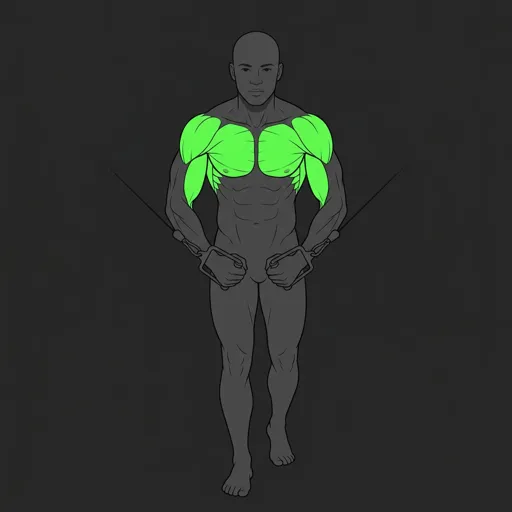
Step by step.
Set both pulleys high, above head height, and attach a single handle to each. Grab a handle in each hand and take a step forward into the middle of the station.
Stagger your feet for balance and lean forward from the hips about 15-20 degrees with your chest up. Let your arms open wide so you feel a stretch across the chest.
Set a slight bend in your elbows, around 10-15 degrees, and lock that angle in place for the whole set. The elbows do not bend any further as you move.
Sweep your arms down and together in an arc, bringing your hands toward each other in front of your lower chest. Move only at the shoulders, like rigid arms swinging through space.
Bring the hands together and squeeze the chest hard at the contracted position, where the cable keeps pulling. Hold the squeeze for a beat.
Let the arms open back out slowly under control, returning to the wide stretched start. Keep the elbow angle and the forward lean fixed the entire time.
The elbow angle is fixed for the entire set. You set a slight bend at the start (maybe 10-15 degrees) and that angle does not change. The elbows should not be pulling the cables together; if the elbows are bending more as the arms come together, the biceps are contributing and the pec is getting an easier ride. Think of the arms as rigid arcs sweeping through space. The shoulder joint is the only thing moving. This is the hardest part of the exercise to maintain as weight increases, and the most common reason people load cable crossovers too heavy.
The forward torso lean is structural, not optional. Leaning forward from the hips (maybe 15-20 degrees) creates the mechanical condition where pulling the cable handles together in front of you is actually horizontal adduction of the shoulder. Standing completely upright and pulling the handles together turns it into a different movement closer to a front delt exercise. The lean puts the cable line in the right position relative to the pec's fiber direction.
The most productive part of the cable crossover is the contracted position, hands together in front of the body, where the pec major is shortened and working against the continued resistance of the cable. At the bottom of a dumbbell fly, the pec has no load. The cable maintains resistance throughout, including at the point where the pec is fully shortened. That's what justifies the cable crossover as a distinct exercise rather than just a cable fly substitute.
One thing worth noting: crossing the hands at the bottom, so one hand finishes above the other, allows a slightly greater range of shoulder adduction and a stronger pec contraction at the finish. Some people feel this is a stronger mind-muscle connection. It requires alternating which hand crosses on top each set, but it's a legitimate technique rather than a form error.
Common questions.
The resistance profile is the main difference. Dumbbell flyes have maximum tension at the bottom of the arc (arms extended wide) and near-zero tension at the top when the dumbbells meet above the chest. Cable crossovers from high pulleys maintain significant tension throughout the entire arc, including at the finish when the hands meet in front of the body. This constant tension at the contracted position is why cable crossovers are generally preferred for chest isolation work. The pec stays loaded where it's actually shortened.
High, above head height. This positions the cable line so that pulling the handles downward and together creates horizontal shoulder adduction, which matches the lower pec fiber direction and produces a strong contraction at the finish. Lower pulleys change the force vector. Setting them at chest height turns it more into a pure horizontal movement (closer to a cable fly), and setting them very low makes it a chest-high sweep that targets the upper pec fibers. High pulley crossovers are the default and train the sternal head of the pec major most directly.
Relatively light weight, yes. But high reps for the sake of it isn't the goal. A weight you can control through the full arc without the elbows bending more or the torso swinging is the correct weight. That often lands in the 8-15 rep range naturally. The cable crossover is typically programmed after heavier pressing work as a finisher or isolation exercise, so the pec is already fatigued and the load required to get productive training effect is lower than it would be fresh.
Usually the torso is too upright. Without the forward lean from the hips, the cable pull angle becomes more of a front-to-back movement that the anterior deltoid handles. Lean forward 15-20 degrees from the hips and keep the chest up. The cable should be pulling you backward, not upward. The other cause is elbows bending during the movement, which shifts the load to the biceps and reduces the pec's contribution. Lock in the elbow angle first, then add the forward lean.


Run the numbers.
One-rep max.
Estimate your max from any rep count. Five formulas, full percentage table.
Plate calculator.
What to load for any target weight, in lb or kg.
RPE calculator.
Convert rate of perceived exertion to training percentages.
Wilks score.
Bodyweight-adjusted total for comparing strength across weight classes.
DOTS score.
The IPF's newer bodyweight-adjusted scoring formula.
IPF GL points.
The IPF's official Goodlift score, in use at meets since 2020.
Volume calculator.
Weekly sets per muscle group, tonnage, and load management.
Strength ratio.
Screen your squat, bench, and deadlift to find the lift that is lagging.
Stop calculating.
Start tracking.
Log every set in RepRaptor. Free forever for lifters.