Dumbbell Bench Press.
The dumbbell bench press trains the same chest, anterior delt, and tricep pattern as the barbell version, but each arm moves independently. That independence increases the range of motion at the bottom, forces both sides to work equally, and removes the fixed bar path that can aggravate shoulder issues in some lifters.

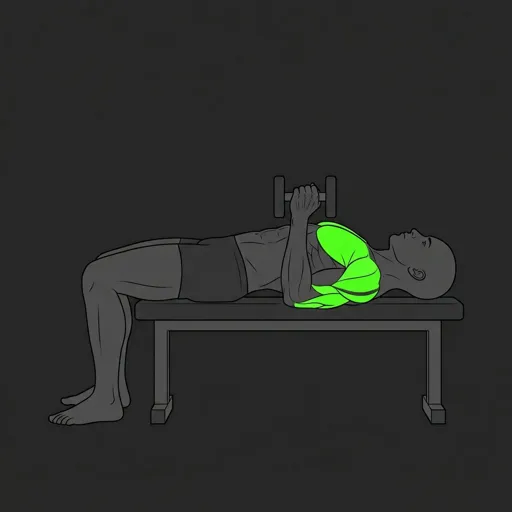
Step by step.
Sit on the end of a flat bench with a dumbbell standing on each thigh. Kick one knee up at a time to pop the dumbbells to your shoulders as you lie back, so they end up at chest level with no wasted effort.
Lie flat with your feet planted, pull your shoulder blades down and together, and press both dumbbells up until the arms are straight over your chest with the palms facing forward.
Set your elbows at roughly 45 to 75 degrees from your torso, not flared straight out and not tucked all the way in.
Lower both dumbbells together under control until they reach around chest level with the forearms vertical. Let them travel a touch wider and lower than a bar would, so the chest gets a deep stretch.
Press the dumbbells back up and slightly together until the arms lock out, keeping both sides moving evenly. If one arm lags or you wobble to one side, the weight is too heavy.
After the last rep, bring the dumbbells to your chest, sit up using your core, and set them back down on your thighs rather than dropping them while lying flat.
Getting the dumbbells into position is genuinely awkward and it's where most beginners waste energy or drop a dumbbell on themselves. The safe way: sit on the edge of the bench with the dumbbells resting on your thighs, then use a sharp knee kick to pop each one up to shoulder level as you lie back. On the way down, reverse it. Don't try to lower them slowly to the floor while lying flat. Sit up first. It sounds obvious but a lot of people skip it and then wonder why they feel destroyed before the set even starts.
At the bottom of the rep, the dumbbells should be around chest level with your forearms vertical. The difference from a barbell is that you can let the dumbbells come slightly wider and lower than a barbell would allow. That's actually the point. You'll feel a deeper stretch in the pec, and that range of motion at the bottom is where the growth stimulus concentrates. Don't cut it short.
The independent movement also means you'll quickly find out if one side is meaningfully stronger than the other. Don't use the stronger arm to compensate. If you're wobbling to one side or one rep is visibly different from the other, go lighter and address it rather than grinding through it with bad mechanics.
One thing worth knowing: the instability of dumbbells recruits more stabilizer activity from the rotator cuff and serratus anterior than a barbell does. That's a feature, not a bug, especially for shoulder health. But it also means you can't go as heavy as a barbell bench. Trying to match barbell numbers with dumbbells usually ends with someone getting a dumbbell dropped on their face. Roughly 80% of your barbell working weight per dumbbell is a reasonable starting conversion.
Common questions.
The standard cue is palms facing forward (pronated grip) throughout the press, which closely mimics the barbell position and keeps the elbows at the appropriate angle. Some lifters prefer a neutral grip (palms facing each other) because it reduces stress on the shoulder at the bottom. Both are valid. The pronated grip recruits more of the pec major in its horizontal adduction function. The neutral grip often feels more comfortable and has good crossover to pressing movements that use a neutral handle. If you have shoulder discomfort with the standard grip, try neutral. You're not missing meaningful chest stimulus.
About 45 to 75 degrees from the torso, same guideline as the barbell press. Fully flared elbows (out at 90 degrees) put the shoulder capsule in an impingement-prone position at the bottom of the movement. Elbows tucked fully in (close to the body) turns it into a tricep-dominant movement. Somewhere in the middle puts the most load on the pectorals where the leverage is good. For reference: at the bottom of the rep, your upper arms should form roughly a 45-degree angle with your torso when viewed from above.
They are shakier, by design. The instability comes from the lack of a fixed bar connecting both hands, which means each arm must control its own path independently. Your rotator cuff, serratus anterior, and smaller shoulder stabilizers are working harder than they would with a barbell. This is usually most noticeable in the first few sessions when you switch from barbell to dumbbells, or if you're training with dumbbells for the first time. It settles as those muscles strengthen. If the dumbbells are shaking so much you can't control them at all, the weight is too heavy.
For hypertrophy, yes. The dumbbell press recruits the pec through a longer range of motion and may produce similar or better growth stimulus at equivalent relative intensities. For maximum strength expression, the barbell is better because it's more stable, allows heavier loading, and the strength transfers more directly to barbell movements. Barbell bench press is also what gets tested in powerlifting. If pure strength is the goal, keep the barbell. If shoulder health, muscle balance, or chest development is the priority, dumbbell pressing has real advantages. Most people benefit from doing both.


Run the numbers.
One-rep max.
Estimate your max from any rep count. Five formulas, full percentage table.
Plate calculator.
What to load for any target weight, in lb or kg.
RPE calculator.
Convert rate of perceived exertion to training percentages.
Wilks score.
Bodyweight-adjusted total for comparing strength across weight classes.
DOTS score.
The IPF's newer bodyweight-adjusted scoring formula.
IPF GL points.
The IPF's official Goodlift score, in use at meets since 2020.
Volume calculator.
Weekly sets per muscle group, tonnage, and load management.
Strength ratio.
Screen your squat, bench, and deadlift to find the lift that is lagging.
Stop calculating.
Start tracking.
Log every set in RepRaptor. Free forever for lifters.