Dumbbell Flyes.
Dumbbell flyes isolate the pectoralis major through a wide arc of shoulder horizontal adduction. Unlike pressing movements, the triceps are almost entirely removed from the equation, putting the mechanical load directly on the chest through a long range of motion, particularly in the stretched position.

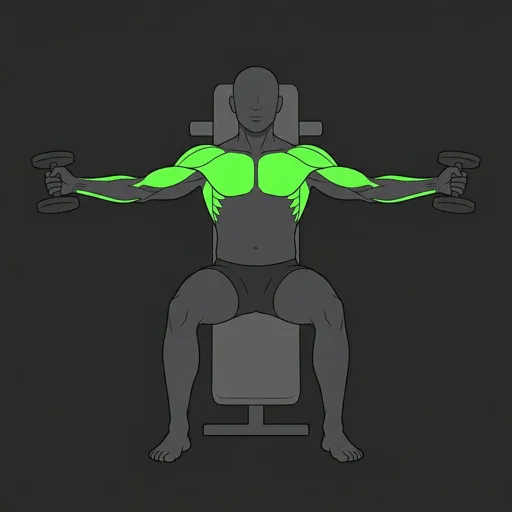
Step by step.
Lie back on a flat bench with a dumbbell in each hand and your feet planted on the floor. Press the weights up over your chest so your arms point at the ceiling and your palms face each other.
Set a soft bend of about 10 to 15 degrees at each elbow and lock that angle in. You hold this same bend for the whole set, so the elbows never straighten and never collapse further.
Open your arms out to the sides in a wide arc, lowering the dumbbells in a slow controlled path. Think about hugging a large barrel rather than letting the elbows flare out to press.
Stop when your upper arms reach roughly parallel to the floor and you feel a deep stretch across the chest. Hold that stretched bottom for a full second under control.
Squeeze the pecs and bring the dumbbells back up along the same arc until they meet over your chest. Drive the movement from the chest, not the hands.
Keep the load light to moderate so you stay in control of the arc at every point. If the weights drop toward the floor with momentum, the chest has stopped doing the work.
Understand what a fly is before you load it: it's a stretch-loaded isolation movement, not a pressing movement with wide arms. The difference matters. A fly should feel like you're hugging a large barrel. The arc goes wide, the chest gets a deep stretch at the bottom, then the arms come back together. If it feels like a press where you open your elbows out, you're pressing, not flying. Those are different exercises that train different mechanics.
The elbow bend is fixed throughout the set, not variable. Set a soft bend of about 10 to 15 degrees before you lower the weight, and maintain that angle to the bottom and back. The elbow bend is there to take the load off the biceps tendon at the stretched position. Some people progressively straighten their arms on the way down thinking it increases the stretch. It does, but it also puts the biceps tendon under a shear load it isn't designed for. Keep the angle constant.
Weight selection here is where people go wrong in the other direction. Flyes are a light-to-moderate load movement for most people. If you're going heavy enough that you can't control the arc and the dumbbells are dropping toward the floor with momentum, you've turned it back into a pressing movement with terrible mechanics. Pick a weight where you feel genuine chest tension throughout the entire arc, including at the very bottom of the stretch. If you can't feel the chest at the bottom, either the weight is too heavy or your lat and shoulder are handling the load instead of the pec.
Pause at the bottom. One full second with the chest in a stretched position under load is worth more than three reps done fast.
The one place the dumbbell fly goes quiet is the top, where the arms point straight up and gravity stops fighting you. If you want tension all the way into the squeeze, run a cable crossover instead, since the line of pull stays on the chest through the whole arc.
Common questions.
They train the same action (horizontal adduction) but the resistance curve differs. With dumbbells, the load peaks at the bottom of the arc (stretched position) when the leverage is worst, and almost disappears at the top when the arms are vertical and gravity offers almost no resistance. With cables, the load is more consistent throughout the arc. You feel resistance at the top of the movement too. If chest stretch is the priority, dumbbell flyes are excellent. If consistent tension through the full range is the priority, cables win. Most programs benefit from having both.
Lower until you feel a genuine stretch across the chest and front shoulders, which for most people is when the upper arm is roughly parallel to the floor or slightly below. Going dramatically below parallel (dumbbells near the floor) isn't more productive and puts the shoulder capsule at a mechanical disadvantage under load. The sensation at the bottom should be a strong chest stretch, not shoulder joint discomfort. If your shoulders ache at the bottom before the chest is stretched, stop at the point of discomfort and work on shoulder mobility separately.
Yes, and actively squeeze the pecs as the arms come together. The top position is where the chest is in its shortened (contracted) position, and actively squeezing there adds a brief isometric contraction. Some people stop just short of touching the dumbbells. That's fine. The point is to bring the arms close enough that the pec is actually shortened, not to clink the weights together. Letting the arms collide with momentum at the top doesn't add anything.
No. Flyes are an accessory movement and a pressing movement is a compound movement. They're not interchangeable. Pressing moves more total weight, recruits the triceps and anterior delt as synergists, and creates more total mechanical tension on the chest. Flyes isolate the pec through a wide arc but at much lower absolute loads. A useful analogy: flyes can supplement and refine a pressing-based program but they can't replace the stimulus that heavy pressing provides. The typical programming sequence is pressing first (when you're fresh), flyes later in the session as accessory work.


Run the numbers.
One-rep max.
Estimate your max from any rep count. Five formulas, full percentage table.
Plate calculator.
What to load for any target weight, in lb or kg.
RPE calculator.
Convert rate of perceived exertion to training percentages.
Wilks score.
Bodyweight-adjusted total for comparing strength across weight classes.
DOTS score.
The IPF's newer bodyweight-adjusted scoring formula.
IPF GL points.
The IPF's official Goodlift score, in use at meets since 2020.
Volume calculator.
Weekly sets per muscle group, tonnage, and load management.
Strength ratio.
Screen your squat, bench, and deadlift to find the lift that is lagging.
Stop calculating.
Start tracking.
Log every set in RepRaptor. Free forever for lifters.