Incline Cable Flye.
The incline cable flye trains the upper chest with constant tension from low pulleys, hitting an arc that dumbbells cannot match. The cables keep load on the muscle even at the top, where free weight flyes go slack.

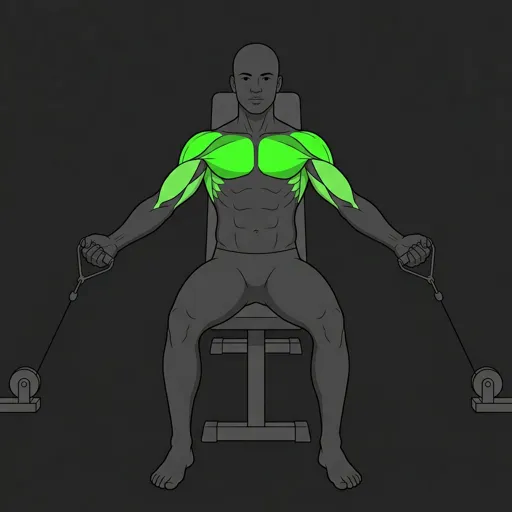
Step by step.
Set both pulleys low, near the floor, and place an incline bench between them at roughly 45 degrees.
Grab a handle in each hand, sit back on the bench, and bring your hands together at arms length over your face.
With a fixed soft bend in the elbows, open your arms out and down in a wide arc until you feel a deep stretch.
Keep the movement at the shoulder only. The elbows do not bend and unbend.
Squeeze the chest to pull the handles back together along the same arc, crossing slightly at the top.
Hold the peak for a beat where the cables are still pulling, then lower under control.
Cables fix the dead spot. At the top of a dumbbell flye your arms point straight up, gravity pulls straight down, and the tension on the chest more or less vanishes right where you are squeezing hardest. A low pulley pulls sideways and up instead, so the chest stays loaded through the whole arc, the contracted top included. Constant tension is what you are buying when you choose cables over the free weight version.
The crossover at the top earns its place in the rep. Because the cables let your hands pass the midline, you get a harder peak contraction than dumbbells can give, where the bells would just collide. Let one hand drift slightly over the other at the top, swap which one leads each set, and actually squeeze there.
Setup is finicky and worth dialing in. Set the pulleys too high and you turn this into a high to low movement that hits the lower chest. Keep them low, put the bench around 45 degrees, and sit far enough forward that the cables track in line with your upper pec. A steeper bench works here than it would with dumbbells, because the pull arrives up from the floor rather than straight down, so the upper chest keeps the load instead of surrendering it to the front delt. If the angle feels off, it usually is, so fix it before you load up.
Think of it as polish on an upper chest session. Once the heavy pressing is done, run it for 12 to 20 and chase the squeeze rather than the load. It sits perfectly next to the cable crossover on a pump day, since both earn their keep from constant tension.
Common questions.
Cables hold tension on the chest through the whole range, the top included, where a dumbbell flye goes slack because the weight points straight down. They also let your hands cross the midline for a stronger peak. Dumbbells still own the loaded stretch at the bottom, so the two cover different jobs.
Low, near the floor, with the bench around 45 degrees so the cables pull up and across the upper chest. Because the pull comes from below, that steeper angle still loads the upper pec rather than the delts. Set the pulleys high and it becomes a high to low movement that hits the lower chest instead.
No, this is pump and isolation work. The value is constant tension and a hard squeeze, so it belongs after your pressing as a finisher around 12 to 20 reps. Grinding it heavy just turns it into a bad press.
Yes, slightly. The cables let your hands pass the midline, which a dumbbell flye cannot, and that extra travel gives a stronger contraction. Let one hand drift over the other at the top and swap the lead each set so you stay even. Keep it controlled.


Run the numbers.
One-rep max.
Estimate your max from any rep count. Five formulas, full percentage table.
Plate calculator.
What to load for any target weight, in lb or kg.
RPE calculator.
Convert rate of perceived exertion to training percentages.
Wilks score.
Bodyweight-adjusted total for comparing strength across weight classes.
DOTS score.
The IPF's newer bodyweight-adjusted scoring formula.
IPF GL points.
The IPF's official Goodlift score, in use at meets since 2020.
Volume calculator.
Weekly sets per muscle group, tonnage, and load management.
Strength ratio.
Screen your squat, bench, and deadlift to find the lift that is lagging.
Stop calculating.
Start tracking.
Log every set in RepRaptor. Free forever for lifters.