Pull-Ups.
The pull-up is a vertical pulling movement done with a pronated (overhand) grip. From a dead hang with a slight torso lean, shoulders and upper arms drive down and back to pull the chest to the bar, fully contracting the lats at the top.

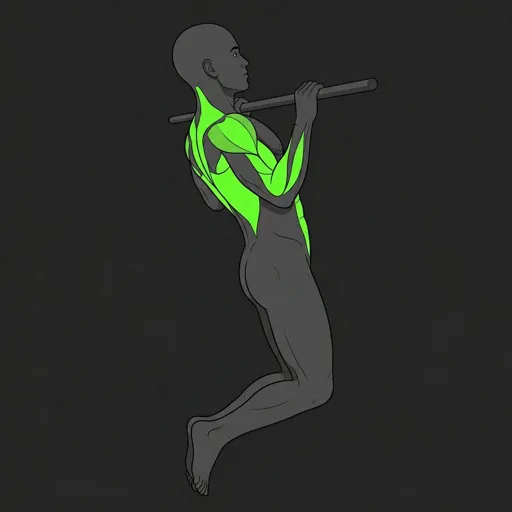
Step by step.
Grip the bar with an overhand grip about shoulder width to slightly wider, palms facing away. Wrap the thumbs around the bar.
Hang from straight arms in a full dead hang, then pull your shoulders down away from your ears to take the slack out of the lats before you move.
Lean back about 30 degrees from vertical with a slight arch and the chest pushed up, so the lats line up with the direction of the pull.
Drive your elbows down and back to pull yourself up, leading with the chest rather than yanking with the arms, until the bar meets your upper chest.
Squeeze the shoulder blades down and together at the top, holding the contraction for a beat.
Lower yourself under control all the way back to a full dead hang with straight arms before the next rep. Do not stop short with bent elbows at the bottom.
The dead hang at the bottom isn't just a rest position. It's where most people give up range of motion. Partial pull-ups that stop with a bent elbow at the bottom are easier, but they cut out the portion of the movement where the lat is most stretched and most stimulated. Full extension at the bottom, every rep. If you can't complete full reps with full extension, you need fewer reps or assistance.
The torso lean described here (about 30 degrees back from vertical, with a slight arch and the chest pushed forward) is not the same as swinging. It's a deliberate setup position that creates a better angle for the lat to do its job. In a perfectly vertical body position, the pull-up becomes more arm-dominant and less lat-dominant. The 30-degree lean puts the lat in line with the direction of pull and lets the shoulder blades retract and depress properly at the top.
At the top, the checkpoint is bar-to-upper-chest contact, not chin-over-bar. Chin over bar requires less pull. Getting the bar to touch the upper chest means you've done a full contraction and your shoulder blades are actually retracted and depressed. Not many people can do this with 20+ reps, but it's the right target for strength work.
If you can't do a single unassisted pull-up, the fastest path is a combination of band-assisted pull-ups (not machine-assisted, which changes the strength curve significantly) and eccentric-only reps. Jump to the top position and lower yourself to a full hang over 5-8 seconds. Three sets of 3-5 slow eccentrics builds the pulling strength faster than most other approaches.
If you can't yet own a single rep, the lat pulldown is the loadable stand in. Set it below your bodyweight, drill the same pulling pattern, and creep the weight up until your first clean rep on the bar is in reach.
Common questions.
Grip. Pull-ups use an overhand (pronated) grip with palms facing away from you; chin-ups use an underhand (supinated) grip with palms facing toward you. Pull-ups load the lats and rear delts more with the shoulder externally rotated under load. Chin-ups involve the biceps more and many lifters find them slightly easier because the supinated grip creates a better mechanical advantage at the elbow. Both are valid pulling exercises. Most programs that list 'pull-ups' mean the overhand version.
Shoulder-width to slightly wider. Very wide-grip pull-ups reduce the range of motion significantly because the shoulder can't extend as far before the anatomical position is reached. They're often described as more lat-focused, but the shorter range of motion undermines that claim. Shoulder-width grip gives the full range of motion and is easier on the shoulder joint. Going wider than about 1.5x shoulder-width doesn't add meaningful benefit and starts to stress the shoulder capsule in a compromised position at the bottom.
Almost always a lat engagement problem. If you initiate the pull by flexing the elbow (pulling with the arms), the biceps take over and the lats never fire properly. The fix: start each rep by depressing the scapula first. Before you bend the elbows, think 'pull your shoulder blades into your back pockets' or 'protect your armpits.' That cue fires the lat and the lats connect the upper arm to the lower back, so once they're engaged, they take the majority of the load. The elbows bend as a consequence of the lat pulling, not as the initiating movement.
Work in the 3-5 rep range across multiple sets with full rest between them. Don't try to hit a high rep count in one set. Five sets of 3 with 2-3 minutes rest will add reps faster than grinding to failure once. Supplement with slow eccentrics: jump to the top of the pull-up and take 5-8 seconds to lower yourself to a dead hang. Eccentrics build pulling strength even when you can't complete concentric reps yet. Add one rep to your best set each week. That rate of progress adds up to 50+ reps in a year.


Run the numbers.
One-rep max.
Estimate your max from any rep count. Five formulas, full percentage table.
Plate calculator.
What to load for any target weight, in lb or kg.
RPE calculator.
Convert rate of perceived exertion to training percentages.
Wilks score.
Bodyweight-adjusted total for comparing strength across weight classes.
DOTS score.
The IPF's newer bodyweight-adjusted scoring formula.
IPF GL points.
The IPF's official Goodlift score, in use at meets since 2020.
Volume calculator.
Weekly sets per muscle group, tonnage, and load management.
Strength ratio.
Screen your squat, bench, and deadlift to find the lift that is lagging.
Stop calculating.
Start tracking.
Log every set in RepRaptor. Free forever for lifters.