Kettlebell Single Arm Row.
The kettlebell single arm row trains one side of the back at a time, hinged over with the free hand braced on a bench or knee. The offset load and the deep hang of the kettlebell challenge the lats, grip, and trunk together.

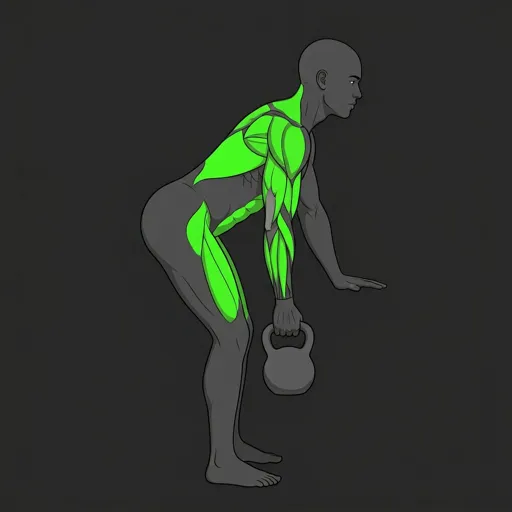
Step by step.
Hinge at the hips with feet about hip width and place your non working hand on a bench or your thigh for support.
Hold a kettlebell in the working hand at arms length, back flat and core braced. This is the start.
Row the kettlebell toward your hip by driving the elbow up and back, not out to the side.
Squeeze the lat at the top and hold for a beat.
Lower under control to a full stretch at the bottom, letting the shoulder blade reach forward.
Finish all reps on one side before switching. Keep the torso from twisting open.
Single arm rowing is the most honest way to find and fix a weak side. With both hands on a bar your stronger lat can quietly shoulder more of the load, but one kettlebell at a time leaves it nowhere to run. If your one arm dumbbell row already exposed a gap between sides, this is the same fix with a tool that hangs lower and bites your grip harder. Train the weaker side first and match the stronger side to it.
The kettlebell earns its keep at the bottom. Its mass sits below the handle, so it hangs deeper than a dumbbell and gives the lat a longer stretch at full extension. Let it tug your shoulder blade forward down there, then row out of that stretch. The deeper hang is why you reach for a kettlebell here when you have the choice.
Drive the elbow toward your hip pocket and keep it there. A hip directed pull keeps the lat as the prime mover, while flaring the elbow wide turns the rep into a rear delt and mid back movement. Decide which one you want and aim the elbow accordingly. For lat thickness, hip pocket every rep.
Keep the trunk locked. The biggest fault is letting the torso rotate open to heave the weight up, which trades back work for a twist your spine never asked for. Run it for 8 to 12 with a real squeeze, and the day you cannot stay square is the day the kettlebell is too heavy.
Common questions.
Rowing one side at a time stops a stronger side from carrying the load, so each lat does its own work. That uncovers and corrects left to right gaps a barbell hides. Bracing the free hand also takes strain off the lower back. Train the weaker side first and match the other to it.
For the stretch, often yes. A kettlebell hangs lower than a dumbbell because its weight sits below the handle, giving the lat a longer stretch at the bottom, and it taxes grip more. A dumbbell works fine too, so use what you have, but the bell adds a little range and grip demand.
Toward your hip pocket, driving the elbow up and back rather than flaring it out. A hip directed pull keeps the lat as the main mover, while a wide flared elbow shifts the work to the rear delts and mid back. Aim the elbow at whatever you want to train.
You are using rotation to help lift the weight. Letting the torso open trades back work for a spinal twist and usually means the load is too heavy. Brace your core, keep your shoulders square to the floor, and row in a controlled 8 to 12 range. Still twisting? Drop the weight.


Run the numbers.
One-rep max.
Estimate your max from any rep count. Five formulas, full percentage table.
Plate calculator.
What to load for any target weight, in lb or kg.
RPE calculator.
Convert rate of perceived exertion to training percentages.
Wilks score.
Bodyweight-adjusted total for comparing strength across weight classes.
DOTS score.
The IPF's newer bodyweight-adjusted scoring formula.
IPF GL points.
The IPF's official Goodlift score, in use at meets since 2020.
Volume calculator.
Weekly sets per muscle group, tonnage, and load management.
Strength ratio.
Screen your squat, bench, and deadlift to find the lift that is lagging.
Stop calculating.
Start tracking.
Log every set in RepRaptor. Free forever for lifters.