Lat Pulldown.
The wide-grip lat pulldown trains the latissimus dorsi through a long pulling arc using a cable machine. It is one of the primary substitutes for pull-ups when bodyweight pulling is not yet accessible, and a staple accessory movement for back width even when pull-ups are already in the program.

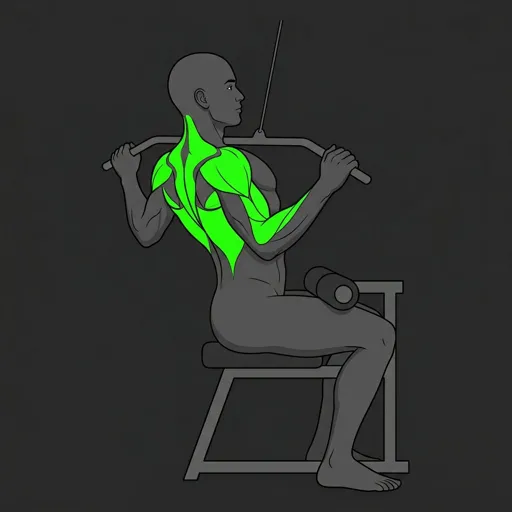
Step by step.
Set the thigh pad so it locks your legs down and stops you lifting off the seat. Grab the bar a little wider than shoulder width with an overhand grip.
Sit down with your arms extended overhead and let the weight stretch the lats at the top. Set your chest tall and lean back about 30 degrees, then hold that torso angle for the whole set.
Pull the bar down by driving your elbows toward your back pockets. Think about leading with the elbows so the lats do the work instead of the hands and biceps.
Bring the bar to your upper chest near the collarbone and squeeze the lats hard at the bottom. Stop there rather than yanking it lower, which only hands the work to the traps and arms.
Let the bar travel back up under control until your arms are straight and the lats are stretched again. Resist the pull the whole way rather than letting it snap your arms up.
Keep the lean steady throughout. If you find yourself rocking back to drag the bar down, drop the weight until the lats can do it on their own.
The lean-back is one of the most misused aspects of this exercise. The instructions say 30 degrees back, which is accurate. A lot of people read "lean back" and lean back 60 or 70 degrees, which turns the movement into something between a row and a pulldown. The 30-degree lean serves a mechanical purpose: it aligns the torso with the cable's line of pull and creates a slightly better lat position at the top. It's not an invitation to use body English to get the bar down.
More grip width is not always better. The wide grip reduces the range of motion at the shoulder compared to a medium grip because the shoulder reaches full abduction before the lats are fully contracted. A grip only slightly wider than shoulder width often produces more actual lat work over a longer range of motion. The "wide" in wide-grip is relative. It doesn't mean hands at the ends of the bar.
The pull ends when the bar touches your upper chest, not your lower chest, and definitely not your chin. Pulling past the upper chest doesn't add lat range. The shoulder joint is already at end range and the traps and biceps take over. Stop when the bar contacts the upper sternum/clavicle area and squeeze there before releasing.
One cue that works for most people: think about pulling your elbows down into your back pockets, not pulling the bar toward you. That image usually activates the lats immediately and removes bicep dominance from the movement. If your forearms are burning before your lats, you're pulling with the hands.
Common questions.
The evidence and practical experience both suggest a shoulder-width or slightly wider grip produces more lat activation through a better range of motion than an extremely wide grip. A very wide grip limits how far the shoulder can adduct (how far the elbow can come down toward the hip), which shortens the effective range. A closer grip lets the elbows travel further down and allows a slightly longer contraction at the bottom. Even so, grip width is one variable among many. Both produce lat growth. If one bothers your wrists or shoulders less, use that one.
In front, to the upper chest. Behind-the-neck pulldowns place the cervical spine in a flexed position under load and impinge the shoulder joint at an extreme angle. They're common in older training culture but the risk-to-benefit ratio is bad. There's no lat stimulus you get from a behind-the-neck pulldown that you don't get from pulling to the upper chest, and the front variation eliminates the neck and shoulder joint stress entirely. Pull to the front every time.
The mechanics are nearly identical. Both train lat pulldown through shoulder adduction and elbow flexion. Key differences: the cable machine provides consistent tension throughout the range of motion and the weight is precisely adjustable. Pull-ups have variable resistance (body weight provides more resistance in a disadvantaged position), require more shoulder and scapular stability, and don't allow weight below your own bodyweight without assistance. For building toward pull-ups, lat pulldowns at a challenging weight are an effective bridge. For maximum pulling strength, pull-ups and heavy loaded pulldowns complement each other.
Bicep dominance on pulldowns is almost always a cue problem. Two fixes: first, think about leading with your elbows, not your hands. Mentally put the hands out of the picture and pull the elbows toward your hips. Second, try wrapping your thumbs under the bar instead of over it (false grip). This reduces the hand's grip reflex and forces the arm to function as a hook rather than a pulling device. Some people also find that slightly reducing the weight and focusing on a strong lat squeeze at the bottom for two seconds per rep re-establishes the correct muscle recruitment pattern.


Run the numbers.
One-rep max.
Estimate your max from any rep count. Five formulas, full percentage table.
Plate calculator.
What to load for any target weight, in lb or kg.
RPE calculator.
Convert rate of perceived exertion to training percentages.
Wilks score.
Bodyweight-adjusted total for comparing strength across weight classes.
DOTS score.
The IPF's newer bodyweight-adjusted scoring formula.
IPF GL points.
The IPF's official Goodlift score, in use at meets since 2020.
Volume calculator.
Weekly sets per muscle group, tonnage, and load management.
Strength ratio.
Screen your squat, bench, and deadlift to find the lift that is lagging.
Stop calculating.
Start tracking.
Log every set in RepRaptor. Free forever for lifters.