Wide Grip Seated Cable Row.
The wide grip seated cable row pulls a long bar to the sternum with the hands set wide and the elbows flaring out. That path shifts the work from the lats toward the mid back and rear shoulders, building width across the upper back.

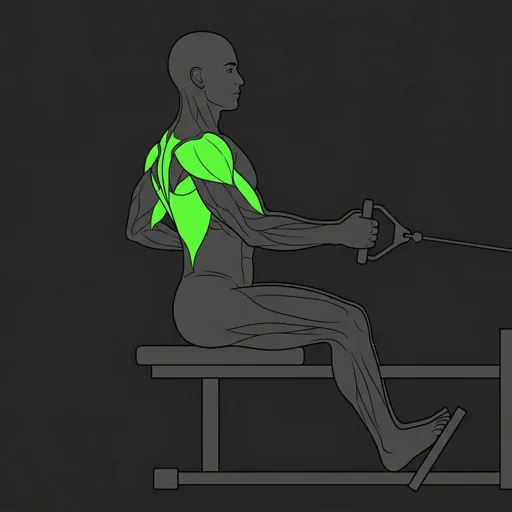
Step by step.
Attach a wide bar to a low cable row station. Sit with feet braced, knees slightly bent, and grab the bar with a wide overhand grip.
Sit tall with arms extended, a small arch in the lower back, and the chest up. This is the start.
Row the bar to your sternum, driving the elbows out to the sides rather than down toward your hips.
Pull the shoulder blades together hard at the top and hold for a beat.
Return under control to full arm extension, keeping the torso upright.
Avoid rocking back and forth to move the weight. The torso stays still.
Grip width and elbow path decide which muscle you are training, and the wide overhand version is a different exercise from the close grip one most people default to. Pull to the sternum with the elbows flared and the work lands in the mid back, rhomboids, and rear delts, the upper back width a standard seated cable row to the belly with tucked elbows skips. Thick back but narrow? This is the variation you have been missing.
Sit still and let the back pull. The cardinal sin on any cable row is rocking, leaning way back to drag the stack with your bodyweight and then swaying forward to reset. That trains your hip hinge while your back coasts. Lock an upright torso with a slight arch and pull with the arms and shoulder blades only. If you have to heave, the weight is winning.
Pull from the elbows. Drive them out and back, and the rear delts and mid back stay switched on while the biceps step aside. The bar should arrive at your chest because your shoulder blades crushed together, with the hands just holding on.
Run it for mid back volume in the 10 to 15 range with a real pause at full contraction. It pairs well with vertical pulling on a width day, since the two attack the upper back from different angles.
Common questions.
Width and elbow path shift the emphasis. A wide overhand grip with the elbows flaring out to a sternum pull targets the mid back, rhomboids, and rear delts for upper back width. A narrow grip pulled to the belly with tucked elbows leans on the lats. They are effectively two exercises on one machine.
Usually rocking or hauling with the hands. Leaning back to drag the stack turns it into a hip movement, and gripping and yanking lets the biceps take over. Sit upright, keep the torso still, and drive the elbows back so the shoulder blades squeeze the bar in. The bar should arrive from the back, not from body sway.
For this variation, the sternum. A higher pull with flared elbows hits the mid back and rear delts the wide grip is meant to train. A low pull to the belly with tucked elbows is the lat focused version. Match the line to the grip you chose.
A standard seated cable row often uses a close neutral grip pulled to the abdomen, which biases the lats. The wide overhand version with a sternum pull moves the work to the upper and mid back for width. Running both, on different days or in one session, covers the back more completely.


Run the numbers.
One-rep max.
Estimate your max from any rep count. Five formulas, full percentage table.
Plate calculator.
What to load for any target weight, in lb or kg.
RPE calculator.
Convert rate of perceived exertion to training percentages.
Wilks score.
Bodyweight-adjusted total for comparing strength across weight classes.
DOTS score.
The IPF's newer bodyweight-adjusted scoring formula.
IPF GL points.
The IPF's official Goodlift score, in use at meets since 2020.
Volume calculator.
Weekly sets per muscle group, tonnage, and load management.
Strength ratio.
Screen your squat, bench, and deadlift to find the lift that is lagging.
Stop calculating.
Start tracking.
Log every set in RepRaptor. Free forever for lifters.