Chin-Up.
The chin-up uses a supinated (underhand) grip with hands closer than shoulder-width. The body hangs from a dead hang with a slight lumbar arch, then pulls until the chin clears the bar, with elbows staying close to the body throughout.

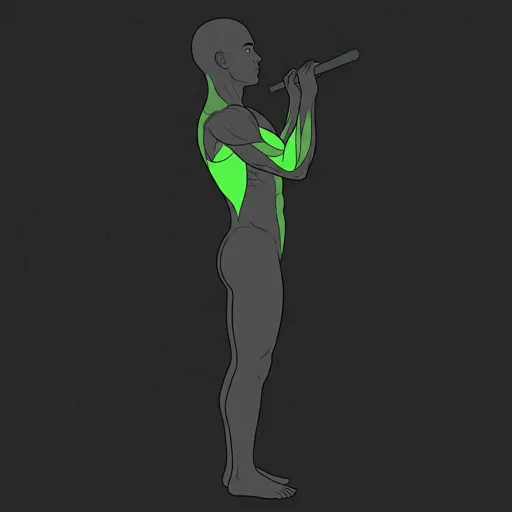
Step by step.
Grip the bar with an underhand grip, palms facing you, hands closer than shoulder width and roughly 12-14 inches apart.
Hang from straight arms in a full dead hang with a slight arch in the lower back, then pull your shoulders down to set the lats before you move.
Keep the torso fairly upright rather than leaning back, so the biceps share the work with the lats.
Pull yourself up by driving the elbows down and keeping them tucked close to your sides the whole way, leading with the chest.
Continue until your chin clears the top of the bar, squeezing the back and biceps at the top.
Lower yourself under control all the way back to a full dead hang with straight arms. Keep the lower body still and avoid any swing or kick to cheat the rep.
The supinated grip doesn't just change which muscles work. It changes how the elbow tracks through space. With palms facing you, the elbows naturally tuck close to the torso during the pull rather than flaring out to the sides. That keeps the lat engaged through the full range of motion and also gives the biceps a better mechanical angle. This is why most people can chin-up more reps or more weight than they can pull-up, and why beginners learning vertical pulling movements often start here.
"Torso as straight as possible" is the cue the instructions use, and it means something specific: resist the urge to lean back. The chin-up, unlike the pull-up, is typically described with a more vertical body position because the goal is to maximize biceps involvement alongside lat work. Leaning back shifts the emphasis toward the lat and reduces biceps recruitment. That's fine if it's what you want, but it changes the exercise. If you want to specifically develop the biceps alongside the back, stay upright.
Chin clearance at the top is the standard. Get the chin above the bar. This is a lower top-position bar than pulling the bar to the chest, but it's the standard for most gym settings and what most programs mean when they count reps. If you're training for maximal strength and back development, aim to get the bar to upper chest level; if you're training for rep counts or muscle endurance, chin over bar is the target.
Common failure pattern: as fatigue sets in, people start initiating with a small body swing. Even a small kip changes the stimulus entirely. A strict chin-up done honestly is about twice as hard as the same movement done with any lower-body momentum. If your reps are degrading in form, stop the set.
Common questions.
Neither is better. They're different. Chin-ups produce more biceps activation due to the supinated grip and are slightly easier mechanically, so most lifters can do more of them. Pull-ups load the shoulder in external rotation and tend to hit the posterior deltoid and infraspinatus more. For back development, both belong in a program. If you can only pick one, chin-ups are the better starting point because a weaker lifter will get more productive reps and more volume in before hitting failure.
Closer than shoulder-width. That's the standard description. In practice, most people settle on a grip that's 6-10 inches narrower than their shoulder width, roughly 12-14 inches apart. Very close grip (hands touching) works but creates wrist torque and reduces the range of motion. A few inches of space between the hands keeps the forearms parallel or slightly angled, which is the strongest position for the pull. If you're not sure, experiment: the grip that lets you feel the lats working while also feeling the biceps contract is the right width for you.
Push-ups train the pushing muscles: chest, shoulders, triceps. Chin-ups train the pulling muscles: lats, biceps, rear delts. These are entirely separate muscle groups, so push-up performance tells you almost nothing about chin-up capacity. Most people are pulling-strength deficient compared to their pushing strength, especially anyone who does a lot of bench pressing or push-up training without a dedicated pulling counterpart. The fix is to start with band-assisted chin-ups or negative reps (jump to the top, lower slowly) and build pulling strength from scratch.
Both have a place, but once you can complete 3 sets of 10 clean reps with full range of motion, adding weight is more productive for strength than chasing higher rep counts. A dipping belt with a 10-25 lb plate attached is the standard method. Added weight at lower reps (3-6) builds strength faster than bodyweight at higher reps (15-20), even though the high-rep sets might feel harder. If you're training for general fitness and don't care about maximal strength, high-rep bodyweight chin-ups are perfectly effective.


Run the numbers.
One-rep max.
Estimate your max from any rep count. Five formulas, full percentage table.
Plate calculator.
What to load for any target weight, in lb or kg.
RPE calculator.
Convert rate of perceived exertion to training percentages.
Wilks score.
Bodyweight-adjusted total for comparing strength across weight classes.
DOTS score.
The IPF's newer bodyweight-adjusted scoring formula.
IPF GL points.
The IPF's official Goodlift score, in use at meets since 2020.
Volume calculator.
Weekly sets per muscle group, tonnage, and load management.
Strength ratio.
Screen your squat, bench, and deadlift to find the lift that is lagging.
Stop calculating.
Start tracking.
Log every set in RepRaptor. Free forever for lifters.