Seal Row.
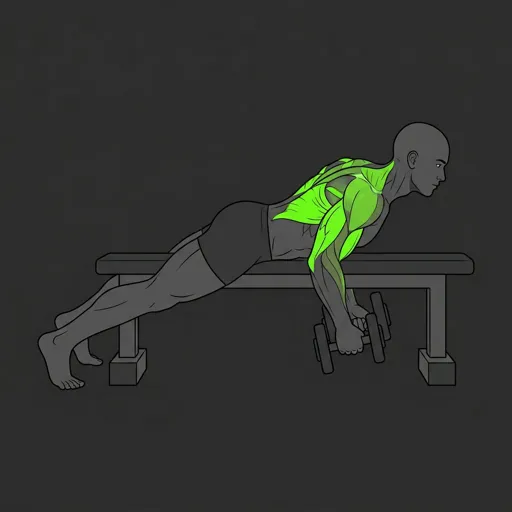
The seal row is a chest supported row done face down on an elevated bench, so the lower back and legs are completely removed from the lift. With nothing to cheat with, every bit of the work lands on the upper back and lats.

Step by step.
Raise a flat bench on blocks or stacked plates so your arms hang free beneath it with dumbbells in hand.
Lie face down with your chest pressed into the bench and your feet braced on the floor.
Let the dumbbells hang at full stretch, palms facing each other. This is the start.
Row both dumbbells up by retracting the shoulder blades and driving the elbows past your torso.
Squeeze the upper back hard at the top for a beat. Keep your chest glued to the bench.
Lower under control to a full stretch at the bottom, then repeat without using any body swing.
The bench does exactly one job, and it does it ruthlessly. It makes cheating impossible. On a bent over row you can sneak in a little hip drive, a little lower back, a little momentum, and most people do without noticing. Lie face down for a seal row and all of that vanishes, so the only thing moving the weight is your back. Ever wondered how much of your row is actually your back? This lift answers it.
That strict position is also why it spares your spine. A heavy one arm dumbbell row or a barbell row taxes the erectors holding your torso in place, and on a high volume back day that fatigue piles up fast. The seal row carries none of it, so you can keep chasing upper back volume late in a session when your lower back is already cooked from deadlifts or squats.
Get the bench high enough. The most common setup mistake is too little elevation, which cuts the bottom stretch short because the dumbbells hit the floor before your arms fully extend. Stack it so even big dumbbells clear the ground at full reach, since that deep stretch is half of why the lift works.
Treat it as honest back hypertrophy, 8 to 15 reps with a pause and a squeeze at the top. Resist the urge to load it like a bent over row, because there is no momentum here to bail you out. The strictness is what you came for, so keep it.
Common questions.
Your chest rests on a raised bench, which takes the legs and lower back out entirely. A bent over row or a one arm dumbbell row lets you use body english to move more, but the seal row strips that away so the upper back does every bit. It is the strictest row there is.
One of the best for it. With your torso supported on the bench, the erectors never have to hold you bent over under load, so there is no lower back fatigue. You can train back volume hard even on days when deadlifts or squats already taxed your spine.
High enough that the dumbbells clear the floor at full arm extension, which usually means blocks or stacked plates under the bench. Too low and the weights hit the ground before you reach a full stretch, cutting the best part of the rep. Give that bottom stretch room.
Lighter than your bent over row, since there is no momentum to help. Treat it as hypertrophy work in the 8 to 15 range with a pause and squeeze at the top. Loading it like a cheat row misses the point; the strictness is the feature.


Run the numbers.
One-rep max.
Estimate your max from any rep count. Five formulas, full percentage table.
Plate calculator.
What to load for any target weight, in lb or kg.
RPE calculator.
Convert rate of perceived exertion to training percentages.
Wilks score.
Bodyweight-adjusted total for comparing strength across weight classes.
DOTS score.
The IPF's newer bodyweight-adjusted scoring formula.
IPF GL points.
The IPF's official Goodlift score, in use at meets since 2020.
Volume calculator.
Weekly sets per muscle group, tonnage, and load management.
Strength ratio.
Screen your squat, bench, and deadlift to find the lift that is lagging.
Stop calculating.
Start tracking.
Log every set in RepRaptor. Free forever for lifters.