Incline Dumbbell Flyes.
The incline dumbbell flye isolates the upper chest through a wide arc, with the bench set low and the arms opening to the sides under a fixed elbow bend. It trains the part of the pec that a flat pressing movement tends to leave behind.

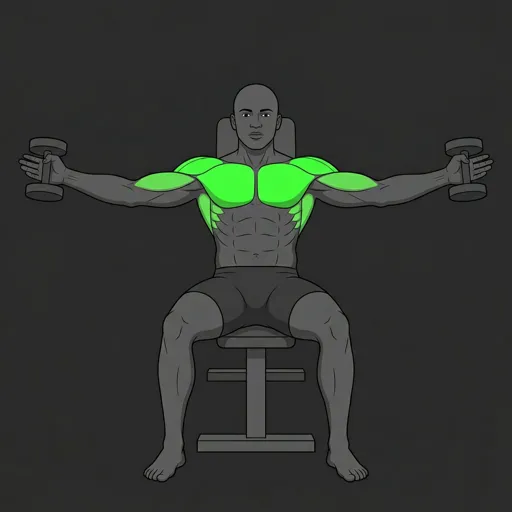
Step by step.
Set an adjustable bench to a low incline, somewhere around 30 degrees. Steeper than that and the front delts start stealing the work.
Sit back with a dumbbell in each hand and press them up over your upper chest, palms facing each other, a soft bend in the elbows.
Open your arms out to the sides in a wide arc, lowering the dumbbells until you feel a stretch across the chest. The elbow angle stays locked the whole way.
Stop when your upper arms are roughly level with your torso. Going deeper than your shoulders can handle is where flyes hurt people.
Bring the dumbbells back along the same arc by squeezing the chest, not by bending the elbows. Imagine hugging a barrel.
Pause briefly at the top without clanging the dumbbells together, then repeat.
Set the bench too steep and the exercise is gone before you start. Past about 40 degrees the front delt takes over and you are grinding out a clumsy shoulder press, nowhere near the upper chest you were aiming for. Keep the incline low, around 30 degrees, so the line of pull stays on the clavicular fibers. If a flat bench is all you own you can still flye, but it works the same region as the dumbbell bench press and leaves the upper chest wanting.
Set the elbow bend on rep one and forget it exists. A flye is rotation at the shoulder, full stop. The second your elbows start opening and closing you have slid into a sloppy dumbbell flyes variation on an incline, and the chest quietly hands the work to your arms.
Leave your ego in the rack. The stretched bottom loads peak tension right where the pec is most vulnerable, which is exactly how heavy dumbbells tear pecs on this lift. Pick a weight you can lower slowly and stop short of the point where your shoulders feel ready to pry apart. Control builds the chest here. Bouncing just hurts people.
Save it for after the heavy work. Once your incline dumbbell press is done, two hard sets of 10 to 15 as a stretch and squeeze finisher will do more for the upper chest than four ragged sets chasing a number.
Common questions.
Around 30 degrees. Low enough to load the upper pec, high enough to feel different from a flat bench. Once you climb past 40 to 45 degrees the front deltoid takes the work and it stops being a chest exercise. If your bench only offers steep settings, use the lowest one.
Press first, while you are fresh. The incline dumbbell press is the strength movement and carries the load. Then finish with flyes, which reach the chest through a stretch the press never touches. Light weight, full arc.
Too much weight dropped too deep. The bottom of a flye is the most stretched and most exposed spot for the shoulder, so heavy dumbbells there load the joint instead of the muscle. Lighten up, stop the descent at torso level, and hold a steady elbow bend so the joint is not prying open.
You can, but the target moves. A flat flye trains the mid chest, the same area as the dumbbell bench press, while the incline biases the upper pec. If the upper chest is your weak point, run the incline version, because that angle is the reason this lift exists.


Run the numbers.
One-rep max.
Estimate your max from any rep count. Five formulas, full percentage table.
Plate calculator.
What to load for any target weight, in lb or kg.
RPE calculator.
Convert rate of perceived exertion to training percentages.
Wilks score.
Bodyweight-adjusted total for comparing strength across weight classes.
DOTS score.
The IPF's newer bodyweight-adjusted scoring formula.
IPF GL points.
The IPF's official Goodlift score, in use at meets since 2020.
Volume calculator.
Weekly sets per muscle group, tonnage, and load management.
Strength ratio.
Screen your squat, bench, and deadlift to find the lift that is lagging.
Stop calculating.
Start tracking.
Log every set in RepRaptor. Free forever for lifters.