Medicine Ball Russian Twist.
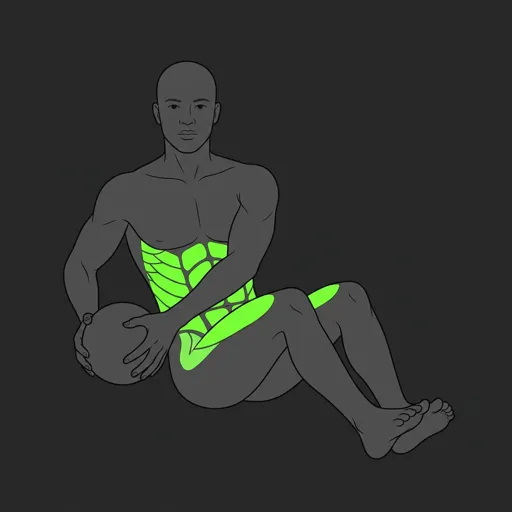
The medicine ball russian twist loads a seated rotation by holding a medicine ball and turning side to side in a reclined V position. The added weight turns a bodyweight ab move into a real strength exercise for the obliques.

Step by step.
Sit on the floor with knees bent and feet flat or slightly raised, holding a medicine ball at your chest.
Lean your torso back to about 45 degrees, making a V shape between your thighs and torso. This is the start.
Rotate your torso to one side, bringing the ball toward the floor beside your hip.
Rotate to the other side in a controlled manner, keeping the chest tall.
Keep your feet planted or held off the floor throughout.
Each side to side rotation counts as one rep. Move with control, not momentum.
A medicine ball is what turns this from filler into actual training. A bodyweight russian twist is fine for a beginner, but once it gets easy your only option is to go faster, and faster is just sloppier. Load it and you can progress the obliques the way you would any muscle, by adding weight rather than chasing more reps. Push the ball a little off your chest and the same weight feels heavier, since the longer lever does the work for you.
The ball should move because your ribcage turns over your hips, not because your arms shuttle it side to side. That is the difference between a busy looking set and one that actually trains the obliques. Cue yourself to turn your shoulders to face each side, and tap the ball to the floor beside your hip to mark a real range each rep.
How far you recline sets the difficulty, and your lower back sets the ceiling. Lean back further and the abs work harder to hold you there, but lean so far that the spine rounds or aches and you have overshot. Keep the chest tall and the spine long, and the moment your back complains, sit up a touch and lighten the ball.
Fifteen to twenty five reps total, or work to time, with control winning over swing every set. For an athletic version, swap the floor tap for a hard throw into a wall on each turn and catch the rebound.
Common questions.
The weight lets you load the rotation and progress the obliques like any other muscle, instead of only adding reps once a bodyweight russian twist gets easy. Holding the ball slightly off your chest lengthens the lever to make a given weight feel heavier. It turns a beginner ab move into real strength work.
Rotate your torso. The common error is swinging the ball across with the arms while the shoulders barely turn, which does little for the obliques. The ball moves because your ribcage rotates over your hips. Turn your shoulders to face each side, and tap the ball down beside your hip each rep.
They are fine with a tall chest and a long spine, but leaning so far back that the lower back rounds or aches is where problems start. Set the recline at a depth you can hold with good posture, rotate under control, and lighten the ball or sit up if your back complains.
Use a heavier ball, hold it further off your chest, raise your feet, or lean further back, each of which loads the obliques and core more. For an athletic version, throw the ball into a wall on each rotation and catch it. Progress gradually and keep the rotation controlled.


Run the numbers.
One-rep max.
Estimate your max from any rep count. Five formulas, full percentage table.
Plate calculator.
What to load for any target weight, in lb or kg.
RPE calculator.
Convert rate of perceived exertion to training percentages.
Wilks score.
Bodyweight-adjusted total for comparing strength across weight classes.
DOTS score.
The IPF's newer bodyweight-adjusted scoring formula.
IPF GL points.
The IPF's official Goodlift score, in use at meets since 2020.
Volume calculator.
Weekly sets per muscle group, tonnage, and load management.
Strength ratio.
Screen your squat, bench, and deadlift to find the lift that is lagging.
Stop calculating.
Start tracking.
Log every set in RepRaptor. Free forever for lifters.