Nordic Hamstring Curl.
The Nordic hamstring curl lowers your kneeling body toward the floor while your ankles stay anchored, resisting with the hamstrings the whole way. It is one of the most effective movements for hamstring strength and a proven tool for reducing hamstring injuries.

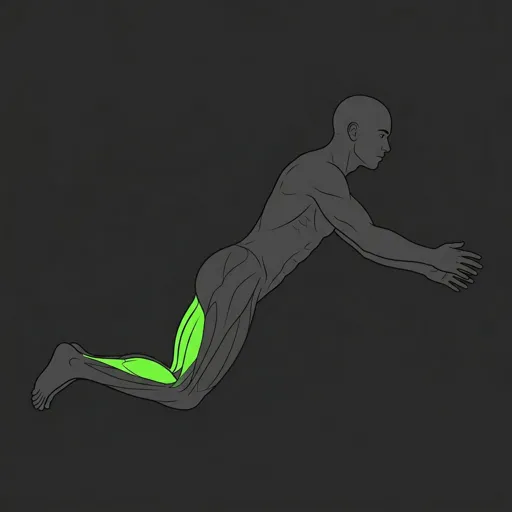
Step by step.
Kneel on a pad with your ankles secured under a sturdy object or held by a partner.
Form a straight line from your knees to your head, with arms crossed or held in front. This is the start.
Lower your torso toward the floor as slowly as possible by letting the knees extend, resisting with the hamstrings.
Fight the descent through the full range, going as far as you can control.
When you can no longer hold, catch yourself with your hands.
Push off the floor lightly with your hands and use the hamstrings to pull back up to kneeling.
The Nordic curl is almost pure eccentric work, and few exercises load that part so hard. You lower against gravity, fighting the descent while the hamstrings lengthen under load, which is the precise stress that builds eccentric strength and toughens the muscle. The research behind it is unusually strong: programs built around the Nordic curl have cut hamstring strain injuries substantially in sprinting and field sports.
It is brutal, and almost nobody can do a full one at first, so expect to drop fast for the first few sessions. Scale it three ways. Lower only as far as you can control before catching yourself, loop a band around your chest from an anchor overhead to share the load, or push off the floor with your hands on the way up. Add range across weeks. Fighting a full unassisted descent on day one just plants you on the floor having learned nothing.
Mind your knees and lower back. Kneel on a pad, hold the hips extended so the body makes one straight line from knees to head, and keep them from piking back to shorten the descent. The line stays rigid and only the knees open.
Keep the reps low, 3 to 6, because the eccentric load is high and the soreness is real, and slot it after your main hamstring work as a strength and injury prevention piece. Stack it with a seated or lying leg curl for knee flexion and a romanian deadlift for the hinge, and the hamstrings have nowhere left to hide.
Common questions.
It loads the hamstrings almost entirely on the eccentric, fighting a slow descent while the muscle lengthens, which builds eccentric strength powerfully. It also has unusually strong research behind it: programs using it have substantially reduced hamstring strain injuries in sprint and field sports.
That is normal, since almost no one can at first. Lower only as far as you can control before catching yourself, loop a band around your chest from an anchor overhead to assist, or push off the floor to help on the way up. Add range gradually over weeks rather than crashing through full reps.
Kneel on a pad to cushion the knees, and keep your hips fully extended so the body holds one straight line from knees to head. Do not let your hips pike back to ease the descent. With the line rigid and only the knees opening, the load stays on the hamstrings.
No, they sit on top of it. Place them after your main hamstring work as a strength and injury prevention finisher, kept to low reps around 3 to 6 since the eccentric load is high. They pair well with a leg curl for knee flexion and a romanian deadlift for the hip hinge.


Run the numbers.
One-rep max.
Estimate your max from any rep count. Five formulas, full percentage table.
Plate calculator.
What to load for any target weight, in lb or kg.
RPE calculator.
Convert rate of perceived exertion to training percentages.
Wilks score.
Bodyweight-adjusted total for comparing strength across weight classes.
DOTS score.
The IPF's newer bodyweight-adjusted scoring formula.
IPF GL points.
The IPF's official Goodlift score, in use at meets since 2020.
Volume calculator.
Weekly sets per muscle group, tonnage, and load management.
Strength ratio.
Screen your squat, bench, and deadlift to find the lift that is lagging.
Stop calculating.
Start tracking.
Log every set in RepRaptor. Free forever for lifters.