Kettlebell Swing.
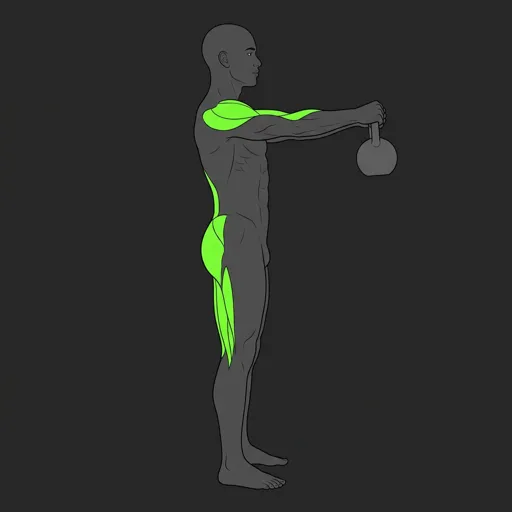
The kettlebell swing trains explosive hip extension by hiking the bell back between the legs and then driving the hips forward to project it to chest height. Power comes entirely from the hips. The arms just steer the bell. Done correctly, it is one of the most efficient posterior chain conditioning tools available.

Step by step.
Stand with the bell a foot or so in front of you and your feet about shoulder width. Hinge at the hips, push your butt back, and reach forward to grab the handle with both hands while keeping your back flat.
Tip the bell toward you, then hike it back between your legs like a football snap. Let it travel high under your hips with your shins close to vertical and your hips loaded back, not in a squat.
Snap your hips forward and stand up hard. Squeeze your glutes and brace your core so the hip drive throws the bell out and up, with your arms staying loose and just guiding it.
Let the bell float up to about chest height at the top of the hip extension. Keep your shoulders packed and lats tight, and do not lift the bell higher with your arms.
Let the bell fall back down on its own and ride it in toward your hips. Hinge again as it passes your thighs, reload the hips, and drive into the next rep without rounding your lower back.
To finish the set, let the bell swing back one last time and set it down in front of you on a controlled hinge rather than dropping it from the top.
The single most common error in swings is squatting instead of hinging. People see the bell go between the legs and instinctively bend the knees deeply, treating it like a squat pattern. A swing is a hinge: hips go back, shins stay near vertical, torso hinges forward. The knees bend a little (they have to) but they're not doing the work. If your shins are angled forward at the bottom, you're squatting. If your hips are back and your shins are close to vertical, you're hinging. The hinge loads the hamstrings and glutes properly; the squat diffuses the load and kills the power.
The hike is what sets up the swing, and most people skip it. Before the first rep, the bell gets "hiked" backward between the legs. Both hands on the handle, bell swinging back under the hips like a football snap. This pre-loads the hamstrings and lets you feel what the hinge should feel like. Starting the swing by just lifting the bell forward misses the initial hip hinge setup and produces a weak first rep.
At the top, the finish matters. Hips fully extended, glutes squeezed hard, lats engaged, core braced. The bell floats momentarily at chest or eye level. It shouldn't be muscled higher with the arms or arrive there slowly. If the bell isn't reaching chest height on its own from the hip drive alone, either the load is too heavy or the hip drive is incomplete. The arms should feel like ropes throughout: they transmit force but don't produce it.
One rep scheme worth knowing: Pavel Tsatsouline's 10x10 protocol (100 reps in sets of 10 with short rests) has been used for years as conditioning work that also builds posterior chain endurance. A 24 kg bell for most trained men, 16 kg for most trained women, is appropriate for this kind of volume work.
If the hinge still feels foreign, drill it slow before you drill it fast. A Romanian deadlift grooves the same hips back, shins vertical pattern under control, and once that pattern is automatic the swing stops collapsing into a squat. The kettlebell deadlift is the most direct primer, since it grooves the exact hinge with the same tool before you add any speed.
Common questions.
For the swing specifically, start heavier than you'd think for most upper body exercises. The swing uses the largest muscles in the body and the movement is driven by explosive hip extension, not shoulder strength. Most men with a training background can start with 16-24 kg. Most women can start with 12-16 kg. Starting too light produces bad habits. A light bell allows you to arm-swing it forward rather than projecting it with the hips, which defeats the purpose. If the bell feels controlled and you're not breathing hard after 10 reps, go up.
The Russian swing stops at chest or eye height. The American swing (popularized by CrossFit) takes the bell to full overhead lockout. Russian swings are the more traditional and generally more appropriate version for most purposes: the hip hinge and explosive hip extension are the point, and the bell naturally floats to an appropriate height when the hip drive is right. American swings require more shoulder mobility and core stability at the top, add overhead loading to the posterior chain lift, and demand a different timing. For building posterior chain power and conditioning, the Russian version is the default.
Depends on your goal. For conditioning and posterior chain endurance, 100-200 total reps per session in sets of 10-20 with short rests (30-60 seconds) is a proven protocol. For strength development with heavier bells, lower volume works better: 3-5 sets of 5-10 reps with full recovery between sets. The swing accumulates fatigue differently than most lifts because it's both strength and conditioning work. Starting with 50-60 total reps in a session and building from there is appropriate for most people in the first few weeks.
Almost always the squat-instead-of-hinge problem. When the knees bend forward and the torso doesn't hinge back sufficiently, the lower back takes over the flexion and extension work that the hips should be doing. The erectors handle this for a few sets, then start complaining. Film yourself from the side and compare your bottom position to the exercise prompt. If your shins aren't nearly vertical and your hips aren't clearly behind your heels at the bottom, you're squatting. Go lighter, work on the hip hinge pattern with a deadlift or Romanian deadlift first, then return to the swing.


Run the numbers.
One-rep max.
Estimate your max from any rep count. Five formulas, full percentage table.
Plate calculator.
What to load for any target weight, in lb or kg.
RPE calculator.
Convert rate of perceived exertion to training percentages.
Wilks score.
Bodyweight-adjusted total for comparing strength across weight classes.
DOTS score.
The IPF's newer bodyweight-adjusted scoring formula.
IPF GL points.
The IPF's official Goodlift score, in use at meets since 2020.
Volume calculator.
Weekly sets per muscle group, tonnage, and load management.
Strength ratio.
Screen your squat, bench, and deadlift to find the lift that is lagging.
Stop calculating.
Start tracking.
Log every set in RepRaptor. Free forever for lifters.