Seated Leg Curl.
The seated leg curl flexes the knees against a machine lever while sitting upright, which keeps the hips bent and the hamstrings on stretch. That stretched position makes it one of the most effective hamstring isolation movements.

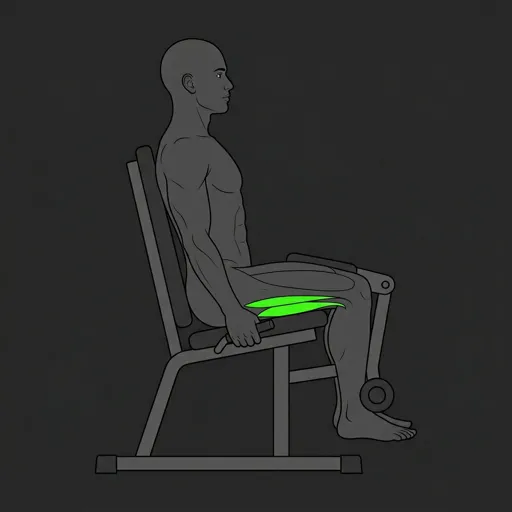
Step by step.
Adjust the machine to your height and sit with your back against the pad, legs extended over the roller.
Set the lower roller a few inches below your calves and lock the thigh pad down over your legs.
Grip the handles and extend your legs straight out in front. This is the start.
Curl the lever down and back by flexing your knees, pulling your heels toward the seat.
Squeeze the hamstrings at the bottom and hold for a beat.
Return slowly to full extension, keeping your torso still against the pad.
The seated position is why a lot of lifters get more out of this than the lying version, and it comes down to muscle length. Sitting keeps your hips flexed, which puts the hamstrings on stretch before you even start curling, and training a muscle in that lengthened position tends to pay off in growth. A well known trial that pitted the seated curl against the lying leg curl found more hamstring growth from sitting, so if you only run one curl, this is a sensible pick. The evidence is not a mountain, but it points the same way the mechanics do.
It also covers what hip hinges leave out. A romanian deadlift trains the hamstrings as hip extensors but barely touches their second job, bending the knee. A leg curl is pure knee flexion, so it trains exactly what your hinges miss. Round out the hamstrings with both, and the seated curl is the curl half done in its most productive position.
Control the lowering and quit heaving. The usual mistake is slamming the weight down and letting it snap the legs straight on the way back. Curl under control, hold the squeeze, and fight the return so the hamstrings keep working as the lever opens. Pin your hips and torso to the pads, and if your butt is lifting off the seat, the load is too heavy.
Treat it as isolation. A full range and a clean tempo will always beat another plate on the stack. Ten to fifteen reps with a pause at peak contraction suits it well, and it counts toward your weekly sets for the hamstrings when you map out volume.
Common questions.
For hamstring growth the seated version looks like the stronger pick. Sitting flexes the hips and puts the hamstrings on stretch before you curl, and a well known trial comparing it with the lying leg curl found more growth from sitting. It is one study, not a stack of them, but it lines up with the mechanics.
Hinges and curls train different hamstring jobs. A romanian deadlift works the hamstrings as hip extensors but barely bends the knee, which is their other function. A leg curl is pure knee flexion, covering what hinges miss. A complete hamstring program runs both.
Usually too much weight and too much momentum, which makes you heave and lift your hips to move the lever. Pin your hips and torso to the pads, curl under control, and resist the return rather than letting it snap your legs straight. If you still lift off, drop the load.
No. It is hamstring isolation, so favor a full range and clean tempo over the stack, around 10 to 15 reps with a pause at the squeeze and a controlled lowering. Pair it with a hip hinge like the romanian deadlift to cover both hamstring functions.


Run the numbers.
One-rep max.
Estimate your max from any rep count. Five formulas, full percentage table.
Plate calculator.
What to load for any target weight, in lb or kg.
RPE calculator.
Convert rate of perceived exertion to training percentages.
Wilks score.
Bodyweight-adjusted total for comparing strength across weight classes.
DOTS score.
The IPF's newer bodyweight-adjusted scoring formula.
IPF GL points.
The IPF's official Goodlift score, in use at meets since 2020.
Volume calculator.
Weekly sets per muscle group, tonnage, and load management.
Strength ratio.
Screen your squat, bench, and deadlift to find the lift that is lagging.
Stop calculating.
Start tracking.
Log every set in RepRaptor. Free forever for lifters.