Lying Leg Curl.
The lying leg curl trains the hamstrings through knee flexion with the hips extended, placing the muscle in a position that emphasizes the short head of the biceps femoris and the semitendinosus. It is the most common machine-based hamstring isolation exercise and a standard accessory movement for posterior chain development.

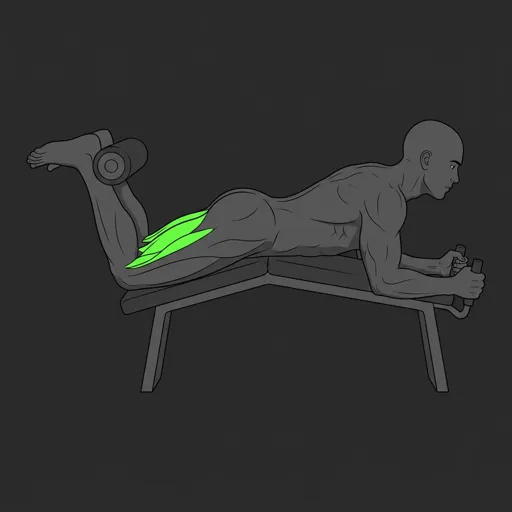
Step by step.
Set the ankle pad so it sits just above your heels, on the back of your lower legs. Lie face down on the bench with your knees just past the edge of the pad.
Hook your heels under the roller and grab the side handles. Press your hips firmly into the bench and point your toes slightly to keep the work on the hamstrings.
Curl your heels up toward your glutes by bending the knees. Drive the movement from the hamstrings and keep your hips pinned to the pad the whole time.
Bring the pad up as far as your range allows and squeeze the hamstrings at the top. Do not let your hips hike off the bench to gain extra height.
Lower the weight slowly, taking 3 to 4 seconds to return to a straight leg. This controlled eccentric is where the hamstrings build strength and resilience.
Keep the toes softly pointed throughout so the calves stay out of the lift. If your hips keep rising, drop the weight until you can hold them flat.
The hamstrings cross two joints: the hip and the knee. Their function changes depending on which joint is involved. In the lying leg curl, the hip is extended (flat on the pad) while the knee flexes. This trains the hamstrings in their knee-flexor role, but it also puts them in a slightly shortened position through the hip compared to standing or seated variations. That distinction matters.
Hip position during the movement is where technique breaks down. When the pad drives down at the top of the curl, many people compensate by letting the hips hike off the bench. The pelvis tilts anteriorly and the glutes lift up. That hip rise shortens the hamstring from the hip end as the knee flexes, reducing total range of motion and taking some load off the muscle. Keep the hips flat. Grab the side handles firmly and don't let the pelvis rotate.
Foot position is worth knowing about. Toes pointed (plantar-flexed) shortens the gastrocnemius, which partially prevents it from assisting the curl. This puts more work on the hamstrings specifically. Toes dorsiflexed (pulled toward the shin) engages the gastroc more as a synergist. Neither is wrong, but if you want maximum hamstring isolation, soft plantar flexion throughout the movement is the deliberate choice.
Control the lowering phase. Eccentric hamstring training has a strong evidence base for both strength development and injury reduction. Slow lowering (3 to 4 seconds) is more effective than letting the weight drop. The hamstring is at risk of strains when loaded lengthening under force, so training the eccentric at manageable loads builds resilience over time. Fast, sloppy negatives don't.
Train the back of the knee and you should train the front too. The curl handles knee flexion for the hamstrings, so pair it with a leg extension for the quads and the joint doesn't end up lopsided in strength.
Common questions.
Seated leg curl trains the hamstring in a more lengthened hip position (hip is flexed in the seated version), which puts the muscle on greater stretch throughout the movement. Research comparing the two shows seated leg curl produces more muscle activation and possibly more hypertrophy stimulus, likely because the hamstring is under greater tension through a longer range at the hip-extended position. The lying version is more common in gyms and still very effective. If your gym has both, the seated curl is worth prioritizing for hamstring development. If you only have the lying version, it's more than adequate.
Hamstring cramping during curls is common and usually signals that the muscle is maximally contracting in a shortened position, which is exactly what happens at the top of the lying leg curl. Two contributing factors: inadequate warm-up and dehydration. Cramping is also more likely when you suddenly increase volume or weight. If cramping is persistent, spend more time stretching the hamstrings before training and make sure you're drinking enough water. Some people find that sitting up between sets (which puts the hamstring on stretch again) helps prevent the subsequent rep from triggering another cramp.
You can't entirely eliminate the glute, but hip hiking is the main compensation to prevent. Keep your hips pressed firmly into the bench pad throughout the curl. If the pelvis is rising, the hamstrings can't complete the range independently and the glute is assisting. Reduce weight until you can perform the movement with the hips flat, then build back up. Holding the side handles and actively pressing the hips into the pad is the cue. Some people also find it helpful to use a slightly lighter weight and focus specifically on the feeling of the knee flexing rather than the curl completing.
Pointed toes (plantar flexion) gives the hamstring more isolation by taking the gastrocnemius slightly out of the movement. The calf is already shortened from the ankle, limiting how much it can contribute at the knee. Neutral or flexed (dorsiflexed) toes let the gastrocnemius participate more. For hamstring-specific work, soft plantar flexion is the cleaner choice. For overall posterior chain conditioning, it matters less. Neither is dangerous. Try both and go with whichever lets you feel the hamstring working harder.


Run the numbers.
One-rep max.
Estimate your max from any rep count. Five formulas, full percentage table.
Plate calculator.
What to load for any target weight, in lb or kg.
RPE calculator.
Convert rate of perceived exertion to training percentages.
Wilks score.
Bodyweight-adjusted total for comparing strength across weight classes.
DOTS score.
The IPF's newer bodyweight-adjusted scoring formula.
IPF GL points.
The IPF's official Goodlift score, in use at meets since 2020.
Volume calculator.
Weekly sets per muscle group, tonnage, and load management.
Strength ratio.
Screen your squat, bench, and deadlift to find the lift that is lagging.
Stop calculating.
Start tracking.
Log every set in RepRaptor. Free forever for lifters.