Kettlebell Deadlift.
The kettlebell deadlift hinges down to lift a single kettlebell from between the feet, building the glutes, hamstrings, and lower back. The compact load and simple setup make it the ideal entry point to deadlifting and to the kettlebell swing.

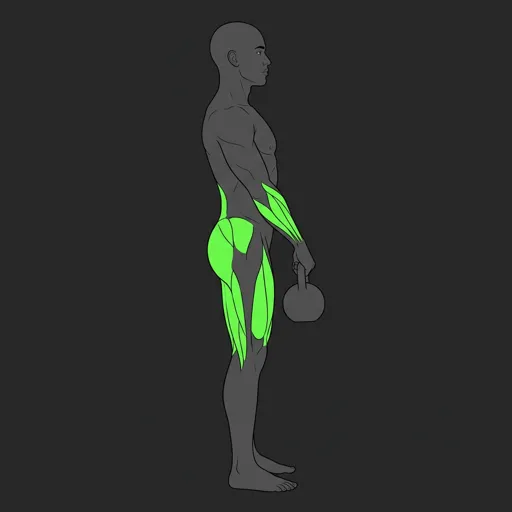
Step by step.
Stand over a kettlebell with feet about shoulder width, the bell centered between your feet.
Push your hips back and bend your knees to grip the handle with both hands, back flat and chest up.
Brace your core and take the slack out of your arms. This is the start.
Drive through your heels to stand up, extending hips and knees together to lift the bell.
Stand tall at the top and squeeze your glutes without leaning back.
Push your hips back and bend the knees to lower the kettlebell under control to the floor.
This is the deadlift everyone should meet first. A kettlebell hangs in an ideal spot when you hinge, between and just behind your hands, so it trains you to push the hips back and keep the load close without the technical baggage of a loaded barbell. The pattern matches a conventional deadlift exactly, only scaled down and quicker to set up, which makes the kettlebell deadlift the obvious starting point before you touch a bar or progress to a sumo deadlift.
It is also your on ramp to ballistic kettlebell work. The hinge you groove here, hips back and a hard snap to lockout, is the same one that powers the kettlebell swing, just performed slowly. Own the deadlift hinge and the swing becomes a question of adding speed, not learning a new skill. Skip this rung and you end up swinging from the lower back, which is where most people go wrong.
Where it falls apart is the knees. Bend them too much and you start squatting the bell up, the quads take over, and the chest drops. Lead with the hips instead: push them back first, let the knees give only as far as the hinge needs, keep the shins close to vertical, and let the bell travel straight up and down right against your body.
Eight to twelve reps suits it as a hinge builder, a warm up, or your only option on a kettlebell only day. Once a single bell stops testing you, size up to a heavier one or graduate to the barbell deadlift where the real loading lives.
Common questions.
One of the best. The bell sits in an ideal position when you hinge, teaching you to push the hips back and keep the load close without the setup of a barbell. The pattern matches a conventional deadlift exactly, just scaled down, so it is the natural first step before a bar or a sumo deadlift.
It is the slow version of the same hinge that powers the kettlebell swing: hips back, then a hard drive to lockout. Master it first and the swing is just a matter of adding speed, not learning a new movement. Skipping it is why many people swing from the lower back instead of the hips.
It is a hinge, not a squat. The common mistake is bending the knees too much and squatting the bell up, which loads the quads and drops the chest. Lead with the hips, let the knees give only as far as the hinge needs, and keep the shins fairly vertical so the glutes and hamstrings drive it.
When a single bell no longer challenges you in your target rep range. Switch to a heavier kettlebell or graduate to a barbell deadlift for real loading. The kettlebell version is the entry point, perfect for learning the hinge, warming up, or training at home with little equipment.


Run the numbers.
One-rep max.
Estimate your max from any rep count. Five formulas, full percentage table.
Plate calculator.
What to load for any target weight, in lb or kg.
RPE calculator.
Convert rate of perceived exertion to training percentages.
Wilks score.
Bodyweight-adjusted total for comparing strength across weight classes.
DOTS score.
The IPF's newer bodyweight-adjusted scoring formula.
IPF GL points.
The IPF's official Goodlift score, in use at meets since 2020.
Volume calculator.
Weekly sets per muscle group, tonnage, and load management.
Strength ratio.
Screen your squat, bench, and deadlift to find the lift that is lagging.
Stop calculating.
Start tracking.
Log every set in RepRaptor. Free forever for lifters.