Cable Pull Through.
The cable pull through trains the hip hinge by driving the hips forward against a rope on a low cable, facing away from the machine. It teaches the hinge pattern and builds the glutes and hamstrings with the load aimed horizontally where the glutes work best.

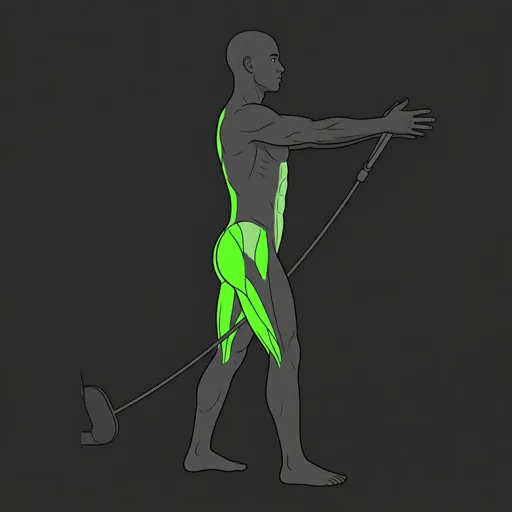
Step by step.
Attach a rope to a low pulley, face away from the machine, and straddle the cable, gripping the rope between your legs.
Step forward to create tension and set your feet about shoulder width with soft knees. This is the start.
Hinge at the hips by pushing them back, letting the cable pull your hands down between your legs.
Keep a flat back and feel the stretch in your hamstrings at the bottom.
Drive your hips forward explosively, squeezing the glutes hard at lockout.
Keep your arms straight throughout. The movement comes from the hips, not the arms.
The pull through is the clearest hinge teacher in the gym, and teaching the hinge is its main job. A horizontal cable gives you an obvious feel for shoving the hips back and then snapping them forward, the same pattern a romanian deadlift and a deadlift ask for but harder to find under a heavy bar. Send a beginner here first. Grooving the hinge where the load is light and the feedback is loud carries straight over to the barbell.
It also loads the glutes from an angle vertical lifts cannot reach. The cable pulls horizontally toward the machine, so the hardest moment is the lockout with your hips fully forward, which happens to be where the glutes are strongest. That makes it a natural partner to vertical glute work like the hip thrust and the barbell glute bridge, hitting the same muscle along a different line with tension on the cable the whole way.
Two faults show up again and again. People row the rope with their arms while the hips sit still, so keep the arms long and use them as a hook, nothing more. And people drop into a squat, bending the knees to stand the load up, so push the hips back and keep the shins close to vertical to hold it as a true hinge.
Drive the hips forward fast and clamp the glutes at the top for 12 to 20 reps. It is light and easy on the joints, and just as happy warming up your hinge before a heavy pull as it is finishing off the glutes and hamstrings at the end.
Common questions.
Two jobs. It teaches the hip hinge, giving clear feedback on pushing the hips back and driving them forward that transfers to the deadlift and romanian deadlift. And because the load runs horizontal, it hammers the glutes at lockout where they are strongest, rounding out vertical work like the hip thrust.
The light load and clear horizontal feedback make the hinge pattern obvious in a way a heavy barbell does not. Beginners feel the hips push back and drive forward without the technique risk of a loaded bar. Grooving it here transfers directly to the romanian deadlift and conventional deadlift.
If you feel your arms, you are rowing the rope instead of hinging, so keep the arms straight and use them as a hook. If you feel your quads, you are bending the knees and squatting it. Push the hips back with fairly vertical shins to keep it a true hinge driven by the glutes and hamstrings.
Either, since it is light and joint friendly. Use it as a hinge primer before heavier pulling, or as a glute and hamstring finisher, running around 12 to 20 reps with an explosive forward hip drive and a hard glute squeeze at lockout. Pair it with vertical glute work like the hip thrust.


Run the numbers.
One-rep max.
Estimate your max from any rep count. Five formulas, full percentage table.
Plate calculator.
What to load for any target weight, in lb or kg.
RPE calculator.
Convert rate of perceived exertion to training percentages.
Wilks score.
Bodyweight-adjusted total for comparing strength across weight classes.
DOTS score.
The IPF's newer bodyweight-adjusted scoring formula.
IPF GL points.
The IPF's official Goodlift score, in use at meets since 2020.
Volume calculator.
Weekly sets per muscle group, tonnage, and load management.
Strength ratio.
Screen your squat, bench, and deadlift to find the lift that is lagging.
Stop calculating.
Start tracking.
Log every set in RepRaptor. Free forever for lifters.