Barbell Glute Bridge.
The barbell glute bridge trains hip extension from the floor with the upper back flat on the ground, loading the glutes and hamstrings through a moderate range. Unlike the hip thrust, the torso stays on the floor (there is no bench elevation), which shortens the bottom range but keeps the setup simple and accessible.

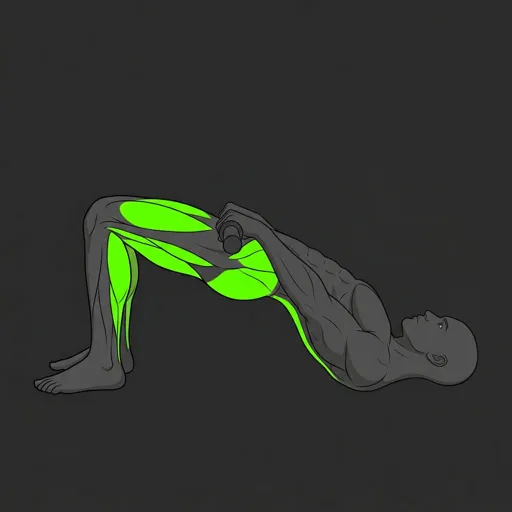
Step by step.
Sit on the floor and roll a padded barbell over your legs until it rests in the crease of your hips. The pad matters once you are loading 135+ lbs against that crease.
Lie back so your upper back and head are flat on the floor. Bend your knees and set your feet flat, about 12-14 inches from your hips and roughly hip width apart.
Grip the bar to hold it in place and brace your core. Tuck your chin slightly so your neck stays neutral.
Drive through your heels and push your hips straight up until your body forms a straight line from knees to shoulders. Your shins should end up close to vertical at the top.
Squeeze the glutes hard and hold the locked out position for one full second instead of rushing past it.
Lower your hips back down under control until they nearly touch the floor, then drive into the next rep. If your heels lift as you push, move your feet a little further from your hips.
The glute bridge and the hip thrust are often treated as interchangeable, but they're not. The floor position limits how far the hips can drop at the bottom, which means the glute never gets the lengthened-position stretch that the hip thrust provides. That distinction matters for hypertrophy: stretched-position loading is where much of the growth stimulus accumulates. The bridge is a good starting point, a warmup tool, or a home gym solution. It's not a long-term replacement for the thrust if glute size is the goal.
Foot position is the main variable. Feet closer to the glutes (about 12-14 inches from the hips) put the hamstrings in a shortened position and make the glutes do more work at the top. Feet further out lengthen the hamstrings and bring them in. Most people find the sweet spot by feel. Shins should be close to vertical at the top of the movement. If your heels are lifting off the floor as you push up, your feet are too far in. If the lockout feels like it's going sideways, they're probably too far out.
The bar needs padding. The inguinal fold (the crease between your lower abdomen and upper thigh) is not a comfortable place to have 135+ lbs of steel without something between them. A thick foam pad, an Abmat, or a folded mat reduces the discomfort enough to actually train through. Without it, the bar pressure derails the set before the glutes do.
One cue that makes a real difference at the top: drive the hips up and then squeeze the glutes deliberately for one full second. Don't just reach the top position and immediately lower. The isometric contraction at peak extension is what actually trains the glute in its shortest position, and most people rush past it completely.
Common questions.
Position of the upper back. In the glute bridge, the upper back stays on the floor. In the hip thrust, the upper back is elevated on a bench. The bench elevation lets the hips drop further at the bottom, putting the glute under load in a more lengthened position. That greater range of motion, specifically the loading in the stretched position, produces more hypertrophy stimulus. The glute bridge is better as a warmup, a home training option, or an entry-level progression before the hip thrust. For serious glute development, the hip thrust wins on range and loadability.
More than you'd expect. The glutes are among the strongest muscles in the body, and the bridge is mechanically efficient at the top where the glutes are fully contracted. Beginners often start with just the bar (45 lbs) to learn foot position and hip lockout. Once form is consistent, load progresses quickly. 135 lbs within a few months is common, and experienced lifters frequently go higher. The limiting factor early on is usually bar comfort without a pad, not actual glute strength.
Heels, primarily. Pressing through the heels shifts load toward the hamstrings and glutes and away from the quads. Some coaches cue 'toes in the air' to force heel drive. That's a valid drill when learning. In practice, the whole foot stays flat on the floor, but the intent is to push backward and up through the heel. If you can feel your quads working hard on glute bridges, your feet are likely too close to your body and your shins are angled too far back at the top.
Yes, and it's often how people start. Bodyweight bridges are a standard warmup for squats and deadlifts and appear in most glute activation protocols before heavier work. Beyond bodyweight, a dumbbell across the hips, a resistance band, or a weight plate are all valid progressions before adding a barbell. The barbell version is worth learning because it loads more easily and distributes weight more evenly across the hip crease, but the bodyweight version has real value for warmup and technique practice.


Run the numbers.
One-rep max.
Estimate your max from any rep count. Five formulas, full percentage table.
Plate calculator.
What to load for any target weight, in lb or kg.
RPE calculator.
Convert rate of perceived exertion to training percentages.
Wilks score.
Bodyweight-adjusted total for comparing strength across weight classes.
DOTS score.
The IPF's newer bodyweight-adjusted scoring formula.
IPF GL points.
The IPF's official Goodlift score, in use at meets since 2020.
Volume calculator.
Weekly sets per muscle group, tonnage, and load management.
Strength ratio.
Screen your squat, bench, and deadlift to find the lift that is lagging.
Stop calculating.
Start tracking.
Log every set in RepRaptor. Free forever for lifters.