Dumbbell Hip Thrust.
The dumbbell hip thrust drives the hips up against a dumbbell held across the crease, with the upper back on a bench. It builds the glutes through full hip extension and is the simplest way to load thrusts without a loaded barbell.

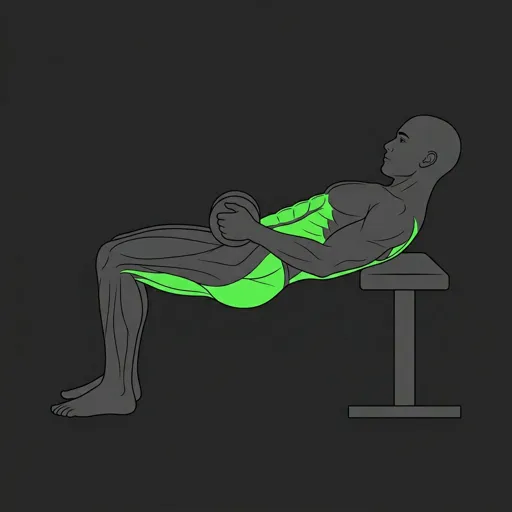
Step by step.
Sit on the floor with your upper back against a bench and a dumbbell resting across your hip crease, held with both hands.
Plant your feet flat at about shoulder width, knees bent near 90 degrees. This is the start.
Drive through your heels to lift your hips until your torso is parallel to the floor.
Squeeze your glutes hard at the top and hold for a beat, shins roughly vertical.
Lower your hips back down under control without letting the dumbbell shift.
Keep your ribs down and avoid arching your lower back to finish the rep.
The hip thrust loads the glutes right where they are strongest, at full hip extension, which is why it is such a reliable glute builder. The dumbbell version is just the accessible way in. A single dumbbell across your lap sets up anywhere, at home or in a packed gym, with none of the hassle of wrestling a loaded barbell into place. You give up some top end load compared to a barbell hip thrust, but the movement and the payoff are the same, which makes this ideal for beginners and for higher rep glute work.
The lockout should come from the glutes. Most people over arch at the top, throwing the hips up by cranking the lower back rather than squeezing. Keep your ribs down and your chin tucked, push the floor away through your heels, and finish by clamping the glutes hard with your torso parallel to the ground. If your lower back is doing the talking up top, you have turned a glute squeeze into a backbend.
A few setup details decide whether you can actually feel it. Pad the dumbbell with a towel or sleeve so it does not bite into your hip bones, and set the bench so its edge catches you around the bottom of the shoulder blades, letting your upper back pivot. Get those right and the muscle gets your attention.
Glutes thrive on volume and a hard squeeze, so live in the 10 to 20 rep range here. When a single dumbbell stops being enough to challenge you, that is your cue to move to the barbell hip thrust or the barbell glute bridge and keep your weekly training volume climbing.
Common questions.
Hip thrusts load the glutes at full hip extension, the position where they are strongest, in a way squats do not. Squats build the legs and glutes together, but when you want to target the glutes directly, the hip thrust is hard to beat.
You are over arching at the top, hauling the hips up with the lower back instead of the glutes. Drop your ribs, tuck your chin, and drive through your heels until the glutes contract hard with your torso parallel to the floor. The top should feel like the glutes clamping shut while the spine stays neutral.
Use a pad, a folded towel, or a barbell sleeve under the dumbbell to spread the pressure off your hip bones. Set the bench so it catches you around the bottom of your shoulder blades so your upper back can pivot. Comfortable setup lets you focus on the glutes.
When a single dumbbell across your lap no longer challenges your glutes in your target rep range. Move to a barbell hip thrust or a barbell glute bridge, which load far heavier. The dumbbell version is the entry point, ideal for beginners and high rep work.


Run the numbers.
One-rep max.
Estimate your max from any rep count. Five formulas, full percentage table.
Plate calculator.
What to load for any target weight, in lb or kg.
RPE calculator.
Convert rate of perceived exertion to training percentages.
Wilks score.
Bodyweight-adjusted total for comparing strength across weight classes.
DOTS score.
The IPF's newer bodyweight-adjusted scoring formula.
IPF GL points.
The IPF's official Goodlift score, in use at meets since 2020.
Volume calculator.
Weekly sets per muscle group, tonnage, and load management.
Strength ratio.
Screen your squat, bench, and deadlift to find the lift that is lagging.
Stop calculating.
Start tracking.
Log every set in RepRaptor. Free forever for lifters.